

Legislative moves to restrict DOJ funds and judicial blocks on redistricting coincide with major shifts in how the Associated Press manages data for AI model development.
The landscape of federal oversight and electoral representation is undergoing a significant shift as the U.S. Congress and the judiciary grapple with the limits of executive influence. On May 26, 2026, Senator Adam Schiff introduced a pivotal piece of legislation aimed at the Department of Justice’s anti-weaponization fund. The bill is specifically designed to block DOJ payouts to President Trump, Vice President Vance, members of Congress, congressional staff, and various political appointees. This legislative maneuver represents a direct attempt to prevent the administrative state from utilizing specialized funds for the benefit of high-ranking officials, emphasizing a return to strict fiscal accountability and the separation of powers within the federal government.
Simultaneously, the battle over the composition of the House of Representatives has moved into the courts and state legislatures. In South Carolina, the state Senate rejected a push by the White House to redraw congressional maps, a plan that would have effectively eliminated the state’s sole majority-Black district. This resistance at the state level was mirrored in Alabama, where a federal court issued a temporary block on a redistricting plan that sought to reduce the number of majority-Black districts from two to one. These legal and legislative actions suggest a robust defense of existing representative structures against attempts to consolidate political alignment through geographic realignment, ensuring that the administrative state cannot easily bypass established voting rights protections.
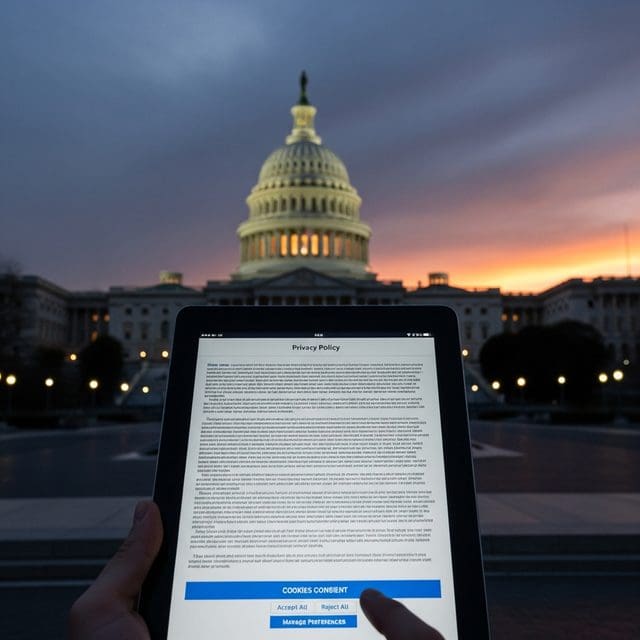
Beyond the halls of the Capitol, the “paper trail” of public information is being redrawn by major media entities. The Associated Press recently implemented a comprehensive update to its B2B privacy policy, reflecting the growing pressure of state-level privacy laws in California, Colorado, Texas, and Virginia. The new policy explicitly categorizes tracking technologies such as cookies, pixels, local storage, and JavaScript. It acknowledges that the use of business-intelligence partners like ZoomInfo may constitute a “sale” or “sharing” of personal information under the California Consumer Privacy Act (CCPA). This shift highlights the increasing difficulty for large organizations to balance traditional revenue models with new, stringent data sovereignty requirements that demand greater transparency for the public.
Crucially, the updated AP policy sheds light on the evolving relationship between journalism and artificial intelligence. The organization confirmed that it licenses published news content, which may incidentally contain personal data, to third-party technology solution providers for the purpose of training AI models and redistribution. This disclosure moves the conversation beyond simple advertising cookies and into the realm of intellectual property and data harvesting for machine learning. While the AP provides opt-out mechanisms for non-essential tracking via tools like Cookiebot, it maintains that essential cookies for site functionality remain mandatory, illustrating the tension between user privacy and the technical requirements of modern digital infrastructure. International users in the EEA and UK now face a one-month response window for data erasure requests, highlighting a global push for data accountability.
On the executive front, the administration remains deeply involved in high-stakes technological and geopolitical mediation. White House Chief of Staff Susie Wiles held meetings with Anthropic CEO Dario Amodei to resolve friction between the Pentagon and the company regarding the Claude AI model. This meeting underscores the federal government’s role in vetting the technologies that will eventually underpin national security. Furthermore, the White House announced a ten-day ceasefire between Israel and Lebanon and reported the reopening of the Strait of Hormuz for transit following negotiations with Iran’s foreign minister. These diplomatic efforts, combined with a subsequent 10% drop in oil prices and a potential $20 billion release of frozen Iranian funds in exchange for uranium stockpiles, demonstrate the immediate impact of executive policy on global market stability and energy security.

Ben Taylor serves as the Senior Correspondent and Investigations Lead for Just Right News, where he anchors the network’s commitment to government transparency and institutional accountability. With a career defined by a relentless pursuit of the facts, Taylor spearheads the acclaimed feature series “The Paper Trail,” a deep-dive investigative column that prioritizes primary source documentation over political rhetoric. Based in the heart of the nation’s capital, he has earned a reputation as one of the most formidable investigative journalists in Washington, D.C., known specifically for his mastery of public records and the Freedom of Information Act.
Taylor’s approach to journalism is deeply rooted in his upbringing in Kansas City, Missouri. Growing up in the “Show Me State,” he developed a healthy skepticism of centralized power and a profound respect for the common-sense values of the American heartland. This Midwestern foundation informs his reporting today, as he bridges the gap between the complex machinations of federal bureaucracy and the everyday concerns of citizens across the country. For Taylor, investigative reporting is not about chasing headlines; it is about ensuring that the government remains answerable to the people it serves.
As an African American man working within the conservative media landscape, Taylor brings a principled perspective to his beat. He views the Constitution and the right to information as the ultimate equalizers in a free society. His work often highlights how bureaucratic overreach and lack of transparency disproportionately affect individual liberties. By focusing on the “paper trail,” Taylor strips away the spin of partisan talking points, instead providing Just Right News readers with the raw data and internal communications that reveal how their tax dollars are spent and how policy decisions are actually made.
In his role as Investigations Lead, Taylor oversees a team dedicated to uncovering the stories that mainstream outlets often overlook. Whether he is auditing federal spending, investigating regulatory overreach, or exposing inefficiencies within the administrative state, his methodology remains consistent: follow the evidence wherever it leads. His presence in Washington, D.C., allows him to maintain a constant watch over the halls of power, yet he remains steadfastly connected to his roots, ensuring his reporting reflects the clarity and directness of his Missouri home.
Throughout his tenure at Just Right News, Taylor has become a vital voice for those who demand integrity in public office. He believes that a well-informed electorate is the strongest defense against government overreach, and he has dedicated his career to providing the public with the tools they need to hold their leaders accountable. Through “The Paper Trail” and his broader investigative work, Ben Taylor continues to set the standard for rigorous, document-driven journalism that champions the values of transparency, individual responsibility, and the rule of law.