

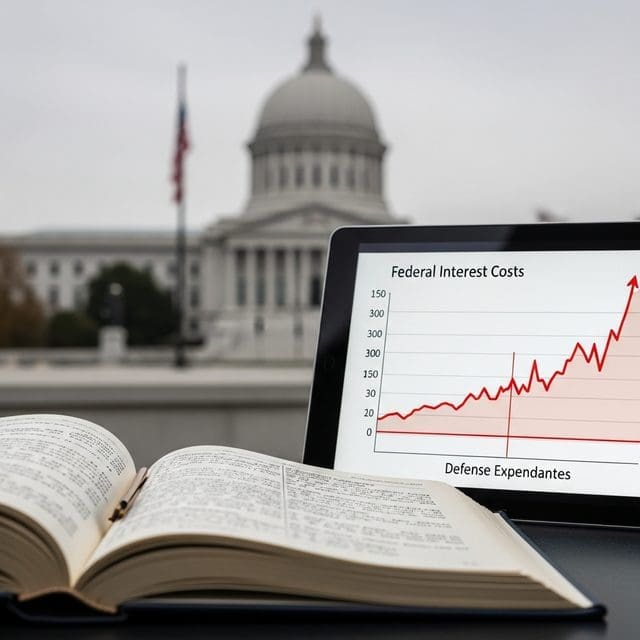
New fiscal data reveals federal net interest payments have officially surpassed national defense outlays as the 2026 deficit climbs toward $1.9 trillion, driven by record bond yields and energy inflation.
The ledger for the first quarter of fiscal year 2026 confirms a milestone that fiscal watchdogs have long warned was inevitable: the cost of servicing the national debt now exceeds the cost of defending the nation. According to the latest data tracking federal outlays, net interest payments reached $270 billion, while defense spending trailed at $267 billion. This shift occurs as the 30-year U.S. Treasury bond yield surged to 5.11% on May 18, 2026, marking its highest level since 2007. The surge is driven by a combination of energy supply disruptions and deep structural deficits that continue to pressure the central bank.
While the Congressional Budget Office (CBO) pegs the total FY 2026 deficit at approximately $1.9 trillion, the underlying mechanics show a government struggling to outrun its own borrowing costs. Federal revenue has seen a boost from tariff-driven customs duties, yet these gains are being neutralized by the sheer volume of debt issuance required to cover the $602 billion quarterly shortfall. The Government Accountability Office (GAO) continues to signal that rising interest costs and demographic pressures are crowding out discretionary priorities, leaving the Treasury with fewer tools to manage economic volatility. Current projections suggest that without a pivot in fiscal policy, federal debt is on a trajectory to reach 120% of GDP by 2036.
This domestic fiscal strain is mirrored globally as major economies abandon previous commitments to austerity. In Tokyo, Japan’s ruling bloc is assembling a ¥3 trillion supplementary budget, roughly $19 billion, to fund emergency energy subsidies. This move reverses earlier plans to narrow the primary-balance deficit, illustrating how the conflict-driven spike in diesel and electricity prices is forcing governments to prioritize short-term price relief over long-term fiscal health. The Japanese government is expected to issue new bonds to cover this relief, despite already having a record ¥122 trillion main budget on the books for the current fiscal year.
Despite the tightening grip of debt, some institutional analysts remain bullish on the private sector’s ability to absorb these costs. UBS Global Wealth Management recently lifted its 2026 year-end S&P 500 target to 7,900 from 7,500, citing resilient consumer spending and aggressive capital expenditure in artificial intelligence. UBS analysts argue that equity multiples can stay elevated even with higher long-term yields, effectively fading recession risks in their portfolio guidance. They point to strong Q1 earnings and continued inflows into U.S. mega-cap tech as offsets to Middle East energy uncertainty.
However, this optimism faces a reality check on the ground. Walmart reports that American consumers begin curtailing spending when gasoline prices hit the $4.50 to $5.00 range, a threshold currently threatened by ongoing Middle East instability. Midwest farmers entering the 2026 planting season are also reporting the worst agricultural downturn since the 1980s crisis, citing mounting financial pressure from Iran conflict-driven diesel and fertilizer price increases. These microeconomic pressures suggest that the “resilient consumer” narrative may be reaching its mathematical limit.
For the American taxpayer, the forensic reality is clear: the federal government is operating on a rolling 12-month shortfall of $1.6 trillion. With Federal Reserve Chair Kevin Warsh facing an April inflation spike and bond markets pressuring for rate hikes, the cost of refinancing this debt will only increase. The April 28-29 policy meeting minutes already indicate a majority of officials see the necessity of rate hikes if inflation remains elevated. The math suggests that without significant structural reform, the era of interest payments dominating the federal budget is not a temporary anomaly, but the new baseline for a nation borrowing against its own future.

Max Grant serves as the Senior Correspondent for Data and Financial Forensics at Just Right News, where he brings a meticulous, investigative eye to the complex world of numbers. In an era where media narratives often overshadow objective reality, Max operates on a simple but firm principle: while rhetoric can be manipulated, the ledger never lies. As the architect behind the acclaimed feature series “Numbers That Talk,” he has carved out a vital niche in conservative journalism, translating dense financial data into clear, actionable insights for the American public.
Max’s journey to the forefront of financial reporting began in Buffalo, New York. Growing up in the Queen City, he was raised with the grit and grounded perspective typical of the Rust Belt. Buffalo is a place that understands the value of a dollar and the consequences of economic shifts on the working class. This upbringing instilled in Max a deep-seated respect for fiscal responsibility and a healthy skepticism toward bureaucratic overreach. He carries the spirit of his hometown into every investigation, viewing his work not just as reporting, but as a form of public service dedicated to protecting the interests of taxpayers and everyday citizens.
Now based in Brooklyn, New York, Max operates from the heart of one of the world’s most influential financial and cultural hubs. This vantage point allows him to keep a close watch on the institutions that drive the global economy. Living and working in a city often defined by progressive policy experiments, Max provides a necessary counter-perspective, using his forensic skills to analyze the real-world costs of local and national governance. His proximity to the financial district ensures he is never far from the source of the data he deconstructs, yet he remains firmly rooted in the conservative values that prioritize transparency and individual liberty.
His beat, Data and Financial Forensics, is more than just a job title; it is a commitment to uncovering the truth hidden within spreadsheets and annual reports. In “Numbers That Talk,” Max dives deep into federal spending, corporate accountability, and the intricate web of international finance. He has a unique ability to spot the anomalies that others miss, identifying where public funds are being mismanaged or where economic policies are failing to deliver on their promises. His reporting is characterized by a relentless pursuit of clarity, stripping away the jargon to show readers exactly how their money is being used and how the economy is truly performing.
At Just Right News, Max Grant is recognized as a steady hand and a sharp mind. He understands that for a free society to function, its citizens must have access to the facts regarding their financial future. By combining his British heritage’s tradition of rigorous inquiry with an American drive for accountability, Max ensures that the numbers don’t just sit on a page—they tell the story of where the country has been and where it is headed. His work stands as a testament to the power of forensic journalism in holding the powerful to account and championing the principles of a transparent, fiscally sound nation.