

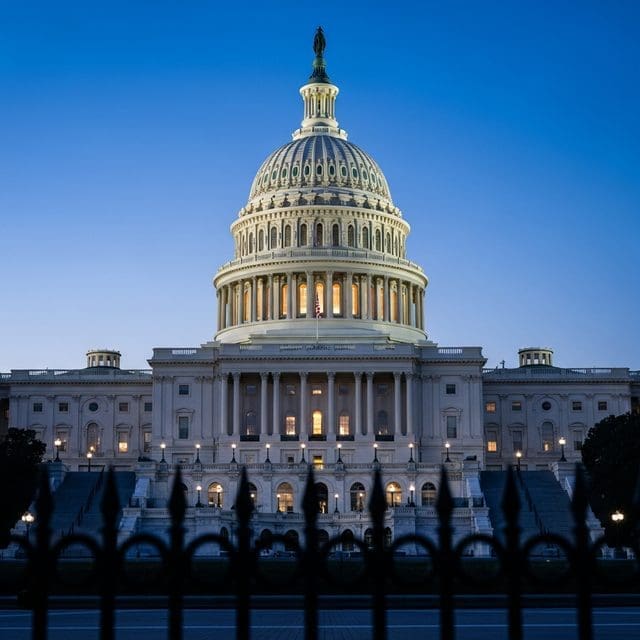
Senate Republican leaders are stripping $1 billion in security funds from a major immigration bill following procedural hurdles and internal dissent over President Trump’s White House ballroom project.
Senate Republican leaders are expected to abandon a controversial $1 billion security proposal for the White House complex and President Donald Trump’s new ballroom project. The decision follows a week of internal caucus friction and a significant procedural ruling that threatened to derail a broader $70 billion immigration enforcement package. Majority Leader John Thune is now pivoting to salvage the core components of the bill, which provides essential funding for U.S. Immigration and Customs Enforcement (ICE) and the Border Patrol through 2029.
The friction began when the White House pressured GOP leadership to include the security package within a budget reconciliation bill. While the Secret Service maintained that the funds were necessary for a new visitor screening center, training, and campus-wide upgrades, approximately $220 million was specifically earmarked for security features related to the President’s ongoing ballroom construction in the East Wing. This specific line item became a political lightning rod, with Democrats labeling the GOP as “Ballroom Republicans” who were prioritizing executive amenities over the economic concerns of average Americans. President Trump defended the project during a tour of the construction site on Tuesday, insisting the ballroom is a “gift” to the nation, yet the optics have remained a point of contention for both parties.
Procedural reality ultimately forced the leadership’s hand. Senate Parliamentarian Elizabeth MacDonough ruled that the ballroom security funding violated the Byrd Rule, which prohibits non-budgetary “extraneous matter” from being included in fast-track reconciliation bills. This ruling meant that Republicans would have needed 60 votes to override the objection—a threshold they could not reach given unified Democratic opposition and public skepticism from several Republican members. Senator John Kennedy (R-La.) summarized the situation bluntly, stating that the bill was “back to square one” regarding the security money because the necessary votes simply did not exist. In response to the setback, President Trump used social media to urge Republicans to fire MacDonough and end the filibuster entirely, though Senate Republicans have historically resisted such drastic changes to chamber rules.
Internal dissent within the Republican caucus further complicated the path forward. Senator Thom Tillis (R-N.C.) characterized the inclusion of the security package as a “bad idea,” arguing that it allowed critics to frame the entire $70 billion enforcement bill as a “billion-dollar ballroom” project. Senator Bill Cassidy (R-La.), who recently lost his primary, questioned the optics of spending a billion dollars on a ballroom while constituents struggle with the costs of groceries, gasoline, and healthcare. These sentiments reflect a growing willingness among some traditionalist Republicans to push back against executive requests they deem fiscally or politically imprudent, especially following the President’s endorsement of Ed Gallrein over Representative Thomas Massie in Kentucky and Ken Paxton over Senator John Cornyn in Texas.
The legislative scramble is also entangled with a proposed $1.776 billion “anti-weaponization” settlement fund. This fund, designed to compensate allies of the President who claim political persecution following a lawsuit over the leak of his tax returns, has become a secondary flashpoint. Senators are currently meeting with acting Attorney General Todd Blanche to discuss placing “fences” around this money to ensure it is not used to compensate individuals involved in the January 6 attack on the Capitol. Senate Democratic leader Chuck Schumer has already signaled that his party will force votes to block or restrict this fund, putting Republicans in the position of having to defend the settlement’s parameters on the Senate floor.
Despite the removal of the ballroom security funds, the underlying bill remains a priority for the Republican majority. It seeks to provide roughly $38 billion to $40 billion for ICE and $26 billion for Customs and Border Protection, funding these agencies through the end of the President’s current term. By utilizing the reconciliation process, Republicans hope to pass these enforcement measures with a simple majority, bypassing a Democratic filibuster. Majority Leader Thune intends to finalize the text and hold a vote before the Memorial Day recess, even as the White House continues to pressure leadership to find an “off-ramp” that preserves the broader immigration package while navigating the collapse of the security funding request.

Miles Harrington serves as the Senior Correspondent for Federal Systems & Executive Power at Just Right News, where he brings a disciplined, constitutionalist lens to the inner workings of the American government. With a focus on the mechanics of the federal bureaucracy and the limits of executive authority, Harrington has established himself as a vital voice for readers who value transparency, accountability, and the preservation of the separation of powers.
A native of Richmond, Virginia, Harrington’s perspective is deeply rooted in the traditions of the Old Dominion. Growing up in a city defined by its historical significance and its role as a center of American jurisprudence, he developed an early appreciation for the foundational principles of the Republic. His upbringing in Richmond—a place where the legacy of the Founding Fathers is woven into the landscape—instilled in him a belief that the federal government should remain within its constitutional bounds. This background informs his skepticism of centralized overreach and his commitment to reporting on the ways in which the administrative state impacts the lives of everyday citizens.
In his current role, Harrington specializes in the complexities of federal systems. He doesn’t just report on the headlines of the day; he digs into the structural shifts within the executive branch that often go unnoticed by the mainstream press. Whether he is analyzing the implications of a new federal regulation or investigating the expansion of agency jurisdiction, his work is characterized by a rigorous adherence to the facts and a dedication to the rule of law.
Harrington is perhaps best known for his signature feature series, “How Washington Works.” Through this ongoing project, he demystifies the often-opaque processes of the nation’s capital, pulling back the curtain on the “Deep State” and the unelected officials who wield significant influence over national policy. By breaking down complex legislative maneuvers and executive orders, he empowers Just Right News readers to understand the true levers of power in Washington. His reporting serves as a necessary check on the federal government, ensuring that the actions of those in power are held up to the light of public scrutiny.
Now based in Washington, D.C., Harrington operates at the epicenter of the political world, yet he remains intentionally distanced from the “Beltway bubble.” His proximity to the halls of power allows him to maintain a robust network of sources across the federal landscape, but his heart remains in the principled conservatism of his Virginia roots. He views his role not merely as a reporter, but as a steward of the public trust, dedicated to providing the clarity and context that conservative voters need to navigate an increasingly complex political environment.
Through his sharp analysis and unwavering commitment to the truth, Miles Harrington continues to be a cornerstone of the Just Right News team. His work ensures that the principles of limited government and executive restraint remain at the forefront of the national conversation, providing a crucial service to those who believe in a government that is truly of, by, and for the people.