

South African authorities have begun the forced relocation of foreign nationals from Durban police stations to undisclosed sites as anti-immigrant mobs issue a June 30 deadline for departures.
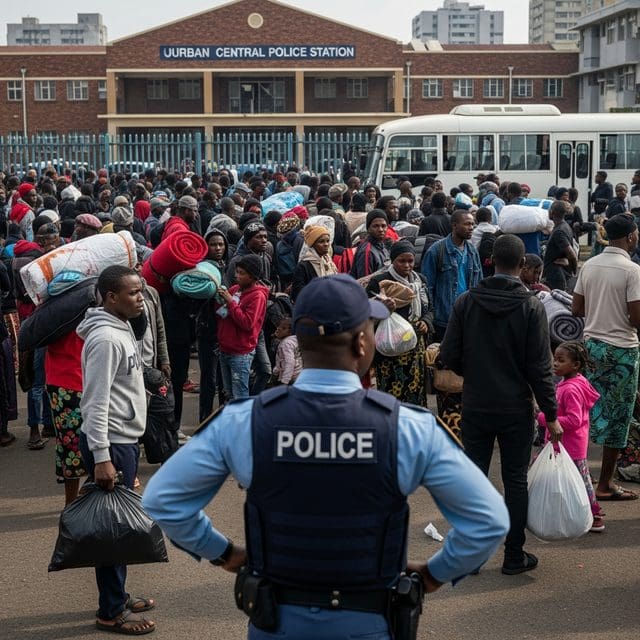
South African police in Durban have initiated the systematic relocation of hundreds of foreign nationals who had sought sanctuary at the Durban Central Police Station and the nearby Diakonia Centre. The move, which began in earnest on May 21, 2026, involves transporting migrants in police vehicles and buses to undisclosed “safer” sites. This intervention follows several days of escalating tension where foreign-born residents were chased from townships and informal settlements by mobs during what local activists termed anti-immigrant “clean-up” operations. The police action aims to clear public spaces, yet it has sparked a debate over the safety and legal standing of those being moved.
The displaced population consists of roughly 300 individuals from various African countries, including many who hold valid refugee permits and asylum seeker documentation. For at least two nights, these families, including young children, slept on the pavement outside the police station after being targeted by vigilante groups. Video footage and social media reports from the area have documented instances of mobs pursuing migrants through the streets, with at least one incident requiring police intervention to prevent an attack on a Mozambican trader’s stall. These events underscore that the threat of violence has transitioned from rhetoric to physical confrontation, leaving many foreign nationals in a state of constant fear for their lives.
Human rights lawyers and civil society organizations in KwaZulu-Natal have raised significant alarms regarding the nature of these relocations. Critics argue that the South African Police Service is treating the crisis primarily as a public-order disturbance rather than a humanitarian or legal protection issue. By dispersing the group to secret locations, advocates fear that the migrants will become less visible and more vulnerable to targeted attacks without the oversight of the legal community or access to formal shelter facilities. There are currently no public guarantees regarding the long-term protection or legal assistance available at these new sites, raising concerns about the transparency of the government’s response.
In response to the perceived failure of local protection, a group of approximately 200 to 300 foreign nationals issued a public appeal for the United Nations High Commissioner for Refugees (UNHCR) and other international bodies to intervene. The migrants explicitly stated that they no longer trust local South African authorities to ensure their safety. They have called for international monitoring of any relocation or repatriation decisions to ensure that their rights under international law are not bypassed in the rush to clear public spaces. This lack of trust highlights a significant breakdown in the social contract between the state and the vulnerable populations residing within its borders.
The volatility of the situation is compounded by a looming deadline set by anti-illegal-immigration activists. These groups have issued a public warning that “hell will break loose” if undocumented foreigners do not leave the region by June 30, 2026. Human rights groups have flagged this language as direct incitement to violence, fearing it could trigger a national wave of xenophobic unrest similar to those seen in previous years. This rhetoric places the police in a difficult position as they attempt to maintain order while navigating deep-seated demographic tensions and the demands of local residents who feel the government has failed to manage migration effectively.
Recent analysis by South Africa’s Human Sciences Research Council (HSRC) indicates that anti-immigrant sentiment has risen sharply across the country throughout 2026. Despite official government calls for African solidarity, the HSRC notes a growing trend of vigilante-style enforcement targeting both African and Asian migrants in poorer urban sectors. This Durban episode is viewed by researchers as a microcosm of a broader national struggle over resources, community character, and the perceived inability of the state to manage its borders and internal migration effectively. As the June 30 deadline approaches, the focus remains on whether the government can uphold the rule of law or if the vacuum will continue to be filled by local enforcement groups acting outside the formal legal system.

Julie Harris serves as a Staff Writer for Just Right News, where she tackles some of the most pressing and complex issues facing the nation today. As the lead reporter for the Migration, Demographics & Cultural Shifts beat, Julie provides a grounded, principled perspective on how the movement of people and the changing makeup of communities are reshaping the American landscape. Her work is defined by a commitment to exploring the long-term consequences of social change, prioritizing the stability of local institutions and the preservation of national identity.
Her deep understanding of these issues is rooted in her upbringing in Tucson, Arizona. Growing up in a prominent border state, Julie witnessed firsthand the intricate realities of migration and the profound impact it has on local infrastructure, law enforcement, and the social fabric. This early exposure instilled in her a respect for the rule of law and a keen awareness of the challenges that arise when federal policies fail to align with the needs of border communities. Her reporting often reflects this lived experience, bringing a necessary level of nuance to topics that are often treated with abstraction in coastal newsrooms.
Now based in Santa Fe, New Mexico, Julie continues to report from the heart of the American Southwest. Her location provides a unique vantage point to observe the intersection of traditional regional cultures and the modern shifts brought about by both internal and external migration. In Santa Fe, a city defined by its rich history and distinct cultural heritage, she finds a perfect environment to explore how communities strive to maintain their character while navigating the pressures of a rapidly changing world. This perspective allows her to bridge the gap between policy debates in Washington and the reality of life in the high desert.
At Just Right News, Julie’s work is characterized by a dedication to examining the data and the human stories that define the “New Mosaic” of America. Her signature feature series, “The New Mosaic,” has become a cornerstone of her reporting. Through this series, Julie explores the evolving social architecture of the United States, documenting how shifts in population affect everything from local economies to the political landscape. She brings a critical eye to the narrative of demographic inevitability, instead asking how these shifts impact the average citizen’s sense of belonging and the integrity of the American social contract.
Julie’s background and her dedication to conservative principles make her a vital voice in contemporary journalism. She understands that demographics are more than just numbers on a spreadsheet; they represent the future of the American family and the nation’s enduring legacy. Through her diligent reporting and insightful analysis, Julie Harris ensures that her readers are informed about the forces shaping their world, providing a perspective that is as thoughtful as it is necessary for the modern era.