

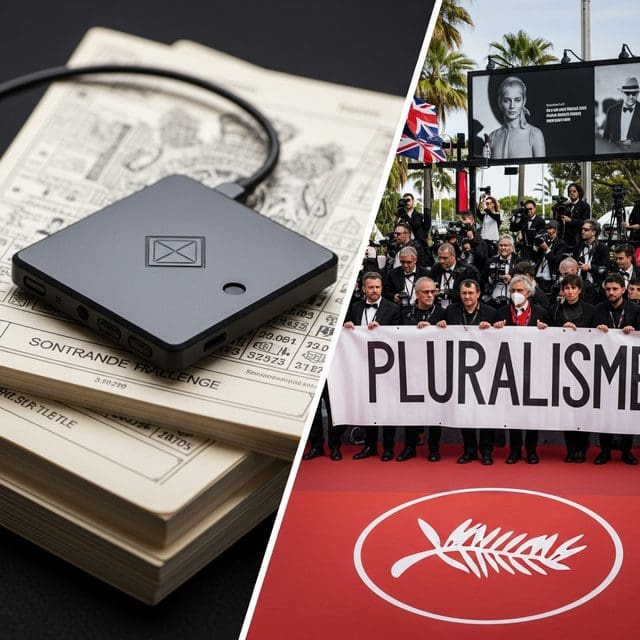
Investigations into Nigel Farage’s crypto-funding and a retaliatory blacklist by Canal+ at Cannes expose the escalating war between independent scrutiny and billionaire-controlled media empires.
The intersection of political finance and media control has reached a volatile boiling point this week, as investigative reporting triggers a formal inquiry into Reform UK leader Nigel Farage. The Parliamentary Commissioner for Standards is currently examining a £5 million gift from Thailand-based crypto billionaire Christopher Harborne, a payment first brought to light by The Guardian. This investigation centers on whether Farage violated strict rules regarding the registration of financial interests in the twelve months preceding his entry into Parliament. A serious breach of these standards could trigger a suspension and a subsequent recall petition, potentially jeopardizing Farage’s political standing in Clacton.
While Farage has consistently framed the scrutiny as an establishment-led “witch hunt,” the scale of the donation has raised fundamental questions about transparency in the digital age. Harborne’s contributions reportedly accounted for nearly two-thirds of Reform UK’s 2025 funding, yet the party has offered what critics describe as “bare minimum” compliance with UK electoral law. Outlets such as Al Jazeera and Byline Times have broadened the narrative, arguing that populist movements are increasingly leveraging globalized, opaque donor networks while simultaneously campaigning on nationalist, anti-elite platforms. This creates a paradox where the very leaders claiming to represent the common man are funded by the most insulated members of the global financial elite.
Simultaneously, the Cannes Film Festival has transformed from a celebration of cinema into a live stage for a media-power accountability fight. Hundreds of French film figures signed an open letter in Libération warning against the expanding cultural empire of Vincent Bolloré. His company, Canal+, serves as a dominant gatekeeper for film funding, but critics allege Bolloré uses his media holdings to platform far-right voices and stifle ideological dissent. The tension reached a fever pitch when the Canal+ logo was reportedly booed at screenings, prompting a swift and aggressive response from the corporate hierarchy.
Canal+ CEO Maxime Saada escalated the conflict by announcing that the network will “no longer work with” the roughly 600 industry professionals who signed the anti-Bolloré petition. This retaliatory move, effectively a political blacklist, mirrors broader concerns about media consolidation and the chilling effect it has on artistic freedom. Commentators in European outlets are explicitly linking Bolloré’s consolidation of Canal+ and related news channels with a broader right-wing influence over news agendas. The threat of financial excommunication serves as a warning to those who would challenge the narrative of market-dominant funding gatekeepers.
This trend of media-as-leverage is not confined to Europe. In the United States, the press continues to grapple with the fragmentation of truth as institutional context shifts. Recent reports indicate that Midwest farmers are entering the 2026 planting season under the worst financial pressure since the 1980s, driven by diesel and fertilizer price increases linked to the ongoing Iran conflict. While the White House announces multi-billion dollar agricultural purchase commitments from China, the domestic media landscape often struggles to connect these geopolitical developments to the lived reality of American citizens, frequently distracted by the same partisan platforming seen abroad.
The role of the press in unearthing financial ties and corporate retaliation remains a critical check on power, yet this mission is increasingly blunted by partisan platforms. Social media-driven reporting often repackages investigative clips to present figures like Farage and Bolloré as victims of a coordinated elite, rather than subjects of legitimate inquiry. As billionaire-aligned media ecosystems prioritize ideological loyalty over objective truth, the ability of the public to access a clear, unvarnished account of who owns their leaders—and their screens—is under unprecedented threat.

Chloe Foster serves as a Staff Writer for Just Right News, where she spearheads the outlet’s coverage of Media, Culture, and Information Integrity. In an era defined by rapid-fire digital communication and shifting societal norms, Chloe has distinguished herself as a vital voice for readers seeking clarity amidst the noise. Her signature feature series, “The Story Wars,” has become a cornerstone of the publication, offering a deep dive into the ideological battles currently shaping American life and the ways in which mainstream narratives are constructed, disseminated, and often manipulated.
Chloe’s unique perspective is informed by a life lived in two of the nation’s most influential cultural hubs. Raised in Los Angeles, California, she grew up in the shadow of the world’s most powerful media and entertainment apparatus. This upbringing provided her with a front-row seat to the “dream factory,” allowing her to observe firsthand how cultural exports are crafted and how they often diverge from the lived experiences of everyday Americans. Her time in Los Angeles instilled in her a healthy skepticism of manufactured consensus and a passion for uncovering the truths that lie beneath polished public relations campaigns.
Today, Chloe operates from Brooklyn, New York, a vantage point that places her at the epicenter of the modern media landscape. Living and working in a deep-blue urban environment as a conservative journalist has sharpened her reporting, requiring a rigorous commitment to intellectual honesty and a steadfast defense of traditional values. Her base in Brooklyn allows her to engage directly with the institutions and influencers who drive the national conversation, providing Just Right News readers with an “on-the-ground” look at the cultural shifts originating in the Northeast.
As a Hispanic woman, Chloe brings a nuanced understanding of community and heritage to her beat. She frequently explores how media portrayals of the Latino community often overlook the deep-seated faith, entrepreneurial spirit, and family-centric values that define it. Her work challenges the monolithic labels often applied by mainstream outlets, instead highlighting the diversity of thought and the conservative principles that resonate within her community.
In her role at Just Right News, Chloe views “Information Integrity” not merely as a buzzword, but as a mission. She believes that a healthy republic requires a media landscape where facts are prioritized over agendas and where the public is empowered to think for themselves. Through “The Story Wars,” she deconstructs the framing of major news events, exposing bias and providing the context necessary for readers to understand the broader cultural implications of the day’s headlines.
Chloe Foster’s reporting is more than just a collection of articles; it is a sustained effort to reclaim the narrative for those who feel sidelined by the prevailing media establishment. By bridging the gap between her West Coast roots and her East Coast base, she continues to provide essential commentary on the forces that define our shared American culture.