

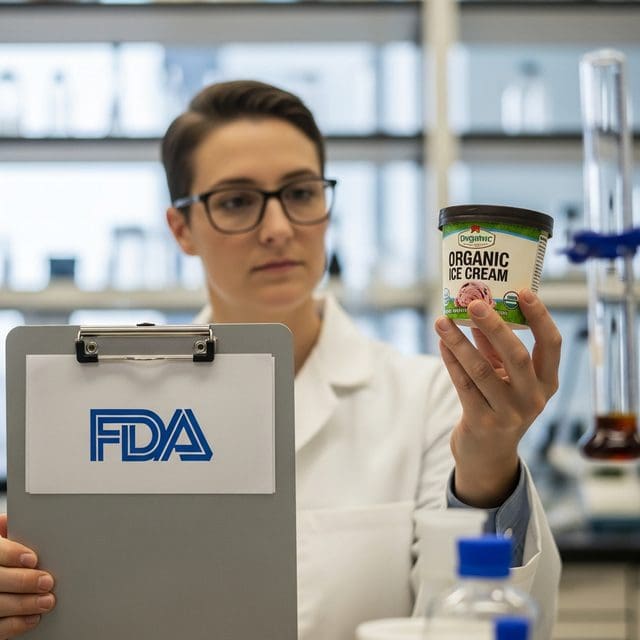
A 17-state recall of organic ice cream due to metal contamination highlights the critical role of FDA oversight during a period of federal leadership vacancies.
The safety of the American food supply and the efficiency of federal oversight are under renewed scrutiny following a significant voluntary recall by Straus Family Creamery. The California-based company issued the recall on May 14 after discovering that a small number of production runs were potentially contaminated with metal foreign material. The affected products, which reached retail shelves as early as May 4, have been distributed across 17 states, including Arizona, California, Florida, Illinois, Pennsylvania, and Texas.
The Food and Drug Administration (FDA) confirmed the recall involves specific lots of vanilla bean, strawberry, cookie dough, Dutch chocolate, and mint chip flavors with best-by dates in late December 2026. While no injuries have been reported, the presence of metal fragments represents a serious breach of manufacturing standards. From a policy perspective, this incident raises pressing questions about the frequency and rigor of FDA facility inspections. When physical contaminants enter the food chain, it often indicates a failure in equipment maintenance or a lapse in production oversight—areas where the FDA must serve as a skeptical watchdog.
This regulatory challenge coincides with a period of institutional uncertainty. Both the FDA and the Centers for Disease Control and Prevention (CDC) are currently operating without Senate-confirmed leadership. This vacancy has led to concerns regarding the government’s ability to respond to complex crises. However, Dr. Deborah Birx recently addressed these concerns, stating there is a “deep bench” of career professionals at both agencies. Birx emphasized that institutional knowledge within the CDC and FDA is sufficient to facilitate a robust response to threats like Ebola, even as political appointments remain in limbo.
For the average family, the immediate concern is the safety of products in their freezer. Straus Family Creamery is advising consumers to discard the affected ice cream rather than return it to stores. To mitigate the financial impact, the company is offering replacement vouchers. This shift toward consumer-led disposal and digital vouchers reflects a modernizing, though decentralized, approach to recall management that places a higher burden of action on the individual.
The broader fiscal implications of such recalls are significant. Every failure in the supply chain adds hidden costs to the healthcare system and erodes consumer confidence. As gasoline prices exceed $4 per gallon nationwide and inflation pressures the American household, the added cost of food waste and potential medical expenses from contaminated products represent a blow to fiscal responsibility. The FDA’s role must be to ensure market competition is not undermined by a lack of transparency or a failure to uphold basic safety standards.
As this situation develops, the focus remains on how the metal contamination was detected and whether current FDA protocols are sufficient. Current notices do not explain the root cause, leaving a gap in public understanding of industrial food risks. For those who champion individual liberty and the doctor-patient relationship, the primary concern remains ensuring federal agencies focus on their core mission of safety and transparency without descending into bureaucratic overreach that stifles innovation and increases costs for the public.

Susan Carter serves as a Senior Correspondent for Just Right News, where she leads the network’s comprehensive coverage of Health, Medicine, and Public Policy. With a career dedicated to dissecting the complexities of the American healthcare system, Susan brings a principled perspective to the most pressing debates of the day. Her reporting is characterized by a commitment to individual liberty, fiscal responsibility, and a healthy skepticism of government overreach, making her a vital voice for audiences seeking clarity in an increasingly regulated landscape.
Raised in Minneapolis, Minnesota, Susan’s professional outlook is deeply informed by the values of the American heartland. Growing up in the Twin Cities, she witnessed firsthand the importance of community-driven solutions and the resilience of the individual. This Midwestern foundation instilled in her a firm belief that the best answers to public policy challenges often come from local innovation and personal responsibility rather than top-down federal mandates. Her background allows her to translate complex legislative jargon into stories that resonate with families who value common sense and local autonomy.
Now based in Baltimore, Maryland, Susan operates from a unique vantage point at the intersection of medical innovation and urban policy. Living and working in a city renowned for its world-class medical institutions and significant public health challenges, she has a front-row seat to the realities of the modern healthcare landscape. Her proximity to these hubs of research and policy allows her to scrutinize how government intervention affects the quality of care and the freedom of medical professionals. In Baltimore, she sees the tangible results of policy decisions, using the city as a lens through which to examine the broader national health debate and the impact of federal spending on local communities.
As the lead for the acclaimed feature series “The Cost of Care,” Susan dives deep into the economic realities facing patients and providers alike. Her work focuses on the necessity of price transparency, the benefits of market competition, and the preservation of the sacred doctor-patient relationship. She is a staunch advocate for the idea that a well-informed public is the best defense against bureaucratic inefficiency. Through this series, she has exposed the hidden drivers of rising medical expenses, always seeking to empower the individual consumer over the massive institution.
Susan’s reporting on public policy is characterized by a commitment to rigorous inquiry and a focus on constitutional limits. Whether she is analyzing new pharmaceutical regulations, investigating the impact of federal health mandates, or exploring the future of medical technology, her goal remains the same: to provide Just Right News audiences with the facts they need to navigate a complex world. By blending her Midwestern sensibilities with the insights gained from her base in Maryland, Susan Carter has become a trusted authority for those who believe that personal freedom and public health are inextricably linked. Her work continues to challenge the status quo, advocating for a system that respects the taxpayer and prioritizes the patient.