

Congressional hearings this week exposed the EPA’s failure to address contaminated Georgia drinking water while revealing internal emails showing cozy relationships between federal regulators and agricultural giant Bayer.
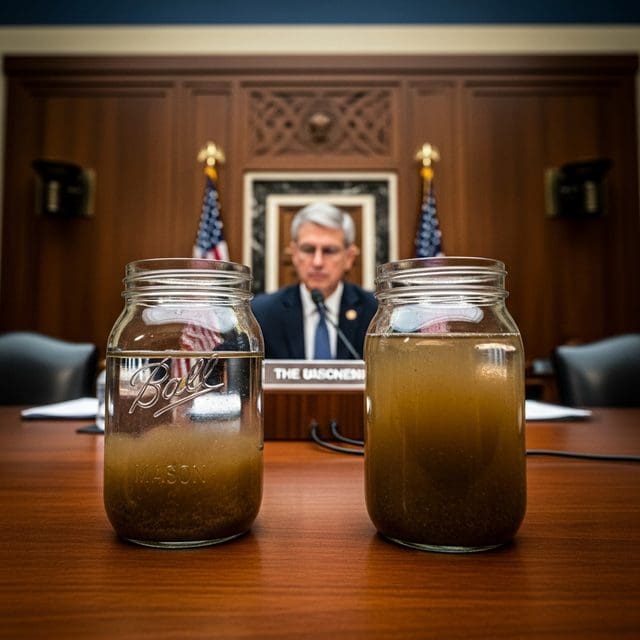
The Environmental Protection Agency is facing intense scrutiny following a House subcommittee hearing where Representative Alexandria Ocasio-Cortez presented jars of murky, brown water sourced from Morgan County, Georgia. The demonstration highlighted the plight of residents living near a Meta data center who report their tap water has become “inconsumable.” This visual indictment of federal oversight underscores a growing tension between rapid tech infrastructure expansion and the fundamental right of rural communities to access clean water.
EPA Assistant Administrator for Water Jessica Kramer admitted the agency has not received a formal request to investigate the contamination, despite a year of community complaints regarding dry taps and ruined appliances. The situation in Morgan County serves as a warning for agricultural hubs like the San Joaquin Valley. While data centers offer economic promises, their massive water requirements during droughts often outpace the EPA’s regulatory capacity. The agency’s claim that new permitting rules for these facilities have “no impact to human health” is being directly challenged by the reality on the ground in Georgia.
Beyond infrastructure, the hearing exposed troubling ties between regulators and the private sector. Internal emails revealed that Bayer executives offered EPA Administrator Lee Zeldin “a small thanks” after the agency withdrew its support for California’s glyphosate cancer warning. For American farmers and families, this perceived proximity between federal officials and multinational agribusiness undermines trust in the safety of the food and water supply. It suggests a regulatory culture that prioritizes corporate convenience over the stewardship of natural resources.
Budgetary constraints are further hampering the agency’s mission. Proposed cuts to state water programs and enforcement staff have left the EPA at historic lows. Critics argue these reductions make it impossible for the agency to proactively manage the environmental impacts of AI-driven infrastructure. Without adequate manpower, the federal government remains reactive, leaving local communities to bear the burden of industrial contamination. This lack of oversight is particularly concerning as water-intensive industries compete with local farms for dwindling aquifer resources.
Legal experts and advocacy groups are now considering litigation against the EPA for its failure to scrutinize the cumulative impacts of industrial permits. The Morgan County dispute is a bellwether for federal oversight in an era of rapid industrialization. If the EPA cannot protect a single rural county’s water supply, there is little confidence it can manage the nationwide surge in data center and industrial farm developments.
For the residents of Georgia’s agricultural heartland, the contaminated water in those jars is a reminder that federal overreach often coincides with a failure to perform basic duties. Protecting the American family requires a return to common-sense stewardship that puts local sovereignty and public health before the interests of global corporations. As the Justice Department focuses on billion-dollar political settlements, the basic infrastructure of American life—clean water and safe soil—must not be allowed to fall further down the list of federal priorities.

Eric Nolan serves as the Senior Correspondent for Food, Water, and Environmental Health at Just Right News, where he brings a principled, common-sense perspective to the most fundamental issues facing the American public. With a career dedicated to uncovering the truth behind the policies that govern our natural resources, Eric has become a trusted voice for readers who value traditional stewardship over bureaucratic overreach. His reporting is defined by a commitment to the idea that true environmentalism is rooted in the protection of the American family and the preservation of the nation’s agricultural heritage.
Raised in Fresno, California, Eric’s worldview was shaped in the heart of the San Joaquin Valley. Growing up in one of the world’s most productive agricultural hubs, he witnessed firsthand the vital connection between the land, the water, and the dinner table. In Fresno, he saw the resilience of farmers and the devastating impact that distant, top-down regulations can have on local communities. This upbringing instilled in him a deep respect for the producers who feed the country and a lifelong skepticism toward the alarmist narratives often pushed by mainstream media. For Eric, environmental health is not an abstract political talking point; it is a matter of ensuring that the people who work the land have the freedom and the resources to do so effectively.
Now based in Eugene, Oregon, Eric operates from a unique vantage point in the Pacific Northwest. Living in a region often defined by intense environmental debate, he provides a necessary counter-narrative to the prevailing trends of the area. From his base in Eugene, he monitors the shifting tides of federal and state policies, ensuring that the voices of rural citizens and property owners are not drowned out by urban activism. His reporting often bridges the gap between the rugged realities of the outdoors and the legislative halls where decisions are made, offering a grounded perspective that prioritizes local sovereignty and practical solutions.
As the lead for the acclaimed feature series “Earth on the Table,” Eric explores the intricate journey of the American food supply. He tackles critical issues such as water rights, soil health, and food security through a lens of national stability and individual liberty. He believes that a healthy environment and a thriving economy are not mutually exclusive, but rather two sides of the same coin of national prosperity. His work consistently highlights how innovation and private-sector ingenuity are the most effective tools for ensuring clean water and a safe food supply, rather than the expansion of the administrative state.
At Just Right News, Eric’s reporting serves as a vital resource for those who seek accountability and transparency. Whether he is investigating the impact of federal land management on local economies or examining the safety of the national food infrastructure, his work remains anchored in the values of heritage and hard work. Eric Nolan continues to be a leading voice in environmental journalism, championing the belief that the best way to protect our natural resources is to empower the people who live and work closest to them.