

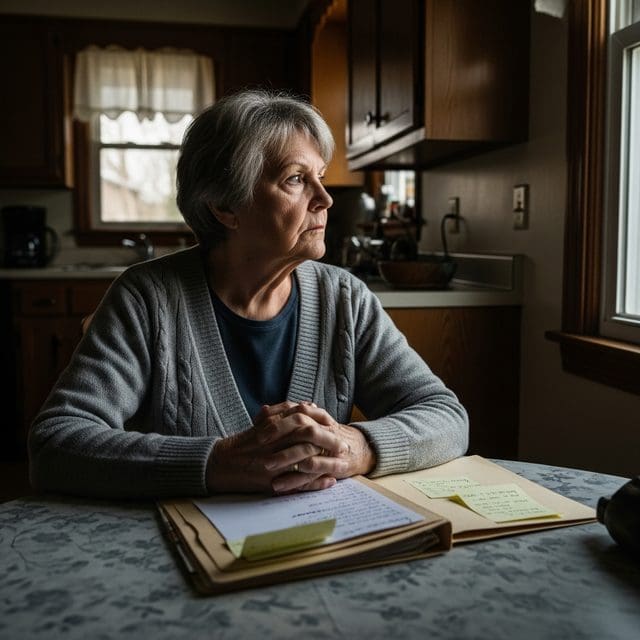
Tabitha Acret’s struggle to find trauma support for her grandson highlights the systemic barriers facing families navigating the aftermath of domestic violence.
The weight of a community is often measured by how it carries its smallest members through their darkest hours. For Tabitha Acret, that weight became a labyrinth of bureaucratic hurdles and silent telephones. After her daughter was murdered—a tragedy witnessed by her young grandson—Acret found herself thrust into a secondary battle: the search for specialized child trauma support in a system that seemed ill-equipped to provide it.
Acret’s story is not just one of personal grief, but a stark illustration of the gap between public safety policy and the lived reality of domestic violence survivors. While national headlines often focus on the immediate response to crime, the long-term psychological recovery of children caught in the crossfire is frequently left to the determination of individual family members. Acret spent months in tears, pleading with various agencies for help that remained out of reach, highlighting a systemic failure to prioritize early intervention for the most vulnerable witnesses of violence.
This struggle for local support occurs against a backdrop of shifting global and national priorities. While the federal government manages complex negotiations—such as the recent three-page peace plan with Iran involving a $20 billion fund release or the resolution of high-tech disputes between the Pentagon and AI firms like Anthropic—the essential infrastructure of community care often feels neglected. For families like Acret’s, the high-level focus on international stability and technological advancement offers little comfort when local domestic violence services are stretched thin.
The self-reliant spirit that defines many communities is being tested by this disconnect. In California, small businesses have formed the Reform CIPA Coalition to push back against litigation that they argue hampers local economic growth, while in Tennessee, state authorities recently reached a settlement with Mariner Finance over lending practices. These movements reflect a broader desire for institutional accountability and the preservation of local stability. Yet, for a toddler who has witnessed the unthinkable, the need is more immediate than policy reform; it is the need for a counselor who is available today, not in six months.
Advocates argue that the preservation of the family unit requires more than just law enforcement; it requires a robust, accessible network of social services that can respond with the same urgency as a 911 call. Acret’s public plea for better services for children who experience domestic and family violence serves as a reminder that the health of a nation is ultimately found in the resilience of its neighborhoods. When the systems designed to protect the innocent become too complex to navigate, the burden of recovery falls entirely on the shoulders of those already carrying the heaviest loads.
As Acret continues to advocate for change, her experience stands as a testament to the necessity of human-scale reporting. Aggregate data on crime and economic growth can obscure the individual faces of those left behind by policy gaps. True progress is not found in the signing of a three-page peace plan or the integration of new software into corporate workflows, but in the ability of a grandmother to find a helping hand for a child in need without having to fight the very system meant to support them.

Ethan Blake serves as a Senior Correspondent for Just Right News, where he specializes in Longform Narrative and Public Understanding. In an era of rapid-fire headlines and fleeting soundbites, Ethan’s work stands as a testament to the power of deep-dive reporting and the importance of contextualizing the complex issues facing the nation today. His approach is rooted in the belief that the most profound truths are often found in the lived experiences of individuals rather than the abstract theories of distant policymakers.
Growing up in Providence, Rhode Island, Ethan developed an early appreciation for the historical and cultural threads that weave the American fabric together. Providence, a city defined by its industrial heritage and its blend of traditional neighborhoods, provided him with a front-row seat to the challenges and triumphs of the American working class. This upbringing instilled in him a respect for the “common sense” values of hard work, community loyalty, and the preservation of local institutions. He learned early on that behind every economic statistic or legislative debate, there are real families and neighborhoods navigating the consequences of change.
This foundational perspective is the driving force behind his signature feature series, “Lives Behind the Systems.” Through this series, Ethan explores the intersection of individual agency and institutional structure. Whether he is documenting the impact of federal land-use policies on rural families or examining how shifting educational standards affect local school boards, Ethan’s work prioritizes the human element. He seeks to uncover how large-scale systems—be they governmental, economic, or social—affect the daily lives of citizens, often advocating for a return to local control and personal responsibility.
Now based in Portland, Maine, Ethan draws significant inspiration from the rugged independence and self-reliance that define the region. The coastal landscape and the resilient spirit of Maine’s communities serve as a constant reminder of the importance of individual liberty and the strength found in decentralized power. Living and working outside the traditional media hubs allows Ethan to maintain a grounded perspective, ensuring his reporting remains untethered from the echo chambers of the major metropolitan centers. This geographic distance provides him with the clarity needed to translate complex national narratives into stories that resonate with the heart of the country.
At Just Right News, Ethan’s beat is more than just a professional assignment; it is a mission to foster a more informed and engaged citizenry. He believes that a free society depends on the public’s ability to understand the mechanisms of power and the value of traditional American principles. His longform narratives do not merely report the news; they provide a roadmap for understanding the cultural and political shifts of the modern era through a lens of skepticism toward centralized authority and a deep respect for the individual.
Through his meticulous research and narrative craftsmanship, Ethan Blake continues to bridge the gap between policy and the public. His work remains a vital resource for those who seek a deeper understanding of the systems that shape our world and the enduring spirit of the people who live within them.