

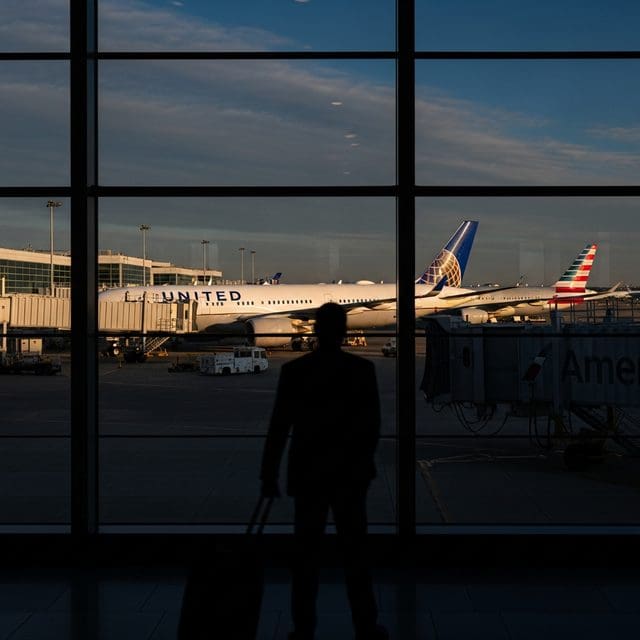
United Airlines CEO Scott Kirby’s recent flight on rival American Airlines highlights the cozy nature of the domestic aviation oligopoly and the persistent threat of further market concentration.
The optics of corporate leadership often reveal more about market dynamics than any quarterly filing. This week, United Airlines CEO Scott Kirby was observed flying first class on American Airlines, his former employer and a primary competitor. While the industry frequently dismisses such occurrences as logistical necessity, the sight of a major executive utilizing a rival’s premium services serves as a stark reminder of the narrow competitive landscape currently governing American skies.
Kirby’s history with American Airlines is more than a matter of past employment. After his departure from the carrier a decade ago, Kirby reportedly floated the idea of a merger between United and American. While such a massive consolidation did not materialize, the sentiment reflects a broader trend among industry titans who view market dominance through the lens of acquisition rather than innovation. For the American traveler, this mindset has historically led to fewer choices, stagnant service quality, and a pricing structure that feels increasingly insulated from true free-market pressure.
Federal regulators at the Department of Justice (DOJ) and the Federal Trade Commission (FTC) have recently signaled a more aggressive stance against such concentration. The airline industry, already dominated by a handful of major players, remains a focal point for antitrust advocates who argue that past mergers have hollowed out regional hubs and penalized small-business travelers. The current administration has emphasized that the goal of antitrust enforcement is not merely to prevent monopolies, but to ensure that the spirit of competition remains robust enough to benefit the individual consumer.
This climate of skepticism toward corporate expansion is not limited to the aviation sector. On May 9, 2026, GameStop CEO Ryan Cohen launched a bold $55.5 billion bid to acquire eBay. The move was met with immediate hostility from the e-commerce giant, which subsequently issued a permanent ban against Cohen. This friction highlights the growing tension between aggressive capital seekers and established platforms that have secured significant market share. When a single entity controls a vast marketplace, the ability to unilaterally deplatform potential competitors or critics becomes a significant concern for those advocating for open digital commerce.
Further complicating the landscape of corporate power is the role of technology as a barrier to entry. Recent discussions surrounding hardware attestation suggest that technical standards are increasingly being leveraged to lock out independent repair shops and third-party software developers. Much like the consolidation of airlines, these technical monopolies restrict the freedom of the individual to choose how they maintain and use their own property. From the runway to the server rack, the trend toward centralization remains the primary threat to the industrial heart of the nation.
As the DOJ continues to scrutinize the legacy of airline mergers, the actions of executives like Kirby will remain under the microscope. The American economy thrives on the independence of its participants and the accountability of its largest institutions. When the leaders of supposedly competing firms appear more like colleagues than rivals, it is the duty of regulators and the press to ask whether the market is truly serving the public or merely sustaining a comfortable status quo for the few at the top.

Greg Sanders serves as the Senior Correspondent for Corporate Power and Antitrust at Just Right News, where he brings a principled, conservative perspective to the complex intersection of big business, government regulation, and the American consumer. With a career dedicated to investigative depth and economic clarity, Greg has become a leading voice in examining how the consolidation of industry power impacts the foundational values of the free market and individual liberty.
Raised in Denver, Colorado, Greg’s reporting is deeply informed by the Western spirit of independence and a healthy skepticism of centralized authority. Growing up in the shadows of the Rockies, he witnessed firsthand the importance of local entrepreneurship and the vital role that small-medium enterprises play in sustaining vibrant communities. This upbringing instilled in him a belief that the American Dream is best preserved when the playing field remains level and when competition—rather than backroom deals between corporate lobbyists and federal regulators—dictates success. For Greg, the rugged individualism of his home state serves as a constant reminder that the economy should serve the people, not the other way around.
Now based in Chicago, Illinois, Greg operates from the heart of the nation’s industrial and financial crossroads. His location in the Midwest provides him with a unique vantage point to observe the real-world consequences of corporate overreach. From the boardrooms of the Loop to the manufacturing hubs that define the region, he tracks the movement of capital and the shifting tides of market influence. Chicago’s history as a center of trade and labor offers a rich backdrop for his work, allowing him to bridge the gap between high-level economic theory and the lived experiences of hardworking Americans who feel the squeeze of monopolistic practices.
At Just Right News, Greg’s beat focuses on the “new monopolies” and the rise of “woke” corporate culture. He argues that when corporations become too large, they often abandon their fiduciary duties to shareholders in favor of social engineering and political posturing. His reporting seeks to hold these “Titans” accountable, ensuring that the power of the purse is not used to silence dissent or bypass the democratic process. He is a firm advocate for the idea that true conservatism requires a vigilant defense of competition, preventing any single entity—public or private—from exerting undue control over the lives of citizens.
This mission is most clearly seen in his acclaimed feature series, “The Titans and the Toll.” In this ongoing project, Greg explores the human cost of market consolidation, from the erosion of consumer choice to the decline of local economies. Through rigorous analysis and boots-on-the-ground reporting, he documents how the concentration of power in sectors like tech, agriculture, and finance creates a “toll” paid by the average family.
Greg Sanders remains committed to the idea that a transparent, competitive market is the greatest engine for prosperity ever devised. Through his work at Just Right News, he continues to provide the essential oversight necessary to protect that engine from the encroaching influence of corporate giants and the bureaucratic structures that enable them.