

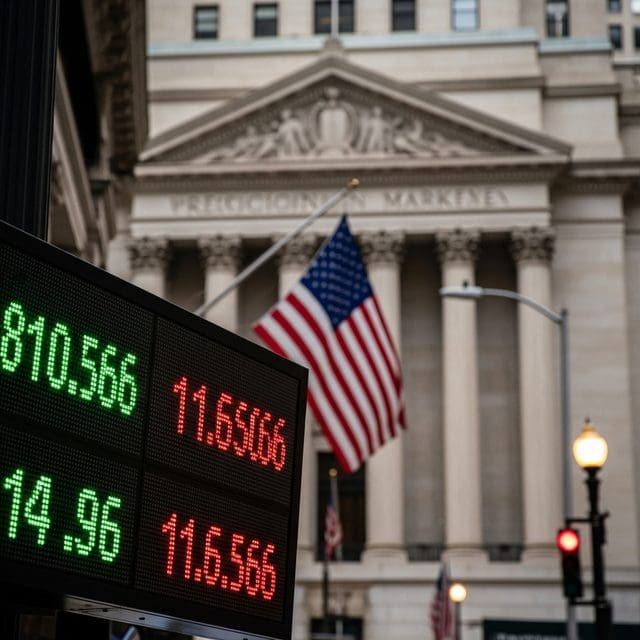
While Wall Street navigates renewed tensions in the Strait of Hormuz, DraftKings leads a shift toward prediction markets as traditional equity buybacks face headwinds.
The economic landscape for American households grew more complex this week as the delicate balance between international diplomacy and domestic market growth faced new disruptions. While the administration attempted to pivot toward a peace framework for the Middle East, renewed hostilities in the Strait of Hormuz have injected fresh volatility into global energy and commodity expectations. This comes at a time when the domestic financial sector is grappling with a shift in how major corporations prioritize their capital.
On the corporate front, DraftKings has emerged as a focal point for investors looking beyond traditional gaming. CEO Jason Robins, speaking with Yahoo Finance’s Julie Hyman, highlighted a strategic shift toward prediction markets and a proprietary exchange. The company reported first-quarter revenue of $1.646 billion, a 17% increase year-over-year, swinging to a net income of $21.1 million from a significant loss the previous year. Robins described the upcoming World Cup as a potential ‘game changer’ for this new vertical, committing up to $300 million to develop a ‘Super App’ for sports and event predictions.
This expansion into alternative markets arrives as traditional avenues for shareholder value show signs of fatigue. Goldman Sachs analysts have revised expectations for S&P 500 share buybacks, forecasting a mere 3% growth for 2026. The firm cites heavy capital expenditures related to artificial intelligence and broader economic headwinds as primary reasons for the slowdown. For the working household, this suggests that the era of aggressive corporate financial engineering may be cooling, placing a higher premium on organic growth and operational efficiency.
Institutional activity remains steady despite these headwinds. Lazard Inc. recently announced a definitive agreement to acquire Campbell Lutyens, signaling continued consolidation in the financial advisory space. Additionally, the SPAC market showed signs of life with both West Enclave Merger Corp. and Plutonian Acquisition Corp II pricing $100 million offerings. In a more unorthodox move, GameStop CEO Ryan Cohen proposed a $55.5 billion acquisition of eBay, a maneuver that resulted in his permanent ban from the e-commerce platform, highlighting the increasingly erratic nature of retail-driven corporate leadership.
Monetary sovereignty also remains a topic of international debate. In Taiwan, Legislator Dr. Ko Ju-Chun presented a formal report on the feasibility of establishing a Bitcoin reserve, echoing a growing global interest in decentralized assets as a hedge against centralized currency fluctuations. This move toward digital reserves reflects a broader skepticism regarding the long-term stability of the current global monetary order.
However, the most immediate threat to market stability remains the situation in the Middle East. Despite Secretary of State Marco Rubio and envoy Steve Witkoff meeting with Qatari leadership to negotiate a settlement framework, the exchange of fire between U.S. and Iranian forces on May 7 has complicated the path to a peace dividend. For the American taxpayer, the suspension and subsequent resumption of escort operations in the Strait of Hormuz serves as a reminder that fiscal health is inextricably linked to national sovereignty and the security of global trade routes.

Jordan Lee serves as the Senior Correspondent for Wall Street, Finance, and Monetary Systems at Just Right News. Based in the heart of the world’s financial capital, New York City, Lee brings a sharp, principled eye to the complex mechanisms that drive the global economy. His reporting is defined by a commitment to fiscal responsibility, the defense of the free market, and a deep-seated belief that a transparent monetary system is the bedrock of a free society.
Raised in Portland, Oregon, Lee’s perspective was forged in a city that has undergone significant cultural and economic shifts. His upbringing in the Pacific Northwest instilled in him a profound appreciation for the industriousness of small business owners and the importance of local economic stability. Watching the evolution of his hometown’s landscape sparked an early interest in how federal fiscal policy and large-scale financial trends eventually trickle down to the average citizen. This background provides him with a unique vantage point; he understands the growing disconnect between the policy-making elite and the reality of Main Street, a theme that frequently resonates throughout his work.
Now operating from his base in New York City, Lee bridges the gap between the high-stakes trading floors of Manhattan and the households of everyday Americans. He views the financial sector not merely as a collection of numbers and tickers, but as a vital engine of American prosperity that requires constant vigilance and accountability. His reporting often highlights the dangers of centralized financial control and the necessity of maintaining a system that rewards merit, risk-taking, and innovation.
As the creator and lead of the featured series, “The Invisible Economy,” Lee pulls back the curtain on the often-opaque world of monetary systems. He specializes in translating the dense jargon of central banking and international finance into actionable insights for the Just Right News audience. His work explores the “invisible” forces—such as inflationary pressures, regulatory creep, and the expansion of the administrative state—that erode the purchasing power of American families. By focusing on these systemic issues, Lee empowers readers to understand the hidden forces shaping their financial independence.
Lee’s journalistic philosophy is rooted in a steadfast commitment to traditional American values. As an Asian American professional who has navigated the competitive corridors of the financial world, he is a vocal advocate for meritocracy and the preservation of the American Dream. He believes that a stable currency and a predictable regulatory environment are essential for national sovereignty and individual liberty. His reporting frequently warns against the risks of government overreach in the private sector, arguing that the most effective solutions to economic challenges arise from competition and individual enterprise rather than bureaucratic mandates.
At Just Right News, Jordan Lee remains dedicated to providing a clear-eyed defense of the taxpayer. Whether he is analyzing market volatility or investigating the long-term implications of national debt, his mission is to provide the truth about where the money is going and what it means for the future of the country. Through his rigorous analysis and principled stance, Lee has become a trusted voice for those who value a strong, sovereign, and fiscally sound America.