

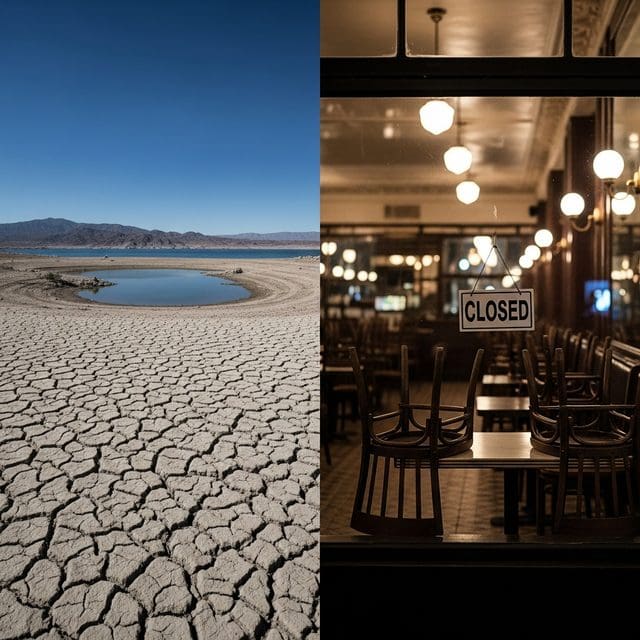
From the arid West to Manhattan’s historic streets, shifting resources and economic pressures are forcing long-standing American institutions to confront a leaner, more uncertain future.
The American spirit has long been defined by the promise of more—more land, more water, and more opportunity. But as May begins, a different narrative is taking hold across the country: the necessity of less. From the parched banks of the Colorado River to the high-rent corridors of Midtown Manhattan, the institutions that once anchored their communities are being forced to shrink or vanish entirely.
In the West, the reality of a drying climate has finally outpaced the optimism of urban planners. California, Arizona, and Nevada have jointly proposed a plan to leave up to one million acre-feet of water in the Colorado River’s reservoirs through 2028. This voluntary retreat aims to stabilize Lake Powell and Lake Mead, the massive basins that serve as the lifeblood for millions. For the people of these states, the proposal represents more than just a policy shift; it is a fundamental renegotiation of how life is lived in the desert. California alone is eyeing a 13 percent reduction in usage by 2027, a move that will inevitably trickle down to every farm, lawn, and local business that relies on the river’s flow.
While the West grapples with the scarcity of nature, the East is contending with the scarcity of the old guard. In Manhattan, the Redeye Grill announced it will close its doors after 30 years. For three decades, the brasserie at 890 Seventh Avenue served as a reliable sanctuary for the Carnegie Hall crowd, a place where the city’s cultural elite and local workers shared space over seafood platters. Its departure follows a broader trend of retail and restaurant closures hitting urban centers, with experts predicting nearly 8,000 store closures across the country this year. The loss of such a landmark suggests that even the most established community pillars are no longer immune to the shifting tides of the modern economy.
This sense of contraction is echoed in the skies and on the roads. The recent shutdown of Spirit Airlines, the first major U.S. carrier to fail in decades, serves as a stark reminder that even federal interventions have limits. After two bankruptcies and a failed bailout, the airline’s disappearance leaves travelers with fewer choices and higher costs, particularly for the working-class families who relied on its budget fares. Meanwhile, in California, the Teamsters are sounding the alarm over new DMV rules allowing driverless heavy trucks, a move they argue prioritizes corporate efficiency over the livelihoods of thousands of human drivers.
Yet, amidst these structural shifts, the impulse to gather remains. In Nevada City, local artisans still filled the streets for the Spring Craft Fair, and in San Jose, the vibrant colors of the Cinco de Mayo parade offered a defiant display of community resilience. These local traditions persist, even as the larger economic and environmental frameworks they exist within are being dismantled and rebuilt.
The challenge for the American family in 2026 is navigating this era of managed decline. Whether it is a farmer in Arizona calculating the cost of a dry well or a waiter in New York looking for work after thirty years at the same grill, the story is the same: the old certainties are evaporating, replaced by a new requirement for self-reliance in a world that is rapidly getting smaller.

Ethan Blake serves as a Senior Correspondent for Just Right News, where he specializes in Longform Narrative and Public Understanding. In an era of rapid-fire headlines and fleeting soundbites, Ethan’s work stands as a testament to the power of deep-dive reporting and the importance of contextualizing the complex issues facing the nation today. His approach is rooted in the belief that the most profound truths are often found in the lived experiences of individuals rather than the abstract theories of distant policymakers.
Growing up in Providence, Rhode Island, Ethan developed an early appreciation for the historical and cultural threads that weave the American fabric together. Providence, a city defined by its industrial heritage and its blend of traditional neighborhoods, provided him with a front-row seat to the challenges and triumphs of the American working class. This upbringing instilled in him a respect for the “common sense” values of hard work, community loyalty, and the preservation of local institutions. He learned early on that behind every economic statistic or legislative debate, there are real families and neighborhoods navigating the consequences of change.
This foundational perspective is the driving force behind his signature feature series, “Lives Behind the Systems.” Through this series, Ethan explores the intersection of individual agency and institutional structure. Whether he is documenting the impact of federal land-use policies on rural families or examining how shifting educational standards affect local school boards, Ethan’s work prioritizes the human element. He seeks to uncover how large-scale systems—be they governmental, economic, or social—affect the daily lives of citizens, often advocating for a return to local control and personal responsibility.
Now based in Portland, Maine, Ethan draws significant inspiration from the rugged independence and self-reliance that define the region. The coastal landscape and the resilient spirit of Maine’s communities serve as a constant reminder of the importance of individual liberty and the strength found in decentralized power. Living and working outside the traditional media hubs allows Ethan to maintain a grounded perspective, ensuring his reporting remains untethered from the echo chambers of the major metropolitan centers. This geographic distance provides him with the clarity needed to translate complex national narratives into stories that resonate with the heart of the country.
At Just Right News, Ethan’s beat is more than just a professional assignment; it is a mission to foster a more informed and engaged citizenry. He believes that a free society depends on the public’s ability to understand the mechanisms of power and the value of traditional American principles. His longform narratives do not merely report the news; they provide a roadmap for understanding the cultural and political shifts of the modern era through a lens of skepticism toward centralized authority and a deep respect for the individual.
Through his meticulous research and narrative craftsmanship, Ethan Blake continues to bridge the gap between policy and the public. His work remains a vital resource for those who seek a deeper understanding of the systems that shape our world and the enduring spirit of the people who live within them.