

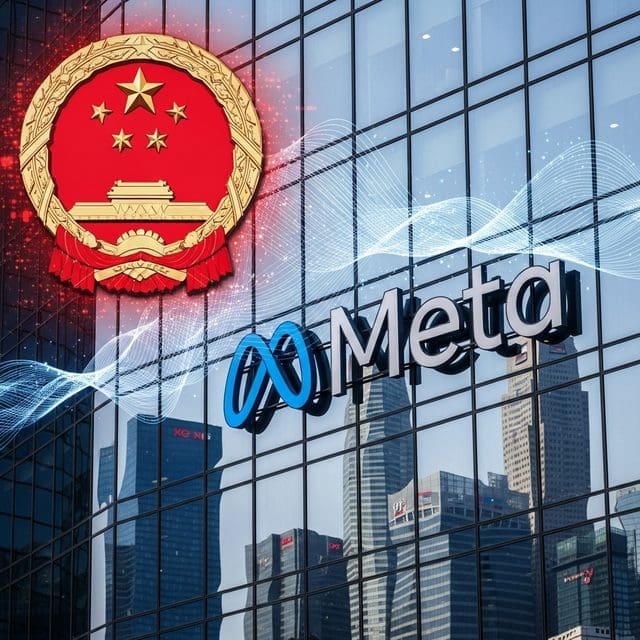
Beijing’s National Development and Reform Commission ordered Meta to unwind its $2 billion acquisition of AI agent startup Manus, signaling a new era of aggressive Chinese digital protectionism.
The geopolitical battle for artificial intelligence supremacy reached a fever pitch on Monday as China’s National Development and Reform Commission (NDRC) issued a formal order prohibiting Meta from completing its $2 billion acquisition of Manus. The move represents a direct challenge to American digital expansion and a stark warning to tech founders attempting to bypass Beijing’s oversight through the so-called ‘Singapore-washing’ model.
Manus, founded in Beijing in 2022 before relocating its headquarters to Singapore in 2025, had emerged as a critical player in the field of general-purpose AI agents. The startup’s technology, capable of executing complex data analysis and coding tasks, was already being integrated into Meta’s Ads Manager and was slated for deployment across Instagram and WhatsApp. However, the NDRC’s intervention requires an immediate withdrawal of all acquisition activities, effectively freezing a deal that Meta claimed was fully compliant with international law.
The enforcement follows a multi-agency probe into how the transaction intersected with China’s tightening export controls. Since late March, Chinese authorities have reportedly imposed exit bans on Manus CEO Xiao Hong and Chief Scientist Yichao Ji, ensuring that the intellectual capital behind the startup remains within Beijing’s reach. This domestic crackdown occurs as the Trump administration simultaneously maintains strict prohibitions on American investment into Chinese AI firms, leaving companies like Manus caught in a pincer maneuver between two suspicious superpowers.
For Meta, the collapse of the Manus deal is a strategic setback in its race against domestic rivals OpenAI and Anthropic. While Meta had already relocated approximately 100 Manus employees to its Singapore offices, the NDRC order creates a legal quagmire regarding the proprietary models and data analysis tools developed by the startup. The intervention underscores the fragility of global tech supply chains when national sovereignty is at stake.
This regulatory escalation coincides with a period of heightened tension for the American administrative state. On the same day the NDRC issued its order, the Trump administration took the unprecedented step of firing all 22 members of the National Science Board, signaling a total overhaul of U.S. science and technology policy. As Washington moves to purge institutional inertia, Beijing is demonstrating that it will use every regulatory lever to prevent the ‘brain drain’ of its most promising AI innovators to the West.
The Manus incident serves as a definitive end to the era of frictionless global tech acquisitions. As China asserts its right to control the destiny of any firm with ‘Chinese roots,’ the necessity for American digital sovereignty becomes even more apparent. For Silicon Valley, the lesson is clear: relying on offshore talent with ties to authoritarian regimes carries a geopolitical risk that no amount of venture capital can mitigate.

Ryan Mitchell serves as a Staff Writer for Just Right News, where he anchors the desk for Cyber, Technology Policy, and Digital Sovereignty. In an era where the digital landscape has become as much a battlefield as any physical territory, Ryan provides a critical conservative lens on the forces shaping the future of American innovation and national security. His work is defined by a commitment to the idea that American leadership in the digital age is not just a matter of economic success, but a necessity for the preservation of global liberty.
Born and raised in Austin, Texas, Ryan’s perspective is deeply rooted in the Lone Star State’s tradition of independence and skepticism of centralized authority. Growing up in a city that transformed from a quiet state capital into a global technology hub, he witnessed firsthand the disruptive power of the tech industry. This upbringing instilled in him a firm belief in free-market principles and the necessity of protecting individual liberties from both government overreach and corporate overstep. His Texan background serves as a foundational compass, guiding his reporting toward stories that emphasize national resilience and the preservation of constitutional values in an increasingly virtual world.
Now based in San Francisco, California, Ryan operates from the epicenter of the very industry he scrutinizes. Living and working in the heart of Silicon Valley allows him to provide “boots on the ground” reporting that few conservative journalists can match. He navigates the cultural and political complexities of the Bay Area to bring Just Right News readers an inside look at the boardrooms and coding labs where the next generation of digital policy is forged. For Ryan, being stationed in San Francisco is a strategic choice; it allows him to challenge the prevailing ideological monoculture of the tech elite from within their own backyard, ensuring that the concerns of middle America are represented in the conversation about our digital future.
His beat—Cyber, Technology Policy, and Digital Sovereignty—covers the high-stakes world of data privacy, artificial intelligence, and the infrastructure of the modern web. Ryan is particularly focused on the concept of digital sovereignty, arguing that for a nation to remain truly free, it must maintain control over its own technological destiny and critical infrastructure. He frequently explores how international regulations and domestic policies impact the ability of American firms to compete without sacrificing the privacy or security of their citizens.
Central to his current body of work is his featured series, “The New Cold War.” Through this project, Ryan examines the escalating technological rivalry between the United States and its global adversaries. He delves into the complexities of state-sponsored hacking, the global race for semiconductor dominance, and the ideological struggle to define the rules of the internet. Ryan views this competition not merely as a commercial race, but as a fundamental defense of Western values against authoritarian digital models. Through his rigorous reporting and principled analysis, Ryan Mitchell ensures that the readers of Just Right News stay informed about the invisible forces defining the 21st century, always advocating for a future where technology serves the cause of freedom.