

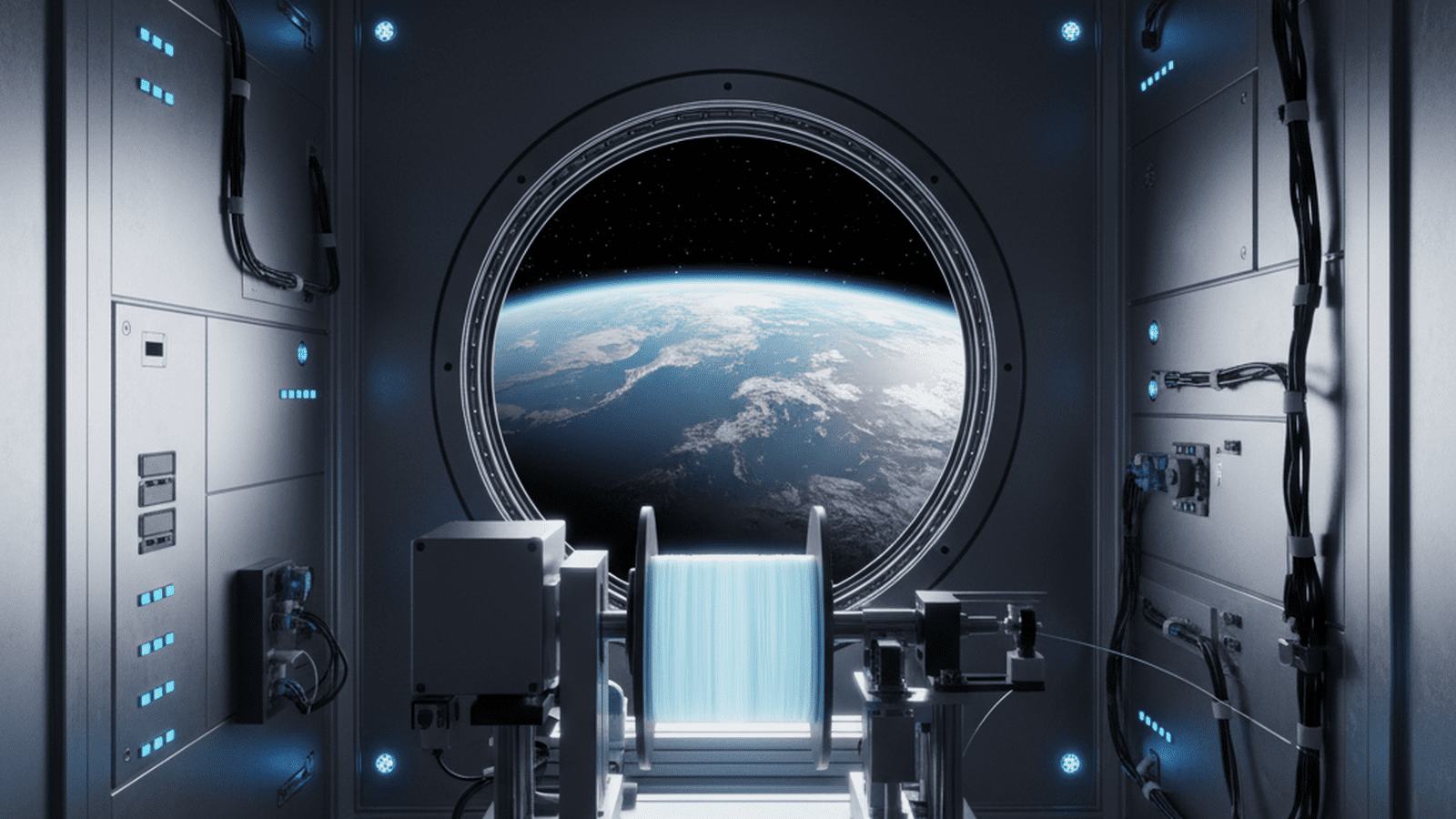
Flawless Photonics has successfully produced over 11 kilometers of high-quality ZBLAN optical fiber aboard the International Space Station. This achievement marks a significant milestone in commercial space manufacturing, overcoming gravity-induced defects that limit fiber performance on Earth.
TLDR: A private-sector breakthrough in microgravity manufacturing has produced record lengths of ZBLAN optical fiber. By eliminating gravity-driven crystallization, Flawless Photonics created material with significantly lower signal loss than Earth-made alternatives. This success paves the way for large-scale industrial production in low Earth orbit.
The landscape of commercial space utilization has shifted from observation and communication toward sophisticated industrial production. Flawless Photonics, a private-sector startup specializing in orbital manufacturing, recently announced a significant breakthrough in the production of ZBLAN optical fibers aboard the International Space Station (ISS). By leveraging the near-weightless environment of low Earth orbit, the company produced over 11 kilometers of high-purity fiber, a feat previously impossible due to the physical constraints imposed by terrestrial gravity.
ZBLAN is a heavy-metal fluoride glass composed of zirconium, barium, lanthanum, aluminum, and sodium. Scientists have long recognized its potential to transmit light across a much broader spectrum than standard silica-based fibers, which are the current backbone of global internet infrastructure. Theoretically, ZBLAN could offer signal loss rates up to 100 times lower than traditional cables, enabling data transmission over thousands of miles without the need for electronic repeaters. However, when manufactured on Earth, gravity causes the elements to settle unevenly, leading to the formation of micro-crystals. These imperfections scatter light and make the fiber brittle, rendering it unsuitable for long-distance telecommunications or high-power laser applications.
The Flawless Photonics mission utilized an automated manufacturing platform designed to operate within the microgravity environment of the ISS. In this setting, the absence of buoyancy-driven convection and sedimentation allows the molten glass to cool without the interference of crystal growth. The company’s proprietary technology precisely controls the drawing process, ensuring a uniform molecular structure throughout the length of the fiber. This recent mission successfully drew 11.9 kilometers of fiber, surpassing all previous attempts at space-based material production by several orders of magnitude. The process was monitored remotely from the company’s ground-based facility, demonstrating the feasibility of autonomous orbital factories.
This achievement represents more than a technical milestone; it validates the economic viability of orbital manufacturing. While the cost of launching raw materials into space remains high, the value of the finished ZBLAN fiber justifies the expenditure. High-performance optical fibers are critical for transoceanic data cables, medical surgical lasers, and advanced sensors used in aerospace engineering. By producing these materials in orbit, companies can create products that are physically superior to anything manufactured on the planet’s surface. The ability to produce kilometers of material rather than mere centimeters suggests that the industry is ready to move beyond the proof-of-concept stage.
The data gathered during the production run indicates that the microgravity-drawn fiber maintains a level of structural integrity that matches theoretical models. Researchers observed a significant reduction in scattering centers, which are the primary cause of signal attenuation. The success of the Flawless Photonics platform suggests that the hardware can be scaled for continuous industrial use. Future iterations of the facility may be integrated into commercial space stations currently under development by companies like Axiom Space and Sierra Space, which aim to provide dedicated modules for industrial research and manufacturing.
The next phase of research involves returning the produced fiber to Earth for rigorous testing in terrestrial laboratories. Engineers will measure the exact attenuation rates and mechanical strength to confirm that the microgravity environment eliminated the crystallization issues. If the results hold, the company plans to establish a permanent manufacturing presence in orbit. This transition toward “Made in Space” products marks a new era where the unique physical properties of the vacuum and weightlessness are harnessed for global technological advancement. As launch costs continue to decrease through reusable rocket technology, the potential for a robust orbital economy becomes increasingly tangible.

Mason Reed serves as a Staff Writer for Just Right News, where he spearheads the Future Frontiers & Special Projects desk. In an era defined by rapid technological shifts and evolving social landscapes, Mason provides a steady, principled voice, examining the innovations of tomorrow through the lens of traditional American values. His work is most prominently featured in his signature series, “The Next Horizon,” where he explores the intersection of emerging technology, national sovereignty, and the preservation of individual liberty.
A native of San Diego, California, Mason’s worldview was shaped by the unique culture of his hometown. Growing up in a region defined by its strong military presence and its history of maritime industry, he developed a deep-seated respect for the institutions that provide national stability and the entrepreneurial spirit that drives the American economy. This upbringing instilled in him a belief that true progress is not found in discarding the past, but in building upon a foundation of proven principles. His reporting often reflects this San Diego influence, emphasizing the importance of a robust national defense and the necessity of maintaining a competitive edge in the global marketplace.
Now based in San Francisco, Mason operates from the heart of the world’s technological engine. Living and working in the Bay Area provides him with a front-row seat to the advancements—and the ideological challenges—emanating from Silicon Valley. While many in the region embrace a “move fast and break things” mentality, Mason’s reporting serves as a vital counterweight. He offers Just Right News readers a “boots on the ground” perspective, documenting how radical local policies and the concentration of tech power impact the everyday lives of citizens. His proximity to the industry allows him to cut through the marketing jargon of big tech to uncover the real-world implications for privacy, free speech, and the nuclear family.
In his “Future Frontiers” beat, Mason tackles complex subjects ranging from the ethics of artificial intelligence to the burgeoning private space race. He approaches these topics with a healthy skepticism toward centralized bureaucracy, championing instead the decentralized innovations that empower individuals. Through “The Next Horizon,” he highlights the pioneers and thinkers who are working to ensure that the future remains a place where human dignity and constitutional rights are protected. He believes that the rapid pace of change requires more than just technical expertise; it requires a moral compass rooted in the Western tradition.
Throughout his tenure at Just Right News, Mason has remained committed to the idea that the future is something to be shaped, not merely accepted. His writing is characterized by a rigorous defense of American exceptionalism and a belief that the country’s best days lie ahead, provided it remains true to its founding ideals. Whether he is investigating the impact of automation on the American workforce or profiling the next generation of aerospace engineers, Mason Reed ensures that his readers are equipped with the insights they need to navigate a changing world with confidence and clarity.