

Fries’s Rebellion began in 1799 when Pennsylvania residents resisted a federal property tax enacted during the Quasi-War with France. The United States government arrested and tried leaders for treason, but President John Adams later pardoned them, leaving a lasting debate over federal authority and the constitutional boundary between resistance and rebellion.
TLDR: In 1799, armed Pennsylvania residents resisted a federal property tax imposed during preparations for possible war with France. John Fries and other leaders were convicted of treason, but President John Adams pardoned them in 1800. The episode tested federal enforcement power and the Constitution’s narrow definition of treason.
In 1798, amid rising tensions with France, Congress approved a direct federal tax on land, houses, and enslaved people to finance national defense. The measure required federal assessors to value property, an unfamiliar reach into local communities. In southeastern Pennsylvania, German-speaking farmers objected to the assessments and the prospect that officials could seize property from people who refused to pay. Their resistance became known as Fries’s Rebellion, after John Fries, an auctioneer and militia captain who emerged as a leader. The dispute tested whether the new federal government could enforce national law against organized local opposition.
The tax was part of the Federalist government’s preparations for a possible full-scale war during the Quasi-War with France. The law assessed houses by size and windows, along with land and enslaved people, and directed federal officials to collect the money. Many residents in Northampton County viewed the assessment as unfair and feared that property valuations would impose a heavy burden. Some also objected to the presence of federal assessors in their homes. Resistance was not uniform, but meetings and confrontations made collection increasingly difficult in communities around Bethlehem and nearby towns.
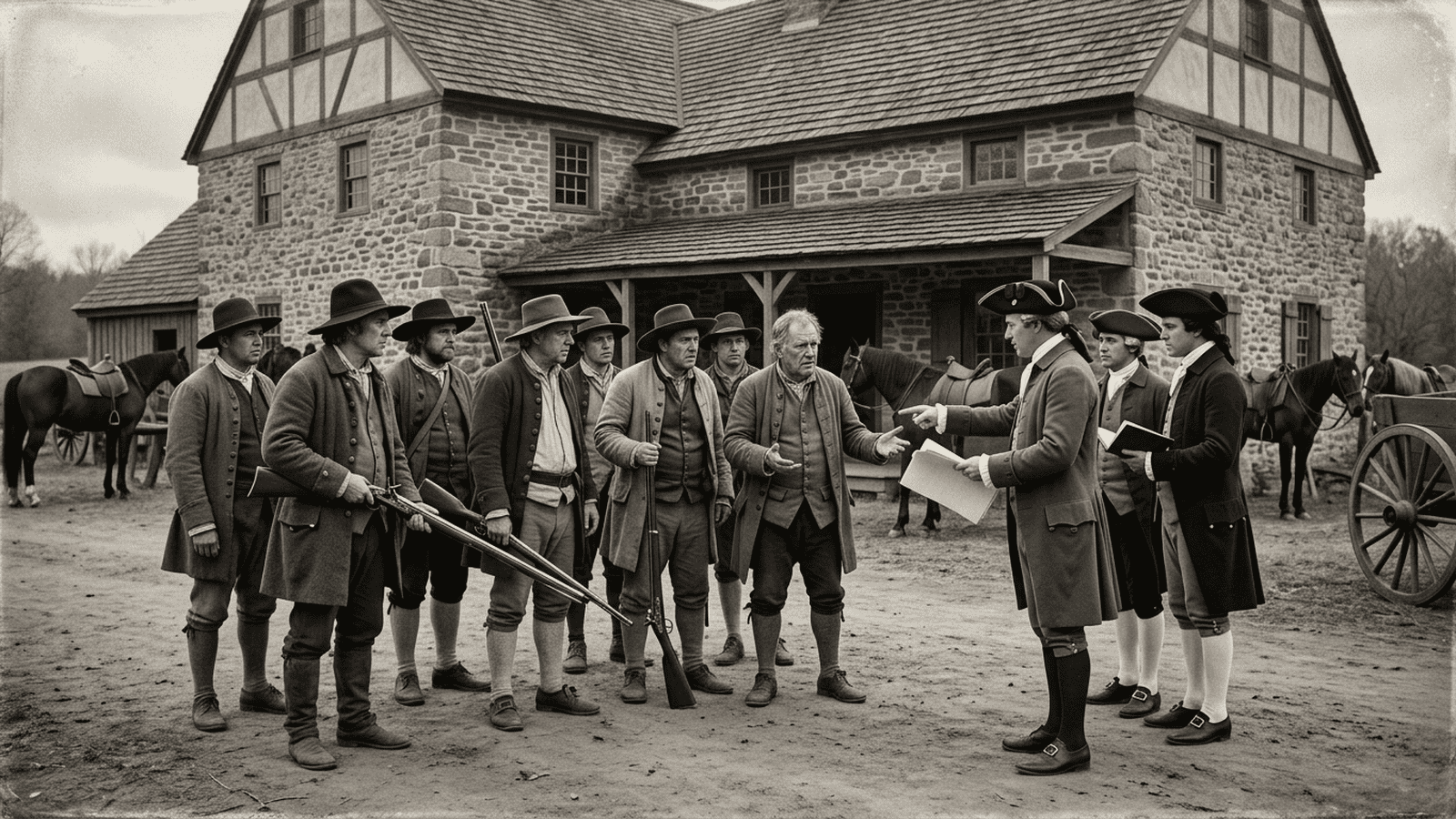
In February 1799, crowds gathered at a tavern in Bethlehem to demand the release of men jailed for resisting tax officials. Fries helped lead armed groups that pressured authorities and escorted the prisoners away. The action was a direct challenge to federal law, though the participants did not set up a rival government or seek independence. President John Adams’s administration sent troops to restore order and arrest suspects. Fries was captured, tried in federal court in Philadelphia, and convicted of treason. Two other men, John Getman and Frederick Zoller, were also convicted.
The case raised difficult questions about the constitutional meaning of treason. Article III defines treason narrowly: levying war against the United States, or adhering to its enemies by giving them aid and comfort. The prosecution argued that organized armed resistance to federal law amounted to levying war. Fries’s lawyers disputed that the disorder met the constitutional threshold, while the trial judge’s instructions to the jury became a focus of controversy. The convictions demonstrated how broadly the government might interpret treason during a crisis, and how federal courts would apply the Constitution to resistance that fell short of rebellion against the nation itself.
Adams initially approved death sentences for Fries and the other defendants. In 1800, however, he issued a pardon, describing the uprising as a mistaken effort by people who had been misled rather than a genuine attempt to overthrow the government. His decision came amid intense partisan conflict. Federalists had supported a forceful response, while Democratic-Republicans criticized the tax and warned that enforcement threatened liberty. The pardon prevented executions and helped calm the region, but it did not erase the constitutional and political dispute over the reach of federal authority.
The tax itself was repealed in 1800, as the threat of war receded and the Democratic-Republicans gained national power. Fries’s Rebellion did not overturn federal law or establish a lasting insurgent movement; it exposed the practical limits and political costs of enforcing unpopular national policies. The episode also left a precedent for debate over the line between protest and treason, the role of federal courts in defining that line, and the president’s power to grant clemency. Later disputes over federal taxation and civil resistance would revisit those questions, while the Constitution’s narrow treason definition remained a safeguard against treating ordinary dissent as disloyalty.

Lila Hayes serves as a Staff Writer for Just Right News, where she anchors the “Courts, Law, and Constitutional Order” beat. Her work is defined by a steadfast commitment to the foundational principles of the American republic and a rigorous defense of the legal frameworks that ensure national stability. As a primary voice for the outlet, she provides readers with a clear-eyed analysis of the judiciary, focusing on the importance of originalism and the preservation of the separation of powers.
Lila’s perspective was forged in the American heartland. Raised in St. Louis, Missouri, she grew up in a Hispanic household where the values of hard work, faith, and respect for the law were paramount. Her upbringing instilled in her a deep appreciation for the American Dream and the legal protections that make it possible. This Missouri background remains a cornerstone of her reporting, providing a grounded, common-sense counter-narrative to the often-insular legal circles of the coastal elite. She understands that the decisions made in high-court chambers have real-world consequences for families and small business owners across the country.
At Just Right News, Lila has become widely recognized for her signature feature series, “The Rulebook of Power.” In this ongoing project, she delves into the mechanics of the federal government, examining how administrative overreach and judicial activism can threaten the delicate balance of the Constitution. She approaches her beat with the tenacity of a veteran journalist and the precision of a legal scholar, consistently advocating for a judiciary that interprets the law as written rather than legislating from the bench. For Lila, the Constitution is not a “living” document subject to the whims of modern social trends; it is a fixed standard that ensures the government remains the servant of the people, not their master.
Now based in Philadelphia, Pennsylvania, Lila finds herself at the very epicenter of American constitutional history. Living and working in the city where the Founders drafted the documents she defends daily provides a constant source of inspiration. The historic halls and landmarks of Philadelphia serve as a daily reminder of the high stakes involved in her reporting. Her presence in the city allows her to bridge the gap between the historical intent of the law and its contemporary application, ensuring that the legacy of the Founding Fathers remains central to the national conversation.
Throughout her career, Lila has remained dedicated to the idea that a free society requires an informed citizenry and a transparent legal system. Her reporting is more than just a collection of headlines; it is a defense of the constitutional order that has sustained the nation for over two centuries. By focusing on the “Rulebook of Power,” she ensures that her readers understand not just what is happening in the courtrooms, but why those decisions matter for the future of American liberty. Lila Hayes continues to be a vital voice for those who believe that the law should be a shield for the citizen and a constraint on the state.