

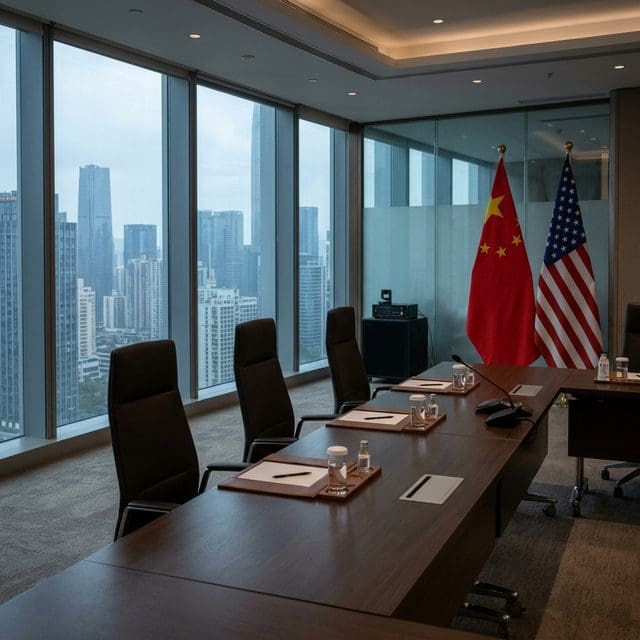
Donald Trump is set to meet Vladimir Putin and Xi Jinping in Shenzhen, with Ukraine excluded as Iran’s attacks on U.S. assets sharpen the stakes for American power.
A summit among President Donald Trump, Russian President Vladimir Putin and Chinese President Xi Jinping is set for November 19 in Shenzhen, but Ukraine will not have a seat at the table. China confirmed the meeting on November 16 without announcing an agenda. U.S. officials say Trump plans to prioritize nuclear-arms reduction and discuss the Iran war. Ukraine is not expected to come up, and officials do not anticipate an agreement.
Ukrainian President Volodymyr Zelenskyy was not invited. U.S. officials describe diplomacy over the war as a separate track involving Washington, Kyiv and Moscow. That may preserve a channel for direct discussions with Russia, but it leaves Kyiv outside a high-profile meeting of three major powers. The Associated Press reports that Democrats and some Republican Russia hawks have criticized the exclusion.
The summit’s format is clearer than its substance. There is no indication that the leaders have settled terms for a deal or that Ukraine’s absence changes the separate diplomatic process. The meeting gives Trump, Putin and Xi an opportunity to test their positions directly, but it is not evidence of a breakthrough. China’s announcement offered no agenda details, leaving the precise scope of the discussion to U.S. officials’ descriptions and the leaders themselves.
The planned focus on nuclear-arms reduction gives the talks a subject with implications beyond the war in Ukraine. But the available reporting does not describe proposed terms, participants’ commitments or a negotiating framework. Any assessment of what the summit might achieve therefore remains preliminary. The gathering will put the American, Russian and Chinese presidents in direct contact, while the substance and outcome remain uncertain.
Events on the battlefield underscore the consequences of leaving Ukraine outside the room. Kyiv says restrictions on Starshield satellite communications remain widespread, with interceptor drones losing communications at roughly 161 kilometers per hour over front-line and occupied areas. Radio Free Europe/Radio Liberty reported that the White House and Pentagon had not responded by late November 14. The report relayed Ukraine’s account and did not include a public U.S. explanation of the restrictions.
Communications failures can affect Ukraine’s use of drones against Russian forces. The dispute also highlights Kyiv’s reliance on capabilities linked to U.S. systems and decisions, even as it pursues a separate diplomatic track. The status of Starshield restrictions remains unresolved as Zelenskyy stays outside the Shenzhen talks. For Kyiv, the issue is operational as well as diplomatic: its battlefield account describes a loss of communications affecting interceptor drones, while Washington has not publicly explained its position in the cited reporting.
The Iran war is another immediate concern. On November 15, Iran’s Islamic Revolutionary Guard Corps claimed it launched six drones at a U.S. air-defense radar at Bahrain’s Al-Riffa helicopter base. Bahrain said it intercepted the attacks. The U.S. military said it shot down two Iranian one-way attack drones and reported no harm.
Bahrain issued two public alerts, its first such warnings since September. The country hosts the U.S. Navy’s Fifth Fleet, making threats to its facilities a direct concern for American operations in the Gulf. Washington’s talks with Moscow and Beijing are unfolding as U.S. forces face risks in another theater. The differing accounts of the attempted attack should be kept distinct: Iran claimed six launches, Bahrain reported interceptions, and the U.S. military reported shooting down two drones.
The United States is also reducing staffing at four Middle East embassies after intelligence indicated Iran had substantially increased efforts to target U.S. personnel, PBS NewsHour reported. The source material says U.S. allies were not consulted before the Iran war began. That history complicates efforts to present American policy as a coordinated alliance strategy: partners are managing risks while Washington pursues talks with adversaries.
The Shenzhen summit may provide a forum to discuss nuclear risks and Iran, but the undeclared agenda leaves its likely results uncertain. Its central political fact is plain: Trump, Putin and Xi will meet, while Zelenskyy and Ukraine remain outside the room. For American power, the test is whether direct engagement can manage competing crises without weakening the position of partners that depend on U.S. support.

Olivia Kendall serves as the Senior Correspondent for Geopolitics, Defense, and Foreign Policy at Just Right News, where she provides a principled, conservative perspective on the complex forces shaping the global stage. With a career dedicated to deconstructing the intricacies of international relations, Kendall has become a trusted voice for readers who value national sovereignty, a robust military, and a foreign policy that prioritizes American interests above all else.
A native of Washington, D.C., Kendall’s professional journey is deeply rooted in her upbringing within the nation’s capital. Growing up in the epicenter of American political life, she developed an early and profound understanding of how policy is crafted and, more importantly, how it often fails to account for the values of the American heartland. This unique vantage point allowed her to witness firsthand the rise of globalist bureaucracies, fueling her commitment to reporting that champions the constitutional foundations of the United States. Her background as a British White American further informs her worldview, providing her with a keen appreciation for the Western tradition and the enduring importance of the “Special Relationship” in maintaining global stability.
Now based in Arlington, Virginia, Kendall operates from the doorstep of the Pentagon and the heart of the nation’s defense establishment. Her proximity to the decision-makers in the military and intelligence communities allows her to provide boots-on-the-ground reporting that is both timely and deeply informed. For Kendall, Arlington is more than just a base of operations; it is a daily reminder of the sacrifices made by the men and women in uniform. This connection to the defense community drives her rigorous coverage of military readiness and her advocacy for a “peace through strength” approach to diplomacy.
At Just Right News, Kendall is perhaps best known for her acclaimed feature series, “The World’s Shadow on America.” In this ongoing project, she explores the direct correlation between international developments and the daily lives of American citizens. Whether she is analyzing the encroachment of foreign adversaries in domestic supply chains or the impact of international treaties on local economies, Kendall’s work serves as a vital bridge between distant geopolitical shifts and their consequences at home. She rejects the notion that foreign policy is an abstract concern for elites, instead proving that what happens in the corridors of power in Brussels or Beijing has a tangible “shadow” that falls across every American doorstep.
Throughout her tenure, Kendall has remained a steadfast critic of international overreach and a vocal proponent of a clear-eyed, realistic foreign policy. She brings a sharp analytical mind to her beat, often challenging the prevailing narratives of the mainstream media to uncover the underlying truths that affect national security. Her reporting is characterized by a refusal to compromise on the truth and a dedication to the idea that a strong, secure America is the world’s best hope for liberty. As a Senior Correspondent, Olivia Kendall continues to lead the charge in providing the essential context and conservative insight necessary to navigate an increasingly volatile world.