

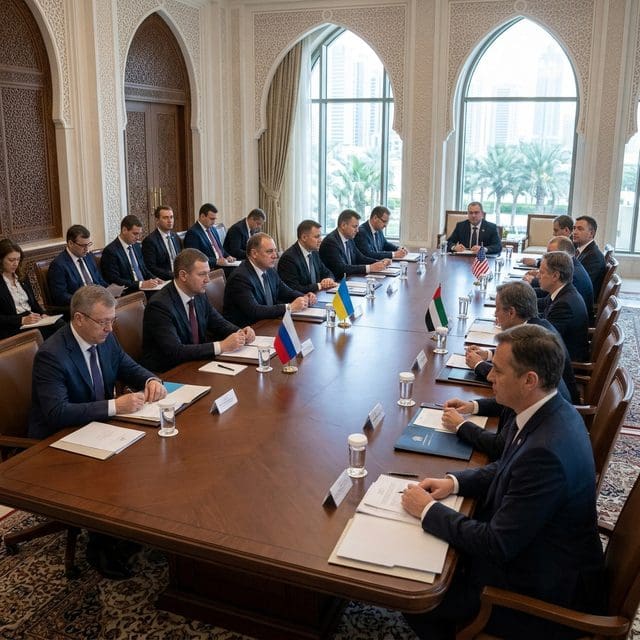
Russia and Ukraine agreed to a prisoner exchange in Abu Dhabi, but the talks exposed Washington’s challenge in coordinating European allies while negotiating directly with Moscow.
A large-scale prisoner exchange was the clearest result of two days of U.S.-mediated talks between Russia and Ukraine in Abu Dhabi. Negotiators made no breakthrough on the larger questions of a settlement or Europe’s role in shaping one.
Russian negotiator Vladimir Medinsky said on November 11 that the sides had agreed to an exchange, with details to come. He described “mutual understanding” on some issues, but Reuters reported no broader breakthrough. An exchange could ease immediate pressure on prisoners and their families; it does not resolve the strategic terms of the war.
The talks also exposed a divide over who gets a seat at the table. Russia said its delegation had not contacted European representatives in Abu Dhabi and did not expect to. Medinsky said Moscow had received no concrete European peace initiative, Reuters reported. European officials from France, Britain, Germany, Italy, the European Union and NATO held or planned separate consultations with U.S. and Ukrainian officials, but were not part of the trilateral format.
That leaves Washington with two tasks: maintaining a direct negotiating channel with Moscow and keeping European allies aligned. The separate consultations allow the U.S. and Ukraine to discuss the talks with European partners, but those partners are not negotiating with Russia in the same room. How their security interests would figure in any eventual understanding remains an open question.
Medinsky said a possible new European security framework was central to the discussions. Another Russian diplomat said Moscow could pursue non-aggression agreements with individual NATO members as part of that architecture, Reuters reported. The remarks signal that Moscow wants to shape security arrangements beyond the battlefield. They do not mean NATO members have accepted the proposal or that an agreement is near.
Ukrainian President Volodymyr Zelensky said on November 10 that European countries should choose an authorized representative or group for peace talks by the end of November. He pointed to a November 19 meeting in Germany as a possible venue. Kyiv’s position underscores its desire for Europe to have a defined role, rather than remain on the sidelines of a U.S.-Russia-Ukraine process.
A separate opening came on military communications with Britain. Russian Foreign Ministry spokeswoman Maria Zakharova said Russia’s Defense Ministry would speak with its British counterpart if London initiated contact. She was responding to British Defense Secretary Wes Streeting’s call for additional military-to-military channels to reduce the risk of miscalculation. Zakharova blamed Britain for closing communication channels in 2024 after expelling Russia’s military attaché, Reuters reported.
Such contacts would not amount to a political settlement, but could help manage risks between two countries with sharply competing security interests. Whether London follows up, and whether a channel could function amid deep distrust, remains uncertain.
Russian state news agency TASS reported that U.S. envoys Steve Witkoff and Jared Kushner could visit Russia in the coming days after the Abu Dhabi talks. A possible meeting with President Vladimir Putin was not confirmed. A visit would show Washington keeping a direct line open, not that Moscow was ready to accept terms supported by Ukraine and its European partners.
For the United States, diplomatic influence will depend on more than keeping meetings in motion. Washington must determine what Moscow is willing to negotiate while coordinating with allies whose security is directly affected. The prisoner exchange is a concrete, limited result; Ukraine’s future and Europe’s security framework remain unsettled.

Olivia Kendall serves as the Senior Correspondent for Geopolitics, Defense, and Foreign Policy at Just Right News, where she provides a principled, conservative perspective on the complex forces shaping the global stage. With a career dedicated to deconstructing the intricacies of international relations, Kendall has become a trusted voice for readers who value national sovereignty, a robust military, and a foreign policy that prioritizes American interests above all else.
A native of Washington, D.C., Kendall’s professional journey is deeply rooted in her upbringing within the nation’s capital. Growing up in the epicenter of American political life, she developed an early and profound understanding of how policy is crafted and, more importantly, how it often fails to account for the values of the American heartland. This unique vantage point allowed her to witness firsthand the rise of globalist bureaucracies, fueling her commitment to reporting that champions the constitutional foundations of the United States. Her background as a British White American further informs her worldview, providing her with a keen appreciation for the Western tradition and the enduring importance of the “Special Relationship” in maintaining global stability.
Now based in Arlington, Virginia, Kendall operates from the doorstep of the Pentagon and the heart of the nation’s defense establishment. Her proximity to the decision-makers in the military and intelligence communities allows her to provide boots-on-the-ground reporting that is both timely and deeply informed. For Kendall, Arlington is more than just a base of operations; it is a daily reminder of the sacrifices made by the men and women in uniform. This connection to the defense community drives her rigorous coverage of military readiness and her advocacy for a “peace through strength” approach to diplomacy.
At Just Right News, Kendall is perhaps best known for her acclaimed feature series, “The World’s Shadow on America.” In this ongoing project, she explores the direct correlation between international developments and the daily lives of American citizens. Whether she is analyzing the encroachment of foreign adversaries in domestic supply chains or the impact of international treaties on local economies, Kendall’s work serves as a vital bridge between distant geopolitical shifts and their consequences at home. She rejects the notion that foreign policy is an abstract concern for elites, instead proving that what happens in the corridors of power in Brussels or Beijing has a tangible “shadow” that falls across every American doorstep.
Throughout her tenure, Kendall has remained a steadfast critic of international overreach and a vocal proponent of a clear-eyed, realistic foreign policy. She brings a sharp analytical mind to her beat, often challenging the prevailing narratives of the mainstream media to uncover the underlying truths that affect national security. Her reporting is characterized by a refusal to compromise on the truth and a dedication to the idea that a strong, secure America is the world’s best hope for liberty. As a Senior Correspondent, Olivia Kendall continues to lead the charge in providing the essential context and conservative insight necessary to navigate an increasingly volatile world.