

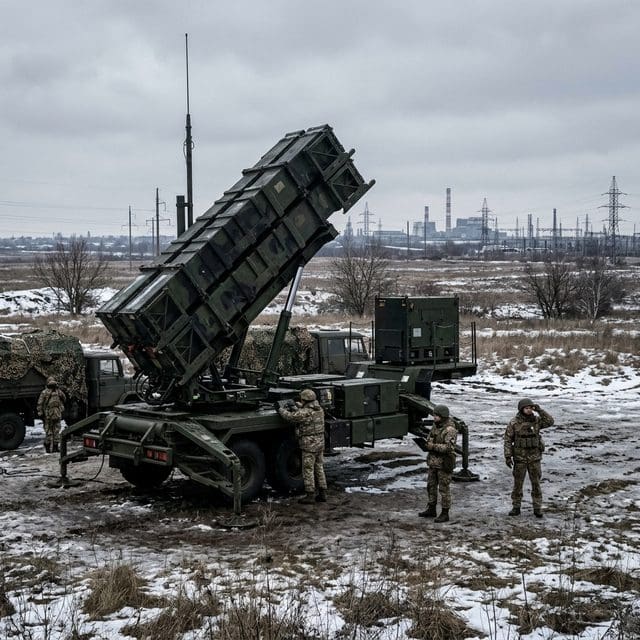
A partner-funded Patriot sale offers Ukraine a future boost, while Russian attacks, Baltic tensions and Tehran’s negotiating posture expose the limits of Western leverage.
The United States has approved a possible sale of 500 Patriot interceptors to Ukraine, but the decision is a long-term commitment, not an answer to Kyiv’s immediate air-defense needs. The missiles have not yet been manufactured and are not expected to arrive until a couple of years into the 2030s, according to officials cited by Al Jazeera and Reuters-based reporting.
The $2.1 billion purchase would be financed entirely by partner governments, including Canada, Germany and Norway through JUMPSTART, alongside EU-backed Ukrainian funds. No U.S. funds are involved. Ukrainian President Volodymyr Zelenskyy welcomed the approval but warned that the schedule does not address urgent winter-defense requirements.
The authorization signals continued allied backing and could give Kyiv a future supply line. It does not put interceptors in Ukrainian launchers today. The gap between approval and delivery reflects the industrial and logistical demands of sustaining a war against a larger power. For Ukraine, the timing matters as much as the total number of missiles: defenses needed this winter cannot be replaced by weapons arriving years later.
Ukrainian authorities said Russian attacks over the previous day killed five people and injured at least 46. Ukraine reported intercepting 105 of 134 drones. About 200,000 homes in Dnipropetrovsk Oblast and 80,000 in Kyiv Oblast were without electricity, according to The Kyiv Independent. Protecting power infrastructure is a military concern with immediate civilian consequences, affecting household heat, industry and the state’s ability to function through winter.
Washington is also navigating disagreement over how its eastern European allies should describe the Russian threat. Reuters reported that Pentagon officials privately urged Lithuania, Latvia and Estonia in recent weeks to moderate public statements about Moscow, arguing that language portraying Russia as cornered could undermine European security. One source said Elbridge Colby urged a Baltic official to avoid “poking” Russia.
Lithuanian officials disputed the account’s implications. They said they had no information about such a request, while the president’s office said neither the president nor his advisers had been asked by allies to soften their rhetoric. The discrepancy remains unresolved. The reported exchange nevertheless points to an alliance challenge: Washington may seek to manage escalation, while countries bordering Russia view deterrence and public clarity as central to their security.
At the G20 foreign-ministers meeting in Atlanta on October 31, EU foreign-policy chief Kaja Kallas accused Russian Foreign Minister Sergei Lavrov of presenting false narratives about Ukraine. She argued that Moscow’s actions contradict its stated openness to negotiations. The EU’s External Action Service said Kallas also called for freedom of navigation in the Black Sea, citing risks to energy security, food supplies and global trade. The waterway’s importance extends beyond the front, connecting military pressure with commercial routes and essential goods.
Iran presents a separate test of leverage. Foreign Minister Abbas Araghchi said Tehran would decide whether to enter direct or indirect negotiations with Washington once the United States accepts Iran’s terms, according to Sputnik. That is Iran’s stated position, not evidence that an agreement is near. Washington must weigh whether pressure can bring Tehran to talks on terms that constrain its choices without triggering another costly confrontation.
Across these fronts, the practical test is capacity: missiles that will arrive years from now, power networks under attack, allies debating how to deter Russia and an Iranian government setting conditions for talks. American influence depends not just on announced commitments, but on whether allies can fund, produce and deliver what Ukraine needs—and whether governments facing different risks can sustain a common strategy.

Olivia Kendall serves as the Senior Correspondent for Geopolitics, Defense, and Foreign Policy at Just Right News, where she provides a principled, conservative perspective on the complex forces shaping the global stage. With a career dedicated to deconstructing the intricacies of international relations, Kendall has become a trusted voice for readers who value national sovereignty, a robust military, and a foreign policy that prioritizes American interests above all else.
A native of Washington, D.C., Kendall’s professional journey is deeply rooted in her upbringing within the nation’s capital. Growing up in the epicenter of American political life, she developed an early and profound understanding of how policy is crafted and, more importantly, how it often fails to account for the values of the American heartland. This unique vantage point allowed her to witness firsthand the rise of globalist bureaucracies, fueling her commitment to reporting that champions the constitutional foundations of the United States. Her background as a British White American further informs her worldview, providing her with a keen appreciation for the Western tradition and the enduring importance of the “Special Relationship” in maintaining global stability.
Now based in Arlington, Virginia, Kendall operates from the doorstep of the Pentagon and the heart of the nation’s defense establishment. Her proximity to the decision-makers in the military and intelligence communities allows her to provide boots-on-the-ground reporting that is both timely and deeply informed. For Kendall, Arlington is more than just a base of operations; it is a daily reminder of the sacrifices made by the men and women in uniform. This connection to the defense community drives her rigorous coverage of military readiness and her advocacy for a “peace through strength” approach to diplomacy.
At Just Right News, Kendall is perhaps best known for her acclaimed feature series, “The World’s Shadow on America.” In this ongoing project, she explores the direct correlation between international developments and the daily lives of American citizens. Whether she is analyzing the encroachment of foreign adversaries in domestic supply chains or the impact of international treaties on local economies, Kendall’s work serves as a vital bridge between distant geopolitical shifts and their consequences at home. She rejects the notion that foreign policy is an abstract concern for elites, instead proving that what happens in the corridors of power in Brussels or Beijing has a tangible “shadow” that falls across every American doorstep.
Throughout her tenure, Kendall has remained a steadfast critic of international overreach and a vocal proponent of a clear-eyed, realistic foreign policy. She brings a sharp analytical mind to her beat, often challenging the prevailing narratives of the mainstream media to uncover the underlying truths that affect national security. Her reporting is characterized by a refusal to compromise on the truth and a dedication to the idea that a strong, secure America is the world’s best hope for liberty. As a Senior Correspondent, Olivia Kendall continues to lead the charge in providing the essential context and conservative insight necessary to navigate an increasingly volatile world.