

A proposed Donbas-for-NATO formula and rising risks around the Strait of Hormuz expose difficult choices for Washington and its allies.
Two tests of American power sharpened Sunday: whether NATO membership could anchor a settlement over Ukraine’s territory, and whether Washington can contain its confrontation with Iran without increasing risks to Gulf shipping and U.S. personnel.
Ukrainian President Volodymyr Zelenskyy said on November 15 that U.S. negotiators had raised a new possibility in talks: Ukraine withdrawing from the remaining Ukrainian-held part of Donbas in exchange for NATO membership. Zelenskyy said it was the first time the idea had been raised in negotiations.
Kyiv has not accepted the proposal. Zelenskyy said Ukraine would consider a referendum only with binding security guarantees, a strong Ukrainian military and reconstruction funding. The conditions reflect the central difficulty of any deal: a territorial concession would need to be matched by protection against a renewed Russian attack.
Moscow’s stated demands leave little room for an easy bargain. Russia continues to seek all of Donbas and opposes Ukraine joining NATO. President Vladimir Putin also told U.S. envoys that foreign troops in Ukraine would be unacceptable, Bloomberg reported on November 14–15. The positions remain far apart, and the proposal is not an agreement.
For Washington and NATO, the question is whether membership could deter another Russian attack—or create a new security obligation without a durable settlement. Zelenskyy’s conditions show Kyiv wants a commitment backed by military strength and resources, not a symbolic offer. Russia’s opposition to both membership and foreign forces underscores the risk that Moscow would resist the safeguards Ukraine seeks.
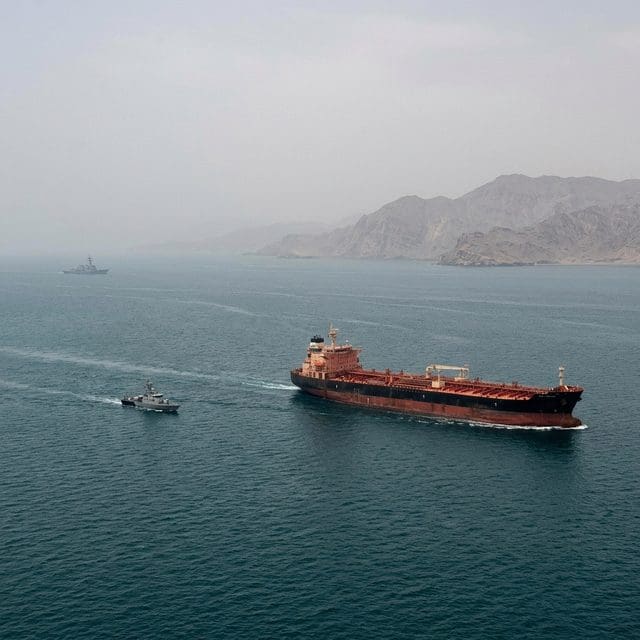
The confrontation with Iran presents a more immediate operational danger. Iran’s navy said three oil tankers caught fire on November 14 after striking naval mines in the Strait of Hormuz. Reuters said it could not independently verify the reports. ABC News reported Sunday that the United States was enforcing a naval blockade of Iranian ports in the Persian Gulf and Gulf of Oman, while Iran claimed control of the strait.
Iran’s Revolutionary Guard Corps also claimed six drones targeted Bahrain’s Riffa helicopter base. That claim, like the reported mine incidents, has not been independently confirmed in the supplied reporting. Reuters said Gulf markets were reacting to the disruption and attacks on Saudi Arabia by Iran-aligned Houthis.
The stakes reach well beyond the immediate military exchanges. Hormuz is a major oil-shipping route, and sustained disruption could affect energy markets and commercial traffic. Washington and its partners would then face the challenge of protecting shipping while avoiding further escalation. The risks come as the United States reduces staffing at four Middle East embassies after intelligence indicated Iran had substantially increased efforts to target U.S. personnel.
Alliance coordination is another concern. PBS NewsHour reported that U.S. allies were not consulted before the Iran war began. Partners expected to manage the consequences of a campaign but excluded from the decision to launch it may be less prepared to coordinate when a crisis deepens.
A separate dispute over Nvidia chips points to the economic side of competition with China. Treasury Secretary Scott Bessent blamed Commerce Secretary Howard Lutnick’s department for not restricting Nvidia sales to China. Megaspeed, a major chip buyer, has drawn scrutiny over its global footprint and possible links to the Chinese government. The company denied wrongdoing and said Alice Huang left in 2025; the available reporting does not establish that Megaspeed acted for Beijing.
Across these fronts, U.S. leverage depends on credible commitments, secure trade routes and coordination with allies. Ukraine’s security terms remain unresolved, while the claims surrounding Hormuz require verification. The actions governments take next will determine whether these crises produce deterrence or wider instability.

Olivia Kendall serves as the Senior Correspondent for Geopolitics, Defense, and Foreign Policy at Just Right News, where she provides a principled, conservative perspective on the complex forces shaping the global stage. With a career dedicated to deconstructing the intricacies of international relations, Kendall has become a trusted voice for readers who value national sovereignty, a robust military, and a foreign policy that prioritizes American interests above all else.
A native of Washington, D.C., Kendall’s professional journey is deeply rooted in her upbringing within the nation’s capital. Growing up in the epicenter of American political life, she developed an early and profound understanding of how policy is crafted and, more importantly, how it often fails to account for the values of the American heartland. This unique vantage point allowed her to witness firsthand the rise of globalist bureaucracies, fueling her commitment to reporting that champions the constitutional foundations of the United States. Her background as a British White American further informs her worldview, providing her with a keen appreciation for the Western tradition and the enduring importance of the “Special Relationship” in maintaining global stability.
Now based in Arlington, Virginia, Kendall operates from the doorstep of the Pentagon and the heart of the nation’s defense establishment. Her proximity to the decision-makers in the military and intelligence communities allows her to provide boots-on-the-ground reporting that is both timely and deeply informed. For Kendall, Arlington is more than just a base of operations; it is a daily reminder of the sacrifices made by the men and women in uniform. This connection to the defense community drives her rigorous coverage of military readiness and her advocacy for a “peace through strength” approach to diplomacy.
At Just Right News, Kendall is perhaps best known for her acclaimed feature series, “The World’s Shadow on America.” In this ongoing project, she explores the direct correlation between international developments and the daily lives of American citizens. Whether she is analyzing the encroachment of foreign adversaries in domestic supply chains or the impact of international treaties on local economies, Kendall’s work serves as a vital bridge between distant geopolitical shifts and their consequences at home. She rejects the notion that foreign policy is an abstract concern for elites, instead proving that what happens in the corridors of power in Brussels or Beijing has a tangible “shadow” that falls across every American doorstep.
Throughout her tenure, Kendall has remained a steadfast critic of international overreach and a vocal proponent of a clear-eyed, realistic foreign policy. She brings a sharp analytical mind to her beat, often challenging the prevailing narratives of the mainstream media to uncover the underlying truths that affect national security. Her reporting is characterized by a refusal to compromise on the truth and a dedication to the idea that a strong, secure America is the world’s best hope for liberty. As a Senior Correspondent, Olivia Kendall continues to lead the charge in providing the essential context and conservative insight necessary to navigate an increasingly volatile world.