

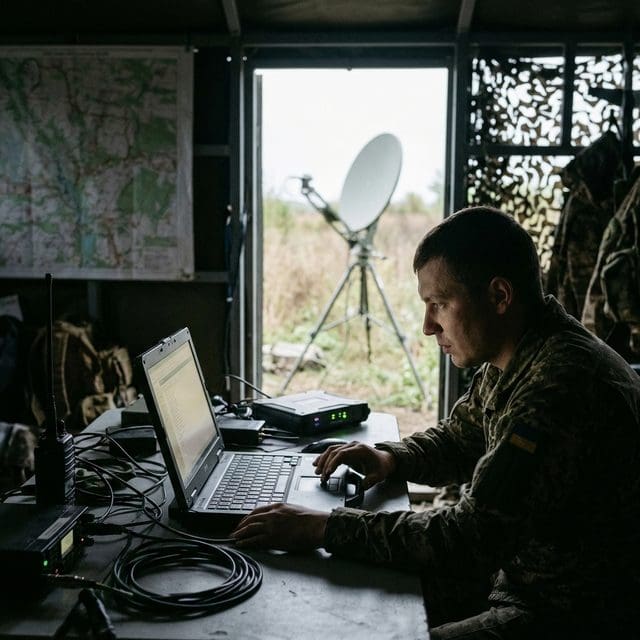
Ukraine says renewed speed restrictions on SpaceX satellite service disrupted military operations, sharpening questions about control and oversight of communications supplied by private companies.
A dispute over satellite communications in Ukraine is exposing a broader policy question for governments that depend on privately operated networks: who can restrict access when a system becomes essential to national security?
Ukrainian President Volodymyr Zelensky said on November 12 that military investigations found recent disruptions were caused by imposed speed restrictions, not a technical failure. He said some Russian strikes had already gotten through because Ukrainian interceptors could not reach sufficient speeds, according to current reporting. The restrictions reportedly affected service across the front line and Russian-occupied areas, though the available reports do not establish the precise technical limits or their full operational effect.
The order behind the restrictions remains unclear. Reuters reported Ukrainian officials were seeking answers from Washington, while U.S. officials and SpaceX had not publicly confirmed who imposed the renewed limits as of November 12. Earlier accounts attributed the decision to people inside the White House; Trump administration officials denied responsibility. Public reporting does not establish which account is correct.
The uncertainty matters beyond the battlefield. Ukraine relies on satellite links for military communications, and the episode illustrates how a private provider’s decisions can affect a country’s ability to operate. A November 12 analysis by the Center for Strategic and International Studies framed the incident as a strategic-dependency risk for allies whose national-security communications rely on a U.S. private company. It said the episode gives those allies further reason to develop alternative networks.
Commercial networks can be deployed quickly and add capacity governments may struggle to build alone. That can be valuable in a conflict, when damaged infrastructure or urgent communications needs make alternatives scarce. But reliance without clear rules for access, restrictions and continuity can leave public authorities uncertain about who has decision-making power in a crisis. That is a governance problem as much as a technology problem—and a reminder that technical capability does not by itself guarantee reliable access.
The dispute is drawing scrutiny in Washington. Senator Richard Blumenthal had requested written answers from SpaceX by November 5 and a company briefing by November 12. His questions concerned who can activate, limit, geofence or terminate Starshield under Pentagon contracts. The contract’s terms are central: what authority the government has, what authority the provider retains, and what notice or review applies when service is constrained. The available reporting does not say whether SpaceX provided the requested answers or held the briefing.
A separate oversight path has not produced an investigation by the Defense Department inspector general. A report published November 12 said the inspector general declined a bipartisan request from nine U.S. senators to investigate the Starlink and Starshield outages, referring the matter to the U.S. Air Force instead. The referral is not an independent inspector-general inquiry, and public reporting does not yet say what the Air Force will examine or when findings might emerge.
For American taxpayers, the issue goes beyond whether a satellite service works. Pentagon contracts raise questions about oversight, contingency planning and how contracted services are governed. If critical communications depend on a single provider, officials need to understand how service could be limited, what backup systems exist and whether contractual protections match the government’s operational needs. The present reports do not answer those questions, but they make the need for clear answers difficult to ignore.
Those questions also matter to allies weighing reliance on U.S.-based providers against investment in alternatives. Diversification can reduce exposure to a single point of control, but it may require money, coordination and time. The CSIS analysis makes the strategic case for alternatives; it does not establish that a replacement network is readily available or that allies have already built one.
The development-policy connection should be stated carefully. Current reports do not document effects on health services, humanitarian aid or civilian communications, nor do they establish a new Canadian government action. Earlier comments attributed to Prime Minister Mark Carney called the restrictions consequential for Ukrainian civilians and urged Canada to diversify defense partnerships, but they do not amount to a new November 12 policy decision. The present evidence does not support claims of specific consequences for hospitals, aid deliveries or public health.
The immediate facts remain limited: Ukraine reports restrictions and operational disruption; the decision-maker has not been publicly identified; and oversight questions are still in motion. For governments relying on commercial infrastructure, resilience depends not only on coverage and speed, but also on transparent authority, enforceable contracts, credible alternatives and a clear account of who is responsible when service changes.

Rachel Vaughn serves as a Senior Correspondent for Just Right News, where she leads the network’s coverage of Global Health, Climate, and Development. With a career defined by intellectual rigor and a commitment to principled reporting, Rachel provides a vital conservative perspective on some of the most complex and high-stakes issues facing the world today. Her work is characterized by a refusal to accept bureaucratic narratives at face value, focusing instead on how international policies impact national sovereignty, individual liberty, and the American taxpayer.
Raised in New Haven, Connecticut, Rachel grew up in an environment dominated by elite academic discourse. This upbringing provided her with a front-row seat to the inner workings of the American establishment, but it also instilled in her a healthy skepticism of the “ivory tower” consensus. She learned early on that while academic theories may sound promising in a lecture hall, they often fail to account for the practical realities of the working class. This background drives her to bridge the gap between high-level policy discussions and the common-sense concerns of everyday citizens, ensuring that her reporting remains grounded and accessible.
Now based in Burlington, Vermont, Rachel operates from a unique vantage point within one of the nation’s most progressive political landscapes. Living and working in a region that often serves as a testing ground for radical social and environmental experiments allows her to witness the real-world consequences of these policies firsthand. From her base in the Green Mountain State, she provides Just Right News readers with essential “boots on the ground” reporting, documenting the friction between local mandates and the constitutional freedoms of the individual. Her presence in Burlington ensures that her critiques of globalist agendas are informed by a direct understanding of how those ideologies manifest at the local level.
In her acclaimed feature series, “Planetary Stakes,” Rachel explores the intersection of international development and environmental stewardship. She rejects the alarmism often found in mainstream media, opting instead for a sober analysis of the economic and geopolitical costs of global climate agreements. Her reporting frequently highlights the importance of market-driven innovation and the role of American leadership in fostering global health without ceding authority to unelected international bodies. Through “Planetary Stakes,” she has become a leading voice for those who believe that true conservation and public health are best achieved through transparency, accountability, and the protection of private property rights.
Throughout her tenure at Just Right News, Rachel has distinguished herself as a journalist who is unafraid to ask difficult questions of global institutions. Whether she is investigating the influence of non-governmental organizations on domestic policy or analyzing the fiscal transparency of international health initiatives, her goal remains the same: to provide her audience with the facts necessary to navigate an increasingly interconnected world. Her blend of East Coast intellectual heritage and her current immersion in the political heart of the Northeast makes her an indispensable asset to the newsroom and a trusted source for readers seeking a principled, conservative take on the issues that define our era.