

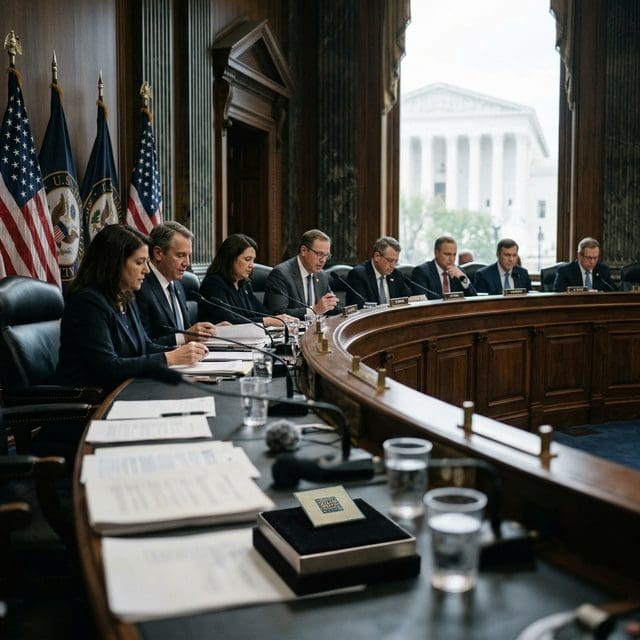
Lawmakers are pressing to tighten controls on advanced AI chips, while the Supreme Court considers whether federal judges can block agency rules nationwide.
Congress is weighing two significant shifts in federal power: tighter controls on advanced AI chips going to China and narrower authority for courts to block agency rules nationwide. Neither proposal has changed the law yet, but both could reshape how technology companies and other businesses navigate Washington.
Republicans are seeking to add new advanced-chip export restrictions to the annual National Defense Authorization Act, according to a Senate aide cited by Reuters on November 13. The defense bill is a major legislative vehicle, but the chip provisions remain proposals. Their inclusion and final terms depend on negotiations in Congress.
House Speaker Mike Johnson has described growing congressional consensus for limiting China’s access to advanced U.S. chips. On November 13, House committee chairs Brian Mast, John Moolenaar and Rick Crawford requested testimony from former Nvidia chief Jensen Huang, Nvidia General Counsel Tim Teter and Commerce Under Secretary Jeffrey Kessler, Forbes reported.
One focus is whether Chinese firms can access U.S. chips’ computing power without importing the chips themselves. The proposed Remote Access Security Act would give the Commerce Department authority to regulate Chinese firms renting computing capacity at overseas data centers equipped with Nvidia chips, Reuters reported. That could put data-center operators and customers, as well as chipmakers, within the reach of future rules. The proposal’s final scope and enforcement details remain unsettled.
For companies, the immediate issue is uncertainty, not a new compliance requirement. Congress is considering multiple ways to expand oversight of chip exports and remote access, while the administration’s licensing decisions remain part of the debate. If restrictions pass, they could constrain sales or services involving overseas computing facilities. Until lawmakers act and agencies set out requirements, firms should not treat proposed measures as current law.
The Supreme Court has agreed to hear the administration’s appeal seeking to limit federal judges’ ability to invalidate agency regulations nationwide in cases under the Administrative Procedure Act. The administration argues that relief should apply to the parties who bring a lawsuit, rather than stopping enforcement for everyone. The Court will address the reach of judicial remedies, not whether any particular regulation is lawful.
That distinction can matter to regulated businesses. A nationwide order can halt a rule across the country while litigation proceeds. If courts are limited to plaintiff-specific relief, companies that did not join a lawsuit could remain subject to a disputed rule even while another party receives relief. The administration’s appeal follows earlier limits on universal injunctions but concerns challenges under the APA. The Court has not yet ruled, and the supplied information gives no decision date.
The technology debate also intersects with economic concerns. Federal Reserve Vice Chair Philip Jefferson said on November 13 that inflation was guiding his policy outlook. He described AI as a technology that could substantially raise productivity over time, while warning that workers could be displaced faster than they can retrain, Reuters reported. His comments identify competing possibilities, not a specific forecast of job losses or a change in interest-rate policy.
For workers and businesses, the near-term effects are limited: no new chip restriction has been enacted, and the Supreme Court has not changed the rules governing challenges to agency action. The next steps are congressional negotiations over the NDAA and the Court’s consideration of the APA case. Chip exporters and cloud-computing firms will be watching the bill’s language; regulated businesses will be watching how the justices define nationwide relief. Until those processes produce decisions, the proposals and arguments do not themselves alter existing obligations.

Ryan Mitchell serves as a Staff Writer for Just Right News, where he anchors the desk for Cyber, Technology Policy, and Digital Sovereignty. In an era where the digital landscape has become as much a battlefield as any physical territory, Ryan provides a critical conservative lens on the forces shaping the future of American innovation and national security. His work is defined by a commitment to the idea that American leadership in the digital age is not just a matter of economic success, but a necessity for the preservation of global liberty.
Born and raised in Austin, Texas, Ryan’s perspective is deeply rooted in the Lone Star State’s tradition of independence and skepticism of centralized authority. Growing up in a city that transformed from a quiet state capital into a global technology hub, he witnessed firsthand the disruptive power of the tech industry. This upbringing instilled in him a firm belief in free-market principles and the necessity of protecting individual liberties from both government overreach and corporate overstep. His Texan background serves as a foundational compass, guiding his reporting toward stories that emphasize national resilience and the preservation of constitutional values in an increasingly virtual world.
Now based in San Francisco, California, Ryan operates from the epicenter of the very industry he scrutinizes. Living and working in the heart of Silicon Valley allows him to provide “boots on the ground” reporting that few conservative journalists can match. He navigates the cultural and political complexities of the Bay Area to bring Just Right News readers an inside look at the boardrooms and coding labs where the next generation of digital policy is forged. For Ryan, being stationed in San Francisco is a strategic choice; it allows him to challenge the prevailing ideological monoculture of the tech elite from within their own backyard, ensuring that the concerns of middle America are represented in the conversation about our digital future.
His beat—Cyber, Technology Policy, and Digital Sovereignty—covers the high-stakes world of data privacy, artificial intelligence, and the infrastructure of the modern web. Ryan is particularly focused on the concept of digital sovereignty, arguing that for a nation to remain truly free, it must maintain control over its own technological destiny and critical infrastructure. He frequently explores how international regulations and domestic policies impact the ability of American firms to compete without sacrificing the privacy or security of their citizens.
Central to his current body of work is his featured series, “The New Cold War.” Through this project, Ryan examines the escalating technological rivalry between the United States and its global adversaries. He delves into the complexities of state-sponsored hacking, the global race for semiconductor dominance, and the ideological struggle to define the rules of the internet. Ryan views this competition not merely as a commercial race, but as a fundamental defense of Western values against authoritarian digital models. Through his rigorous reporting and principled analysis, Ryan Mitchell ensures that the readers of Just Right News stay informed about the invisible forces defining the 21st century, always advocating for a future where technology serves the cause of freedom.