

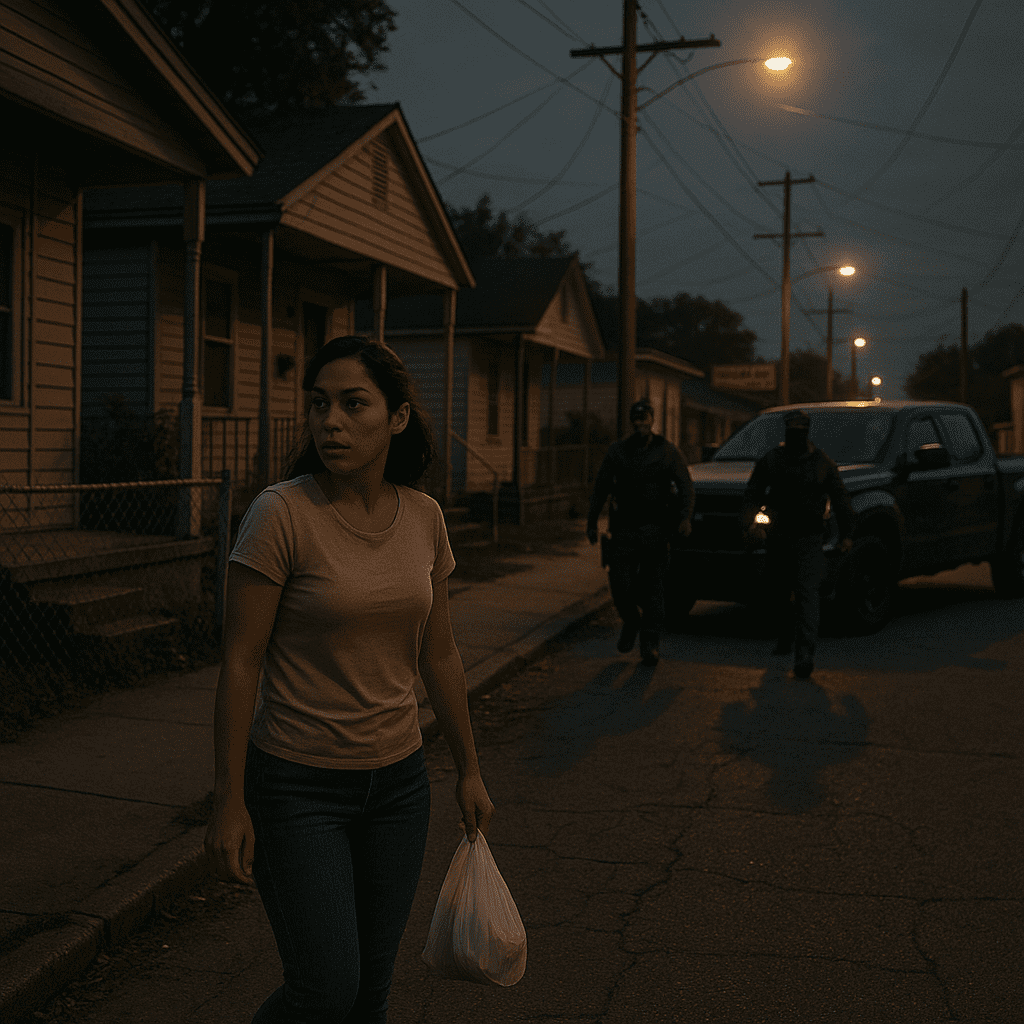
Security footage obtained by The Associated Press shows Jacelynn Guzman, a U.S. citizen, walking home from a corner store in Louisiana when a truck pulls alongside her and two masked federal agents step out and approach her. The AP account does not identify the agency involved, explain why Guzman was targeted, or describe how the encounter ended. Set against broader AP coverage of immigration detention and court-ordered releases, the incident illustrates how aggressive tactics can reach into ordinary neighborhood spaces. For Latino communities in high-enforcement areas, such encounters can erode the presumed boundary between citizen and noncitizen and deepen uncertainty about who may be stopped. Further details would likely depend on any legal actions, agency explanations or oversight inquiries that follow.
Jacelynn Guzman, a U.S. citizen, was walking back to her Louisiana home from a trip to the corner store when an unmarked truck pulled up beside her and two masked federal agents stepped out, according to security footage obtained by The Associated Press. The video, described in an AP account, shows the agents approaching Guzman on her own street before she returns toward her home. The footage does not include audio, and the AP report does not specify what the agents said, what agency they represented, or how the encounter ended.
The brief but startling sequence unfolds in an ordinary neighborhood setting, with Guzman making a routine walk that residents commonly associate with safety and familiarity. The presence of masked federal agents in that space, attempting to engage a woman later identified as a U.S. citizen, pushes a typically distant immigration-enforcement image directly onto a residential block. The AP description does not clarify whether the agents identified themselves, produced a warrant, or explained why they had targeted Guzman.
While the security footage is the primary factual record referenced in the AP account, key details remain unknown. The report does not state how long the interaction lasted, whether the agents attempted to detain Guzman, or whether neighbors witnessed the confrontation. It also does not specify whether Guzman or her family were later contacted again by federal authorities. That absence of detail leaves open questions about the exact scope of federal authority asserted on the street that day.
Even with those gaps, the imagery of the encounter resonates far beyond a single block. In many Latino neighborhoods, immigration enforcement is often understood as something that happens at workplaces, on highways, or at official buildings. The scene described by AP instead places federal power in the most intimate setting of daily life: the walk between a corner store and a front door. For U.S. citizens of Latino heritage, such moments can blur the line between who is presumed “deportable” and who is presumed to fully belong.
The Louisiana footage appears alongside other immigration-related coverage on the AP site, including stories about federal judges limiting detention powers and about people freed from immigration custody by court order. That broader context underscores how enforcement and legal oversight are unfolding simultaneously. In one video, a man identified as Kilmar Abrego Garcia is shown speaking to the press outside an ICE field office after a judge ordered his release from federal immigration detention and he returned home in Maryland. In another item, AP reports on a federal judge issuing an order to prohibit immigration officials from detaining him.
Placing Guzman’s experience next to those stories highlights how enforcement practices can spill over onto citizens who are not the intended targets. The AP account does not claim that the agents sought to arrest Guzman or that they confused her with anyone else, but the simple fact that masked federal officers felt empowered to confront a U.S. citizen walking home from a corner store carries its own weight. For Latino communities in high-enforcement regions, such incidents can reinforce the perception that ancestry or neighborhood may matter as much as legal status in triggering official scrutiny.
The Louisiana incident also lands in a wider cultural and political atmosphere that AP’s homepage reflects, with religion stories describing Nativity scenes that incorporate ICE imagery to protest immigration raids, and legal pieces about judges reining in certain detention practices. Together, they sketch a country where immigration enforcement is not only a legal system but also a visible, contested presence in public and private life. Guzman’s walk home, interrupted by masked agents, becomes another instance of that visibility pressed into everyday routines.
For now, the security footage and AP’s limited description are the only publicly reported elements of the episode. There is no information in the AP text about whether Guzman has filed a complaint, whether any oversight body has requested additional records, or whether the agency involved has offered an explanation. Future court filings, local inquiries or additional reporting, if they emerge, will shape how this incident is understood within debates over federal enforcement tactics and their impact on who feels at home in American neighborhoods.

Julie Harris serves as a Staff Writer for Just Right News, where she tackles some of the most pressing and complex issues facing the nation today. As the lead reporter for the Migration, Demographics & Cultural Shifts beat, Julie provides a grounded, principled perspective on how the movement of people and the changing makeup of communities are reshaping the American landscape. Her work is defined by a commitment to exploring the long-term consequences of social change, prioritizing the stability of local institutions and the preservation of national identity.
Her deep understanding of these issues is rooted in her upbringing in Tucson, Arizona. Growing up in a prominent border state, Julie witnessed firsthand the intricate realities of migration and the profound impact it has on local infrastructure, law enforcement, and the social fabric. This early exposure instilled in her a respect for the rule of law and a keen awareness of the challenges that arise when federal policies fail to align with the needs of border communities. Her reporting often reflects this lived experience, bringing a necessary level of nuance to topics that are often treated with abstraction in coastal newsrooms.
Now based in Santa Fe, New Mexico, Julie continues to report from the heart of the American Southwest. Her location provides a unique vantage point to observe the intersection of traditional regional cultures and the modern shifts brought about by both internal and external migration. In Santa Fe, a city defined by its rich history and distinct cultural heritage, she finds a perfect environment to explore how communities strive to maintain their character while navigating the pressures of a rapidly changing world. This perspective allows her to bridge the gap between policy debates in Washington and the reality of life in the high desert.
At Just Right News, Julie’s work is characterized by a dedication to examining the data and the human stories that define the “New Mosaic” of America. Her signature feature series, “The New Mosaic,” has become a cornerstone of her reporting. Through this series, Julie explores the evolving social architecture of the United States, documenting how shifts in population affect everything from local economies to the political landscape. She brings a critical eye to the narrative of demographic inevitability, instead asking how these shifts impact the average citizen’s sense of belonging and the integrity of the American social contract.
Julie’s background and her dedication to conservative principles make her a vital voice in contemporary journalism. She understands that demographics are more than just numbers on a spreadsheet; they represent the future of the American family and the nation’s enduring legacy. Through her diligent reporting and insightful analysis, Julie Harris ensures that her readers are informed about the forces shaping their world, providing a perspective that is as thoughtful as it is necessary for the modern era.