

Mortgage-rate pages and building-industry results offer limited clues about housing costs, while unverified home-market figures leave the latest affordability picture incomplete.
Fresh housing-market headlines offer a narrow view of the costs facing households: Investopedia updated mortgage-rate comparison pages on Nov. 10, while building-products company Installed Building Products reported growth led in part by commercial and multifamily work. But the material available does not provide current mortgage-rate figures or verified national data on home prices and rents, limiting what can be concluded about affordability this week.
Investopedia posted pages covering current mortgage rates, jumbo loans and refinancing. The headlines identify the pages and their publication date, but contain no quoted rates, fees, points, loan assumptions or borrower qualifications. Without those details, they cannot establish whether financing became more or less affordable, or how much a typical borrower would pay.
That distinction matters for households weighing a purchase, refinance or move. A headline rate is not a full estimate of a mortgage payment, which also depends on loan size, down payment, credit profile and other terms. The available Investopedia material does not supply enough information to compare those costs or calculate a representative monthly payment.
The interest-rate outlook remains consequential. Federal Reserve Gov. Chris Waller said a half-point rate hike in December was possible, depending on October consumer-price data, according to MarketWatch. That was a conditional possibility, not a decision or a direct forecast for mortgage rates. Mortgage borrowing costs can respond to broader financial conditions, so a policy-rate change should not be treated as a one-for-one adjustment in home-loan rates.
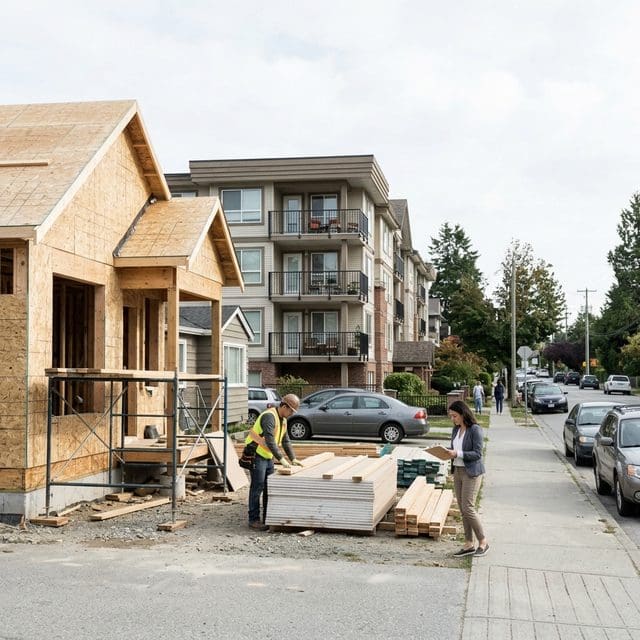
On the construction side, Installed Building Products reported third-quarter revenue of $808 million, up 4% from a year earlier, according to a Nov. 10 earnings-call summary by TickerReport. The company said commercial and multifamily work helped offset softer demand for new single-family homes. The summary did not provide a breakdown of how much each segment contributed, nor did it establish whether the reported growth would translate into lower construction costs or more affordable homes.
The contrast is notable but limited: activity in commercial and multifamily work can support building-sector revenue even as demand for new single-family homes weakens. It does not, by itself, show whether more apartments are reaching renters, whether rents are easing, or whether construction is occurring where housing demand is greatest. Those questions depend on local supply, land-use rules, financing and project costs—details absent from the available reports.
Zillow Group was listed as a source for an October housing report published Nov. 5, but the supplied figures for pending listings, existing-home sales, home values, inventory, mortgage payments and rents are masked and could not be independently matched to a cited source. They therefore cannot support a reliable claim about the direction or scale of national housing-market changes. No masked estimates are used here.
The reporting gap is meaningful for a cost-of-living assessment. A complete picture would require verified figures on actual mortgage terms, rents, available homes and sales activity, alongside local information about construction and household incomes. The current material supplies none of those measures in usable form.
For now, the evidence supports a restrained conclusion: housing-related businesses are seeing different conditions across market segments, and the Federal Reserve’s next steps remain dependent on inflation data. It does not establish whether the typical American’s cost of buying or renting a home has risen or fallen in the latest month. That answer requires reliable, comparable numbers—not a mortgage-rate page title or unverified market statistics.

Deborah Cole serves as a Senior Correspondent for Just Right News, where she spearheads the network’s coverage of Housing, Infrastructure, and Mobility. With a career defined by a commitment to rigorous reporting and a focus on the fundamental pillars of American community life, Deborah brings a principled perspective to the complex issues that dictate how and where we live. Her work is grounded in the belief that sound policy, fiscal responsibility, and respect for private property are the essential foundations of a prosperous society.
Originally from Boston, Massachusetts, Deborah’s upbringing in one of the nation’s oldest and most historically significant cities deeply influenced her professional trajectory. Growing up amidst the architectural legacy and dense urban planning of New England, she developed an early appreciation for the importance of durable infrastructure and the role of local tradition in shaping neighborhoods. Her perspective is informed by the classic American values of her hometown—hard work, community cohesion, and a healthy skepticism of top-down bureaucratic mandates that often overlook the unique needs of individual citizens.
Today, Deborah operates from her base in Austin, Texas, a city that serves as a primary laboratory for her reporting. Austin’s rapid expansion and its status as a hub for innovation and migration provide her with a front-row seat to the most pressing challenges in modern infrastructure and housing. From the Lone Star State, she chronicles the tensions between rapid growth and the preservation of the American Dream, often highlighting how market-driven solutions and deregulation can address the housing shortages that plague many of the country’s metropolitan areas.
At Just Right News, Deborah is perhaps best known for her signature feature series, “Where We Live.” Through this platform, she explores the intersection of public policy and private life, moving beyond mere statistics to tell the stories of families, small business owners, and local developers. Her reporting frequently highlights the importance of mobility—not just in terms of transportation and transit, but as a vehicle for economic opportunity and social stability. She remains a staunch advocate for the taxpayer, consistently scrutinizing government spending on large-scale projects and advocating for transparency in how infrastructure dollars are allocated.
Deborah’s beat is more than just a collection of policy topics; it is an investigation into the physical and legal structures that allow families to flourish. Whether she is reporting on the impact of zoning laws on suburban development or the necessity of maintaining the nation’s highway systems, her work is characterized by a dedication to the facts and a respect for the constitutional principles that protect the rights of homeowners.
As a Senior Correspondent, Deborah Cole continues to be a vital voice for Just Right News, providing the audience with the clarity and context needed to navigate an ever-changing landscape. Her reporting ensures that the values of individual liberty and local sovereignty remain at the forefront of the national conversation regarding the future of our cities and towns. Through her tireless efforts, she remains committed to informing the public on the issues that hit closest to home.