

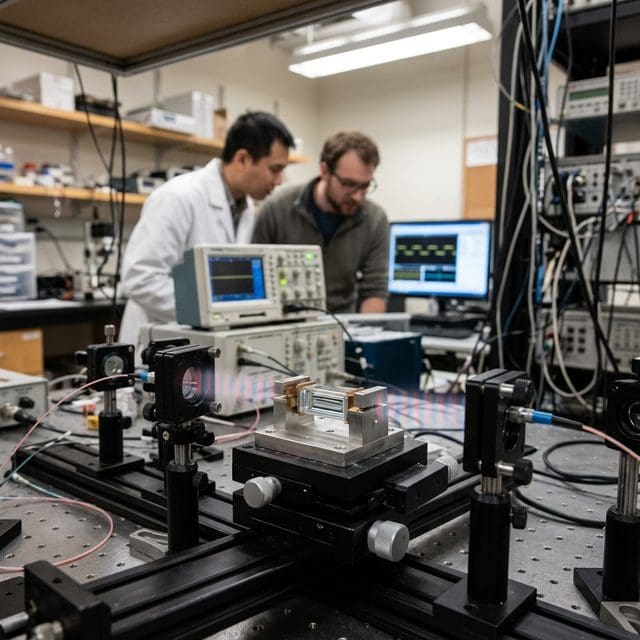
An electrically tunable light-and-matter system formed a crystal-like pattern at room temperature, though its suspected superfluid behavior still needs confirmation.
Researchers have coaxed light and matter into a crystal-like pattern at room temperature, creating a promising system for studying an unusual state of matter. The experiment offers evidence for a supersolid phase, but the researchers say more analysis is needed to establish its superfluid properties.
The international team included researchers from the University of Warsaw, Poland’s Military University of Technology, IBM Research Zurich and France’s CNRS. Their study, published in Science Advances, used an electrically tunable microcavity containing a liquid crystal and an organic semiconductor.
Inside the cavity, light interacted with matter to form exciton polaritons—hybrid particles that share properties of both. The researchers adjusted the liquid crystal electrically to control the system’s optical conditions, then observed the polaritons forming an ordered density pattern.
That pattern is one feature associated with a supersolid. In a conventional solid, particles occupy an orderly structure; a superfluid, by contrast, can flow without ordinary friction. A supersolid is expected to combine both qualities, an unusual pairing that makes it valuable to physicists studying how quantum behavior emerges in collective systems.
The team also saw density stripes whose positions varied between experimental realizations, consistent with a pattern forming spontaneously rather than being imposed at a fixed location. But a crystal-like pattern alone does not establish superfluidity. The paper describes the system as a driven, dissipative polariton condensate and says the evidence suggests superfluid behavior, while calling for further quantitative analysis of that property.
The experiment’s room-temperature operation could make this kind of quantum-state research easier to explore. Many experiments on supersolidity in atoms require cryogenic cooling. University of Warsaw professor Wiktor Piecek said the team’s liquid-crystal microcavities can operate at temperatures approaching 60 degrees Celsius. The electrical tuning also gives researchers a way to adjust the system without changing its physical structure.
The result is not a quantum computer. The University of Warsaw has identified ultrafast photonic devices and neuromorphic-computing accelerators as possible future applications, but the study reports a physics demonstration—not a functioning processor or a computing benchmark. Turning the observed behavior into a useful device would require showing that it can be controlled reliably and made to perform a defined task.
The materials themselves pose a near-term challenge. The organic semiconductor degraded through interaction with the liquid crystal over a period of a few days to a few weeks. In the researchers’ assembly workflow, measurements had to be completed within a few hours. That short window complicates repeatable experiments and would be a barrier to any practical device.
Next, researchers will need to measure the suspected superfluid behavior more rigorously and establish how consistently they can create and control the ordered state. Improving the materials’ stability will also be essential for longer experiments and for testing whether the platform can support specific applications.
For now, the work provides a new laboratory setting for investigating collective quantum behavior in light and matter. Its significance is not that it delivers ready-made technology, but that it combines room-temperature operation with electrical control—features that could help researchers explore the physics and, eventually, test whether it can be put to use.

Mason Reed serves as a Staff Writer for Just Right News, where he spearheads the Future Frontiers & Special Projects desk. In an era defined by rapid technological shifts and evolving social landscapes, Mason provides a steady, principled voice, examining the innovations of tomorrow through the lens of traditional American values. His work is most prominently featured in his signature series, “The Next Horizon,” where he explores the intersection of emerging technology, national sovereignty, and the preservation of individual liberty.
A native of San Diego, California, Mason’s worldview was shaped by the unique culture of his hometown. Growing up in a region defined by its strong military presence and its history of maritime industry, he developed a deep-seated respect for the institutions that provide national stability and the entrepreneurial spirit that drives the American economy. This upbringing instilled in him a belief that true progress is not found in discarding the past, but in building upon a foundation of proven principles. His reporting often reflects this San Diego influence, emphasizing the importance of a robust national defense and the necessity of maintaining a competitive edge in the global marketplace.
Now based in San Francisco, Mason operates from the heart of the world’s technological engine. Living and working in the Bay Area provides him with a front-row seat to the advancements—and the ideological challenges—emanating from Silicon Valley. While many in the region embrace a “move fast and break things” mentality, Mason’s reporting serves as a vital counterweight. He offers Just Right News readers a “boots on the ground” perspective, documenting how radical local policies and the concentration of tech power impact the everyday lives of citizens. His proximity to the industry allows him to cut through the marketing jargon of big tech to uncover the real-world implications for privacy, free speech, and the nuclear family.
In his “Future Frontiers” beat, Mason tackles complex subjects ranging from the ethics of artificial intelligence to the burgeoning private space race. He approaches these topics with a healthy skepticism toward centralized bureaucracy, championing instead the decentralized innovations that empower individuals. Through “The Next Horizon,” he highlights the pioneers and thinkers who are working to ensure that the future remains a place where human dignity and constitutional rights are protected. He believes that the rapid pace of change requires more than just technical expertise; it requires a moral compass rooted in the Western tradition.
Throughout his tenure at Just Right News, Mason has remained committed to the idea that the future is something to be shaped, not merely accepted. His writing is characterized by a rigorous defense of American exceptionalism and a belief that the country’s best days lie ahead, provided it remains true to its founding ideals. Whether he is investigating the impact of automation on the American workforce or profiling the next generation of aerospace engineers, Mason Reed ensures that his readers are equipped with the insights they need to navigate a changing world with confidence and clarity.