

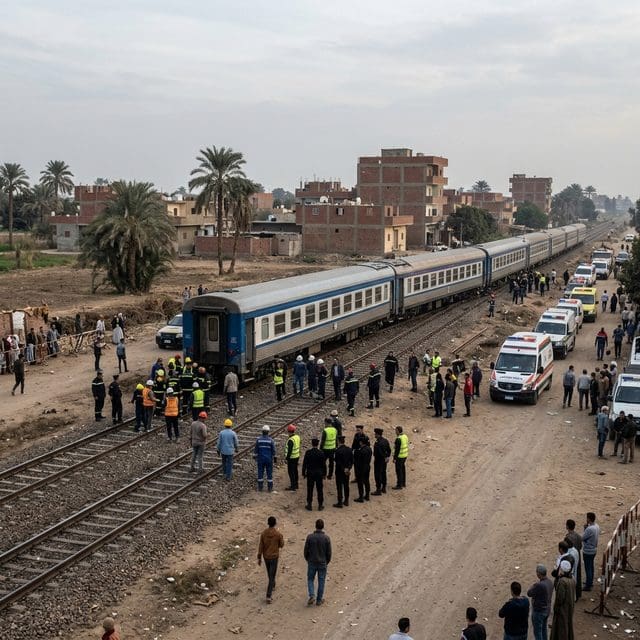
Egypt’s health ministry reported four deaths and 88 injuries after two passenger trains collided in Giza, as authorities opened an investigation and key details remained unreported.
Two passenger trains collided Sunday in Egypt’s Giza province, killing at least four people and injuring 88, according to the country’s health ministry. The crash occurred in Al-Ayyat, about 76 kilometers south of Cairo, reports from The Straits Times and The Hindu said.
The two accounts, published on November 8, describe the same collision and cite the health ministry’s casualty figures. They establish the reported toll and location, but offer few details about the circumstances. Neither report identifies the trains, says whether they were traveling in the same direction, or describes the sequence of events before impact.
Egyptian authorities have launched an investigation into the cause, The Hindu reported. The available reports do not say what investigators have examined, whether railway staff or passengers have been interviewed, or when findings might be released. They do not attribute the collision to equipment failure, signaling, track conditions, human error or any other factor. Until investigators provide evidence, assigning a cause would go beyond what is known.
The reports also leave the immediate medical response largely undescribed. They do not say where injured passengers were taken, how many remained hospitalized, or whether anyone was in critical condition. No account from an emergency service or hospital appears in the supplied material, and there is no description of rescue operations or treatment. The reported 88 injuries indicate a significant number of people needed medical attention, but the figure alone does not reveal the severity of the injuries or the demands placed on local health services.
The Hindu noted that Al-Ayyat was the site of Egypt’s worst-ever rail disaster. That history makes the location notable, but the brief report does not detail the earlier disaster or establish any connection between it and Sunday’s collision. The historical reference is not evidence that the same safety conditions or causes were present this time. Investigators’ findings will be needed to determine what, if anything, the two events have in common.
Other basic questions remain unanswered in the source material: whether rail service was suspended, whether the crash affected nearby routes, what immediate safety steps were taken, and whether authorities have revised the initial casualty count. The reports do not state whether all passengers have been accounted for. These gaps matter because an early toll can describe the immediate aftermath without fully documenting the human consequences or the response that followed.
The health ministry’s figures provide a snapshot, not a complete account of the injured passengers’ recovery. Without details from hospitals or emergency responders, the scale and duration of care cannot be assessed. Nor do the reports describe whether nearby medical facilities had adequate capacity, faced shortages, or needed assistance. It would be inaccurate to conclude from the information available that the crash overwhelmed local services—or that the response proceeded without difficulty.
For American audiences, the confirmed news is limited to the collision, the reported deaths and injuries, and the opening of an inquiry. The source material identifies no U.S. connection, effect on Americans, or international aid response. It also does not link the crash to a World Health Organization program, pandemic preparedness, climate impacts or a broader development initiative. The available facts do not support broader conclusions about rail safety across Egypt or in other countries.
The collision appeared among recent headlines gathered in a search focused on global health, pandemics, climate and development. Other items in that roundup, including university arts events and entertainment coverage, provide no further information about the Egyptian crash. The train collision is the clearest health-related event in the supplied reporting, but coverage remains brief and focused chiefly on the initial casualty count.
Further statements from investigators, hospitals and emergency services could clarify the cause, the response and the condition of those injured. For now, the ministry’s reported figures and the existence of an investigation are the main established facts. Al-Ayyat’s history makes the inquiry consequential, but does not itself explain what happened Sunday.

Rachel Vaughn serves as a Senior Correspondent for Just Right News, where she leads the network’s coverage of Global Health, Climate, and Development. With a career defined by intellectual rigor and a commitment to principled reporting, Rachel provides a vital conservative perspective on some of the most complex and high-stakes issues facing the world today. Her work is characterized by a refusal to accept bureaucratic narratives at face value, focusing instead on how international policies impact national sovereignty, individual liberty, and the American taxpayer.
Raised in New Haven, Connecticut, Rachel grew up in an environment dominated by elite academic discourse. This upbringing provided her with a front-row seat to the inner workings of the American establishment, but it also instilled in her a healthy skepticism of the “ivory tower” consensus. She learned early on that while academic theories may sound promising in a lecture hall, they often fail to account for the practical realities of the working class. This background drives her to bridge the gap between high-level policy discussions and the common-sense concerns of everyday citizens, ensuring that her reporting remains grounded and accessible.
Now based in Burlington, Vermont, Rachel operates from a unique vantage point within one of the nation’s most progressive political landscapes. Living and working in a region that often serves as a testing ground for radical social and environmental experiments allows her to witness the real-world consequences of these policies firsthand. From her base in the Green Mountain State, she provides Just Right News readers with essential “boots on the ground” reporting, documenting the friction between local mandates and the constitutional freedoms of the individual. Her presence in Burlington ensures that her critiques of globalist agendas are informed by a direct understanding of how those ideologies manifest at the local level.
In her acclaimed feature series, “Planetary Stakes,” Rachel explores the intersection of international development and environmental stewardship. She rejects the alarmism often found in mainstream media, opting instead for a sober analysis of the economic and geopolitical costs of global climate agreements. Her reporting frequently highlights the importance of market-driven innovation and the role of American leadership in fostering global health without ceding authority to unelected international bodies. Through “Planetary Stakes,” she has become a leading voice for those who believe that true conservation and public health are best achieved through transparency, accountability, and the protection of private property rights.
Throughout her tenure at Just Right News, Rachel has distinguished herself as a journalist who is unafraid to ask difficult questions of global institutions. Whether she is investigating the influence of non-governmental organizations on domestic policy or analyzing the fiscal transparency of international health initiatives, her goal remains the same: to provide her audience with the facts necessary to navigate an increasingly interconnected world. Her blend of East Coast intellectual heritage and her current immersion in the political heart of the Northeast makes her an indispensable asset to the newsroom and a trusted source for readers seeking a principled, conservative take on the issues that define our era.