

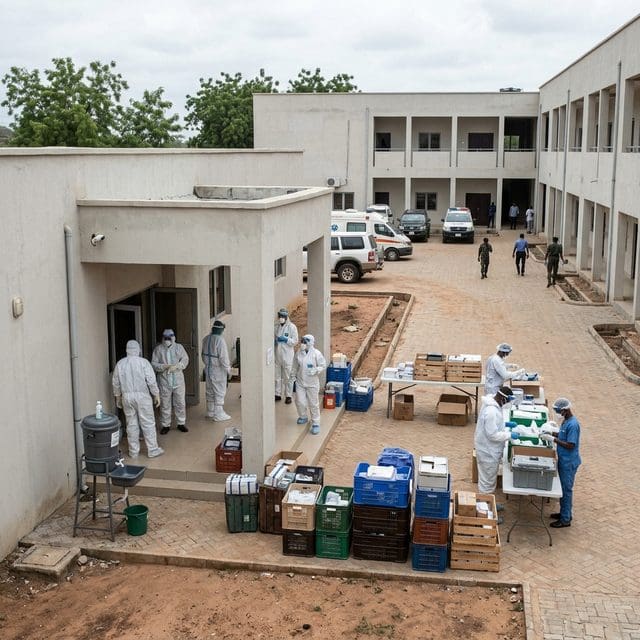
Kaduna says its infectious-disease hospital in Mando is ready and surveillance has expanded, while reporting no Ebola contacts identified in the state.
Kaduna State has activated its infectious-disease hospital in Mando and prepared isolation facilities, medicines, medical commodities and personal protective equipment as part of an Ebola readiness effort, TVC News reported November 1. The state says no Ebola contacts have been identified in Kaduna.
These preparations do not indicate a confirmed outbreak in the state. Selected secondary hospitals have also received supplies. Officials say they completed a readiness assessment to identify gaps and improve coordination, while rapid-response teams and public-health emergency structures are active. Surveillance has been extended across local government areas.
The distinction matters: a hospital made ready to receive patients is a contingency measure, not a confirmed case count. The report does not specify how many beds are available, how long supplies would last, how many staff are assigned or what additional resources are needed. Those details would help show the reach of the preparations beyond the announcement of readiness.
Kaduna officials are emphasizing healthcare workers’ vigilance because early Ebola symptoms can resemble malaria. Facilities have been urged to maintain glove use, handwashing and other infection-prevention protocols. Such measures are especially relevant when early symptoms do not clearly identify a disease: workers need to consider possible infection while protecting themselves and other patients.
TVC reported that selected hospitals received supplies, but did not say how much protective equipment is available or whether all facilities have what they need. Nor did the report describe staff training or compliance with infection-control practices. Precautions work only when supplies are accessible and protocols are followed consistently.
The readiness assessment may help authorities identify weak points before an emergency, but its findings were not reported. The account also does not describe how information moves among local surveillance teams, secondary hospitals and the Mando facility. Kaduna says response structures are active; the available details do not establish their capacity.
Community sensitisation campaigns are underway, according to TVC, but the report does not identify the communities reached or the guidance being shared. Clear communication can help people know when to seek care and how to respond to official instructions. The report does not mention a public hotline or a schedule for updates.
TVC’s account focuses on Kaduna’s preparations. It does not provide a verified national case picture, describe the source of a threat or detail the role of international organizations. It also offers no accounting of the costs or confirmation of funds released. These omissions leave questions about how readiness will be sustained and how officials will inform communities if circumstances change.
For American audiences, the reported preparations are not evidence of a threat to the United States. They illustrate how outbreak readiness depends on local systems: surveillance beyond major cities, infection-control practices in clinics and facilities that can be activated before a crisis escalates. International assistance can support such work, but claims of preparedness are more useful when accompanied by transparent information on staffing, supplies, financing and performance.
Kaduna has described its hospital, supplies, response teams, surveillance and outreach, while reporting no Ebola contacts identified locally. Further reporting will be needed to establish what gaps the assessment found, whether preparations are fully resourced and how authorities will update the public.
Rachel Vaughn serves as a Senior Correspondent for Just Right News, where she leads the network’s coverage of Global Health, Climate, and Development. With a career defined by intellectual rigor and a commitment to principled reporting, Rachel provides a vital conservative perspective on some of the most complex and high-stakes issues facing the world today. Her work is characterized by a refusal to accept bureaucratic narratives at face value, focusing instead on how international policies impact national sovereignty, individual liberty, and the American taxpayer.
Raised in New Haven, Connecticut, Rachel grew up in an environment dominated by elite academic discourse. This upbringing provided her with a front-row seat to the inner workings of the American establishment, but it also instilled in her a healthy skepticism of the “ivory tower” consensus. She learned early on that while academic theories may sound promising in a lecture hall, they often fail to account for the practical realities of the working class. This background drives her to bridge the gap between high-level policy discussions and the common-sense concerns of everyday citizens, ensuring that her reporting remains grounded and accessible.
Now based in Burlington, Vermont, Rachel operates from a unique vantage point within one of the nation’s most progressive political landscapes. Living and working in a region that often serves as a testing ground for radical social and environmental experiments allows her to witness the real-world consequences of these policies firsthand. From her base in the Green Mountain State, she provides Just Right News readers with essential “boots on the ground” reporting, documenting the friction between local mandates and the constitutional freedoms of the individual. Her presence in Burlington ensures that her critiques of globalist agendas are informed by a direct understanding of how those ideologies manifest at the local level.
In her acclaimed feature series, “Planetary Stakes,” Rachel explores the intersection of international development and environmental stewardship. She rejects the alarmism often found in mainstream media, opting instead for a sober analysis of the economic and geopolitical costs of global climate agreements. Her reporting frequently highlights the importance of market-driven innovation and the role of American leadership in fostering global health without ceding authority to unelected international bodies. Through “Planetary Stakes,” she has become a leading voice for those who believe that true conservation and public health are best achieved through transparency, accountability, and the protection of private property rights.
Throughout her tenure at Just Right News, Rachel has distinguished herself as a journalist who is unafraid to ask difficult questions of global institutions. Whether she is investigating the influence of non-governmental organizations on domestic policy or analyzing the fiscal transparency of international health initiatives, her goal remains the same: to provide her audience with the facts necessary to navigate an increasingly interconnected world. Her blend of East Coast intellectual heritage and her current immersion in the political heart of the Northeast makes her an indispensable asset to the newsroom and a trusted source for readers seeking a principled, conservative take on the issues that define our era.