

A Princeton public seminar examines global health challenges as two candidate vaccines prepare to join a trial targeting Bundibugyo Ebola in the Democratic Republic of the Congo.
A public seminar at Princeton University is putting a broad question on the table: where is global health advancing, and where is it falling behind? The question has immediate relevance as researchers prepare to test two candidate vaccines during an Ebola outbreak in the Democratic Republic of the Congo, while the World Health Organization also reports a worldwide setback in adolescent physical activity.
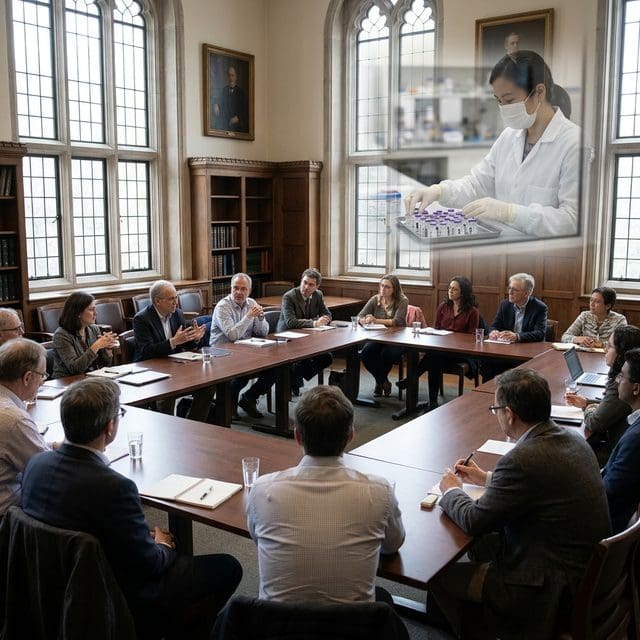
Princeton’s Director’s Seminar Series scheduled “Global Existential Challenges: Global Health — Advances and Setbacks” for 11:45 a.m. on Nov. 5 in A71 of the Louis A. Simpson International Building. The session features Pascaline Dupas, James Raymo and Alyssa Sharkey, with Deborah Yashar moderating, and is open to the public. The university’s event description presents the series as a forum for Princeton faculty to examine major questions from multidisciplinary and comparative perspectives.
The event listing does not specify the panelists’ positions on particular policies or outbreaks. Nor does the available information establish that the seminar will address the latest Ebola vaccine development. That distinction matters: an academic discussion can help frame difficult choices, but its announced topic should not be mistaken for a statement of the panel’s conclusions.
The vaccine development is a separate, concrete example of both progress and uncertainty. According to the UN and WHO, Oxford/Serum Institute’s ChAdOx1 vaccine and Moderna’s mRNA-1469 are due to join the Tumaini Ebola trial in the DRC, pending national approvals. It would be the first outbreak evaluation of vaccines specifically designed for Bundibugyo virus.
The approval condition is consequential. Research conducted during an outbreak depends not only on scientific readiness but also on decisions by the country where the trial takes place. National authorities must retain a meaningful role in determining whether and how research proceeds; local consent and oversight are not administrative hurdles to be waved away in the name of urgency.
The supplied information does not give case or death totals for the outbreak, nor does it establish the vaccines’ effectiveness. They are candidates entering an evaluation, not proven protection. Any claim about their likely impact would run ahead of the evidence available here. The trial’s significance is more limited but still notable: it creates an opportunity to assess two Bundibugyo-specific approaches in an outbreak setting.
The American stake is practical rather than a claim that every global-health problem affects every American in the same way. Outbreaks can demand international coordination and scientific resources, and vaccine research can add evidence useful to future public-health decisions. But the sources provided do not quantify a direct risk to the United States or estimate what the trial will cost. Those limits deserve to remain visible in policy debates about foreign aid and preparedness, where public commitments should be paired with clear accounting of objectives, oversight and results.
A separate WHO report, dated Nov. 4, adds a longer-term concern: one in four adolescents worldwide had no active days during the previous week. The figure describes a broad public-health challenge, but the report detail supplied here does not identify causes, differences among countries or the interventions WHO recommends. It therefore cannot, on its own, support a single global prescription.
Taken together, the developments illustrate why “advances and setbacks” is a useful frame, not a verdict. A new trial may generate needed evidence, while a global activity measure signals a problem whose causes and remedies require more detail. Princeton’s seminar offers a public setting for examining those trade-offs. The harder test for governments and international institutions will be whether programs respect national decision-making, disclose their costs and show what measurable results they deliver.

Rachel Vaughn serves as a Senior Correspondent for Just Right News, where she leads the network’s coverage of Global Health, Climate, and Development. With a career defined by intellectual rigor and a commitment to principled reporting, Rachel provides a vital conservative perspective on some of the most complex and high-stakes issues facing the world today. Her work is characterized by a refusal to accept bureaucratic narratives at face value, focusing instead on how international policies impact national sovereignty, individual liberty, and the American taxpayer.
Raised in New Haven, Connecticut, Rachel grew up in an environment dominated by elite academic discourse. This upbringing provided her with a front-row seat to the inner workings of the American establishment, but it also instilled in her a healthy skepticism of the “ivory tower” consensus. She learned early on that while academic theories may sound promising in a lecture hall, they often fail to account for the practical realities of the working class. This background drives her to bridge the gap between high-level policy discussions and the common-sense concerns of everyday citizens, ensuring that her reporting remains grounded and accessible.
Now based in Burlington, Vermont, Rachel operates from a unique vantage point within one of the nation’s most progressive political landscapes. Living and working in a region that often serves as a testing ground for radical social and environmental experiments allows her to witness the real-world consequences of these policies firsthand. From her base in the Green Mountain State, she provides Just Right News readers with essential “boots on the ground” reporting, documenting the friction between local mandates and the constitutional freedoms of the individual. Her presence in Burlington ensures that her critiques of globalist agendas are informed by a direct understanding of how those ideologies manifest at the local level.
In her acclaimed feature series, “Planetary Stakes,” Rachel explores the intersection of international development and environmental stewardship. She rejects the alarmism often found in mainstream media, opting instead for a sober analysis of the economic and geopolitical costs of global climate agreements. Her reporting frequently highlights the importance of market-driven innovation and the role of American leadership in fostering global health without ceding authority to unelected international bodies. Through “Planetary Stakes,” she has become a leading voice for those who believe that true conservation and public health are best achieved through transparency, accountability, and the protection of private property rights.
Throughout her tenure at Just Right News, Rachel has distinguished herself as a journalist who is unafraid to ask difficult questions of global institutions. Whether she is investigating the influence of non-governmental organizations on domestic policy or analyzing the fiscal transparency of international health initiatives, her goal remains the same: to provide her audience with the facts necessary to navigate an increasingly interconnected world. Her blend of East Coast intellectual heritage and her current immersion in the political heart of the Northeast makes her an indispensable asset to the newsroom and a trusted source for readers seeking a principled, conservative take on the issues that define our era.