

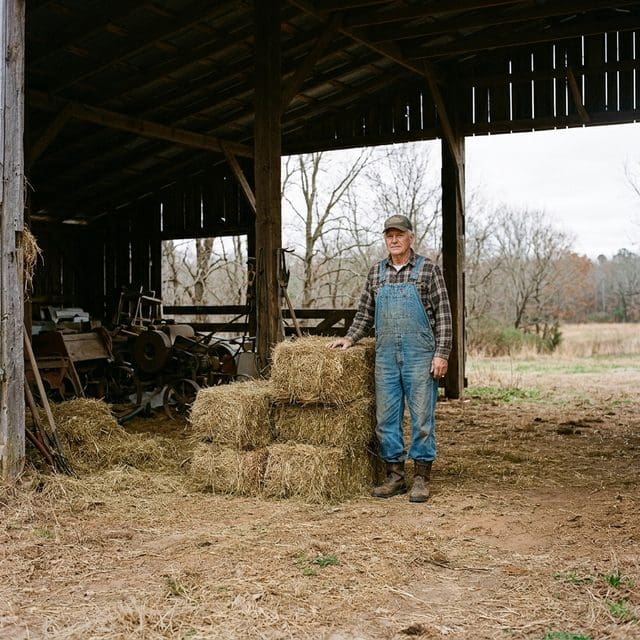
A Central North Carolina farmer told ABC11 his hay harvest fell to about one-third of normal as dry soils delay planting and forecast rain offers little expected relief.
Months of dry weather are cutting farm production across Central North Carolina, leaving some growers with less hay and fewer crops for customers while raising the cost of an already difficult season.
Fuquay-Varina farmer John Burt told ABC11 on Nov. 6 that his hay yield was roughly one-third of normal. His barn held about 1,000 to 1,200 bales, compared with more than 3,000 in a typical year. Burt said some customers may be unable to get hay this year.
ABC11 reported that many farmers were producing less than half their usual crop yields. Burt also cited rising diesel and fertilizer costs, which add to the pressure of a poor harvest. The reporting does not specify how many farms or customers may face shortages, but Burt’s bale count shows the scale of the shortfall at his operation.
Dry conditions are affecting planting as well as harvests. Johnston County Extension told ABC11 that soils were extremely dry and some wheat farmers were delaying planting while waiting for rain. The reports do not quantify how many farms or acres are affected.
ABC11 said Raleigh-Durham International Airport had received no measurable rain since Oct. 17, and reported the greatest coverage of extreme drought in North Carolina since July. Forecast rainfall totals were expected to remain at one inch or less. Rain could offer short-term relief, but the station said it was not expected to significantly improve drought conditions.
Limited rainfall may not restore soil moisture after a prolonged dry spell. The available reporting does not provide a verified statewide rainfall-deficit total or reservoir levels, so it does not establish the effect on water supplies beyond farms.
The immediate evidence is agricultural: reduced hay, lower crop yields, and planting delays. The reports do not establish that household drinking water is unsafe, food has been contaminated, or pesticides or other pollutants have been detected. Drought raises practical concerns about water availability and farm operations, but is not itself proof of a food-safety or water-quality failure.
The source material also documents no specific response by state or federal regulators, including the Environmental Protection Agency. It contains no agency testing results, emergency water notices, or enforcement actions to evaluate. The available reporting therefore describes a weather and production problem, not a documented regulatory failure involving contamination. It provides no basis for attributing the dry conditions to a particular environmental policy or cause.
For families and communities, the distinction matters. Farmers face concrete production losses and higher operating costs; consumers could eventually feel effects from tighter local supplies, but the reports do not quantify impacts on food prices or availability. Burt’s concern about hay customers is a potential local shortage, not evidence of a regionwide supply disruption.
Useful indicators in the coming weeks will include sustained rainfall, soil conditions, planting progress, and updates from agricultural extension offices and water managers. ABC11’s reporting suggests that limited forecast rain is unlikely to reverse the strain farmers are already describing. Verified information on reservoirs and public-water supplies would help clarify whether drought is affecting households and infrastructure as well as farms; that information is not established in the cited reports.

Eric Nolan serves as the Senior Correspondent for Food, Water, and Environmental Health at Just Right News, where he brings a principled, common-sense perspective to the most fundamental issues facing the American public. With a career dedicated to uncovering the truth behind the policies that govern our natural resources, Eric has become a trusted voice for readers who value traditional stewardship over bureaucratic overreach. His reporting is defined by a commitment to the idea that true environmentalism is rooted in the protection of the American family and the preservation of the nation’s agricultural heritage.
Raised in Fresno, California, Eric’s worldview was shaped in the heart of the San Joaquin Valley. Growing up in one of the world’s most productive agricultural hubs, he witnessed firsthand the vital connection between the land, the water, and the dinner table. In Fresno, he saw the resilience of farmers and the devastating impact that distant, top-down regulations can have on local communities. This upbringing instilled in him a deep respect for the producers who feed the country and a lifelong skepticism toward the alarmist narratives often pushed by mainstream media. For Eric, environmental health is not an abstract political talking point; it is a matter of ensuring that the people who work the land have the freedom and the resources to do so effectively.
Now based in Eugene, Oregon, Eric operates from a unique vantage point in the Pacific Northwest. Living in a region often defined by intense environmental debate, he provides a necessary counter-narrative to the prevailing trends of the area. From his base in Eugene, he monitors the shifting tides of federal and state policies, ensuring that the voices of rural citizens and property owners are not drowned out by urban activism. His reporting often bridges the gap between the rugged realities of the outdoors and the legislative halls where decisions are made, offering a grounded perspective that prioritizes local sovereignty and practical solutions.
As the lead for the acclaimed feature series “Earth on the Table,” Eric explores the intricate journey of the American food supply. He tackles critical issues such as water rights, soil health, and food security through a lens of national stability and individual liberty. He believes that a healthy environment and a thriving economy are not mutually exclusive, but rather two sides of the same coin of national prosperity. His work consistently highlights how innovation and private-sector ingenuity are the most effective tools for ensuring clean water and a safe food supply, rather than the expansion of the administrative state.
At Just Right News, Eric’s reporting serves as a vital resource for those who seek accountability and transparency. Whether he is investigating the impact of federal land management on local economies or examining the safety of the national food infrastructure, his work remains anchored in the values of heritage and hard work. Eric Nolan continues to be a leading voice in environmental journalism, championing the belief that the best way to protect our natural resources is to empower the people who live and work closest to them.