

A rare particle decay reached evidence-level significance at CERN, while researchers in Warsaw reported a room-temperature supersolid state made from light–matter hybrids.
Two recent results point to different frontiers in physics: one probes nature’s smallest scales for hints of unknown particles or forces, while the other brings an unusual quantum state into room-temperature conditions. Neither is a finished revolution. Both are meaningful steps, and both come with important caveats.
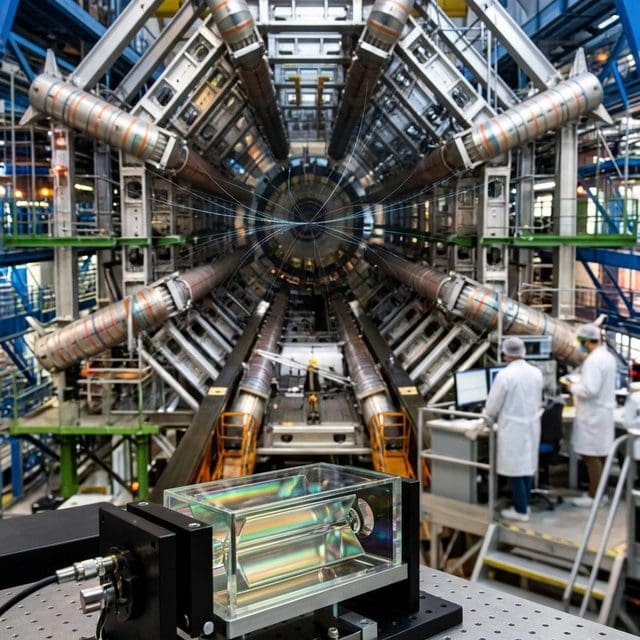
At CERN, the LHCb Collaboration reported evidence for a rare decay of a neutral beauty meson into two muons. The process, written as B₍d₎ → μ⁺μ⁻, is expected to occur only about once for every 10 billion beauty particles. The result combines new data from 2024–2025 with earlier measurements from 2011–2018.
The newer data alone reached 3.0 standard deviations of statistical significance; combining them with the earlier data raised the result to 3.2. In particle physics, that is enough to call the finding evidence, but it falls short of the conventional five-sigma threshold for a discovery. The distinction matters: a signal at this level is compelling enough to pursue, but researchers cannot rule out statistical fluctuation as confidently as they can at the discovery threshold.
The decay is interesting because it is rare and tightly constrained by the Standard Model, physicists’ best-tested account of fundamental particles and forces. If its measured behavior ultimately differs from predictions, the discrepancy could point indirectly to particles or forces not yet observed. The current result does not establish such a discrepancy or demonstrate new physics. It gives researchers another precise test to check as more data arrive.
The upgraded LHCb detector can collect data at up to five times its previous rate, according to reporting by Phys.org, with University of Manchester researchers contributing detector technology. More data could strengthen the statistical case, though additional measurements—not the present evidence alone—will determine whether the result reaches discovery-level significance.
A second report, published in Science Advances, concerns a supersolid: an uncommon state of matter that combines a repeating, crystal-like pattern with fluid-like behavior. Researchers from the University of Warsaw, the Military University of Technology, IBM Research Zurich and CNRS observed the state in an exciton-polariton Bose–Einstein condensate.
Exciton polaritons are short-lived hybrids of light and matter. In this experiment, a specially designed liquid crystal and an organic semiconductor were placed in an optical microcavity, allowing strong light–matter coupling at room temperature rather than at temperatures near absolute zero. The polaritons persist for only a few picoseconds before forming the condensate, making the observed organization all the more striking.
The evidence included two kinds of order at once: a periodic pattern in light intensity and a persistent spin helix, a recurring pattern in polarization. In simpler terms, the system showed both regularly spaced bright regions and an organized polarization pattern, while retaining the fluid-like properties associated with a condensate. The reports describe the operating condition as room temperature; they do not establish a precise temperature in degrees Celsius.
That distinction between a laboratory demonstration and a practical device is important. The work does not show a ready-made quantum computer or sensor. Researchers say room-temperature operation and the ability to control the liquid crystal’s optical properties with voltage could be useful for future ultrafast photonic devices, optical sensors or computing accelerators. Those applications remain possibilities to investigate, not results demonstrated by this experiment.
Together, the studies show how progress in physics often looks: a stronger statistical hint that demands confirmation, and a controlled experiment that makes a delicate quantum behavior accessible under less extreme conditions. The next tests are straightforward to state, even if difficult to achieve—more LHCb data, and further experiments to establish how reliably the room-temperature supersolid can be controlled and what useful functions it can perform.

Mason Reed serves as a Staff Writer for Just Right News, where he spearheads the Future Frontiers & Special Projects desk. In an era defined by rapid technological shifts and evolving social landscapes, Mason provides a steady, principled voice, examining the innovations of tomorrow through the lens of traditional American values. His work is most prominently featured in his signature series, “The Next Horizon,” where he explores the intersection of emerging technology, national sovereignty, and the preservation of individual liberty.
A native of San Diego, California, Mason’s worldview was shaped by the unique culture of his hometown. Growing up in a region defined by its strong military presence and its history of maritime industry, he developed a deep-seated respect for the institutions that provide national stability and the entrepreneurial spirit that drives the American economy. This upbringing instilled in him a belief that true progress is not found in discarding the past, but in building upon a foundation of proven principles. His reporting often reflects this San Diego influence, emphasizing the importance of a robust national defense and the necessity of maintaining a competitive edge in the global marketplace.
Now based in San Francisco, Mason operates from the heart of the world’s technological engine. Living and working in the Bay Area provides him with a front-row seat to the advancements—and the ideological challenges—emanating from Silicon Valley. While many in the region embrace a “move fast and break things” mentality, Mason’s reporting serves as a vital counterweight. He offers Just Right News readers a “boots on the ground” perspective, documenting how radical local policies and the concentration of tech power impact the everyday lives of citizens. His proximity to the industry allows him to cut through the marketing jargon of big tech to uncover the real-world implications for privacy, free speech, and the nuclear family.
In his “Future Frontiers” beat, Mason tackles complex subjects ranging from the ethics of artificial intelligence to the burgeoning private space race. He approaches these topics with a healthy skepticism toward centralized bureaucracy, championing instead the decentralized innovations that empower individuals. Through “The Next Horizon,” he highlights the pioneers and thinkers who are working to ensure that the future remains a place where human dignity and constitutional rights are protected. He believes that the rapid pace of change requires more than just technical expertise; it requires a moral compass rooted in the Western tradition.
Throughout his tenure at Just Right News, Mason has remained committed to the idea that the future is something to be shaped, not merely accepted. His writing is characterized by a rigorous defense of American exceptionalism and a belief that the country’s best days lie ahead, provided it remains true to its founding ideals. Whether he is investigating the impact of automation on the American workforce or profiling the next generation of aerospace engineers, Mason Reed ensures that his readers are equipped with the insights they need to navigate a changing world with confidence and clarity.