

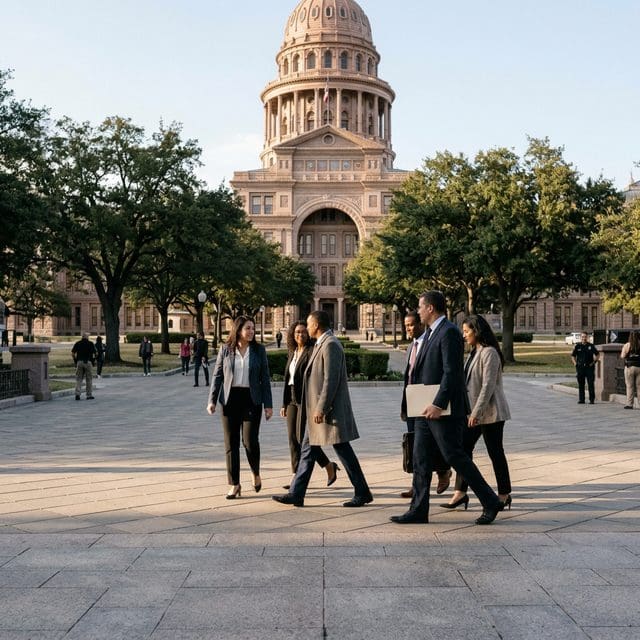
Texas Gov.-elect Gina Hinojosa is assembling an administration positioned to scrutinize the state’s voucher program, while legal limits leave major changes to lawmakers.
Texas Gov.-elect Gina Hinojosa is building a transition team that signals a coming contest over education policy, but she cannot undo the state’s new voucher program on her own. The limits show how state policy is shaped not just by a governor’s agenda, but by legislatures, local institutions and the powers assigned to each office.
On Nov. 5, Hinojosa named Joe Madden executive director of her transition team. Ryan Pollock of the Texas State Building and Construction Trades Council and former Republican Rep. Ernest Bailes will serve as co-chairs; former Austin Independent School District trustee Tamala Barksdale was named senior adviser. Hinojosa said additional appointments are expected in the coming weeks, KUT Radio reported.
The mix of labor, education and Republican participants points to a broad transition operation, but the appointments alone do not establish what policies the incoming administration will pursue. The education commissioner search is a more direct indication of an early priority: Hinojosa has pledged to remove Texas Education Agency Commissioner Mike Morath on her first day, and her team is actively interviewing a replacement. Morath’s term expires at the end of 2026.
The team is taking shape as Texas launches a major education experiment. The Texas Tribune reports that the program’s first year is funded at $1 billion. Participating private-school families qualify for about $10,500 annually, homeschoolers for up to $2,000, and children with disabilities for up to $30,000. More than 111,000 families are participating, and about 17% of recipients attended public schools in the 2024–25 school year.
Those figures show the program’s reach, but not whether it is improving educational outcomes. The share of recipients who previously attended public school indicates some families are shifting from the public system, though it does not by itself explain why families enrolled or what results students will achieve. Republican Sen. Paul Bettencourt has said lawmakers should review results from the 2026–27 school year before deciding what to change. Supporters and critics will have to assess evidence as families use the program, rather than treating participation alone as proof of success or failure.
The state’s education authority has also been visible in local school governance. Since 2023, Morath has appointed management boards in seven districts, putting state authority in direct tension with locally elected leadership. A new commissioner could alter the administration’s approach, but the transition team has not announced a position on those interventions. The interviews offer no indication yet of how a successor would approach them.
Hinojosa’s options on vouchers are substantial but limited. She cannot repeal the program unilaterally. She could veto future voucher legislation or use a line-item veto to target education-savings-account funding in the next budget. Overriding a veto would require two-thirds majorities in both legislative chambers. That means any effort to change the program would depend not only on executive priorities but also on lawmakers’ willingness to revise the law or budget.
Incoming Comptroller Sarah Eckhardt has said she will audit voucher spending and expand public disclosure, while acknowledging that a major overhaul requires lawmakers. Audits and disclosure could provide information for families and legislators weighing the program, but they would not themselves repeal or redesign it. The governor, comptroller and Legislature have different responsibilities: vetoes, oversight and changes to the law. A transition-team pledge is not itself a policy change; the program’s future will depend on budget decisions and legislative action as well as its results.
A separate development highlights the role of private investment in Texas. Elon Musk said Nov. 6 that Tesla plans to wind down Cybertruck production at Gigafactory Texas around mid-2027 to make room for increased Cybercab production. Reuters reported it remains unclear whether Cybertruck production will move elsewhere or end entirely. Austin is the only known Tesla facility equipped for the truck’s specialized components.
The plan does not establish a broader trend in Texas or signal a change in state policy. It does illustrate that companies can alter production plans even as states compete for investment. The more direct political test for Hinojosa will be whether she can use the powers of her office—and persuade lawmakers—to reshape the state’s education policy.

Dylan Brooks serves as the Senior Correspondent for Statehouses and Local Governance at Just Right News, where he brings a principled, constitutionalist lens to the often-overlooked machinery of state-level politics. As the lead voice behind the acclaimed feature series “Fifty Laboratories of Power,” Dylan has dedicated his career to the idea that the most impactful governance happens closest to home. His reporting consistently champions the Tenth Amendment, exploring how individual states can serve as testing grounds for innovative, conservative policy solutions that prioritize personal liberty and fiscal responsibility.
A native of Des Moines, Iowa, Dylan’s journalistic philosophy was forged in the heart of the American Midwest. Growing up in a community where local school board meetings and town halls were the bedrock of civic life, he developed a deep appreciation for the “retail politics” of the heartland. This upbringing instilled in him a fundamental belief that the American experiment is best preserved when power is decentralized. He carries the values of his Iowa roots into every assignment, maintaining a healthy skepticism of federal overreach and a steadfast commitment to the concerns of everyday citizens over the interests of the administrative state.
Now based in Madison, Wisconsin, Dylan operates from one of the nation’s most pivotal political battlegrounds. His location in a state capital known for its rigorous policy debates allows him to provide Just Right News readers with a front-row seat to the legislative process. From Madison, he tracks the ripple effects of statehouse decisions on local municipalities, ensuring that the connection between high-level policy and community impact is never lost. His work often highlights the success of conservative governors and legislatures in fostering economic growth, protecting parental rights, and securing the integrity of local institutions.
As an African American man in the conservative media landscape, Dylan offers a vital perspective on how limited government and free-market principles empower individuals and families. He frequently reports on how deregulation and school choice initiatives provide new avenues for success in underserved communities, challenging the monolithic narratives often presented by legacy media outlets. Dylan’s work is characterized by a commitment to the facts and a refusal to shy away from the complex realities of modern governance.
Throughout his tenure at Just Right News, Dylan has become a trusted authority for readers who value a rigorous, principled approach to the news. Whether he is dissecting a complex state budget or profiling a local grassroots movement, his goal remains the same: to provide the American public with the information they need to hold their local leaders accountable. By focusing on the “Fifty Laboratories of Power,” Dylan Brooks ensures that the vital work being done in statehouses across the country receives the national attention it deserves, always through a lens that respects the traditions and sovereignty of the American people.