

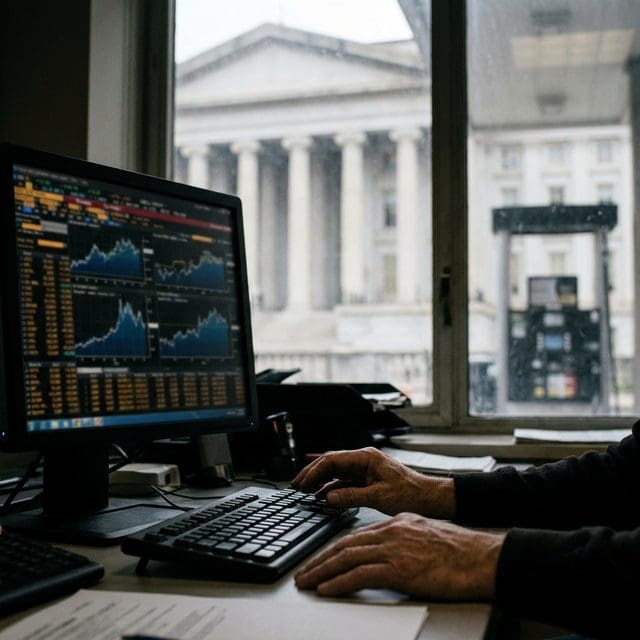
SPY is up 0.27%, but sharp recent swings in technology shares, unsettled oil risks and upcoming inflation and Treasury-auction dates complicate the market picture.
SPY is up 0.27% on the session, a modest gain against a volatile backdrop. The S&P 500 lost an estimated $2.9 trillion in market value on November 5, its largest one-day loss on record, as technology and AI-linked shares plunged. Chipmakers including Nvidia and AMD rebounded the following day. That sequence shows investors remain quick to reassess the technology shares that have helped drive the market.
Leadership across U.S. stocks has shifted from day to day. On November 4, the Dow Jones Industrial Average had its biggest rise in 18 months as oil prices plunged and bond yields fell. The subsequent selloff and chip-stock rebound show why a small gain in SPY is not, by itself, evidence of a broad recovery. The available reporting does not provide verified current-session closes or a complete measure of market breadth.
The swings reflect uncertainty about whether large technology companies’ AI spending will generate returns to match its scale. A rebound in chip shares after a sharp decline may indicate buyers returning, but it does not resolve questions about valuations or future earnings. When a handful of large companies weigh heavily in broad indexes, their performance can lift a benchmark while other shares lag. SPY’s move is a snapshot, not a measure of conditions across every sector.
Investors face two scheduled tests on November 10: October consumer-price data and a $42 billion auction of 10-year Treasury notes. A $25 billion auction of 30-year bonds follows on November 12. Inflation data can affect expectations for Federal Reserve policy, while auction demand offers a signal of investors’ appetite for U.S. government debt. The source material does not provide a verified current-session Treasury yield, so no direction for yields today can be established from it.
Those borrowing costs matter beyond financial markets. Treasury yields help shape rates across the economy, including some mortgage and business borrowing costs. If investors demand higher returns on government debt, financing conditions may tighten, though the effect on individual loan rates varies. The upcoming auctions and inflation report are events to watch, not guarantees of a particular market move or policy decision.
Oil has retreated from recent highs, but geopolitical risks remain. On November 6, WTI was reported at $89.93 a barrel, down 13.58% for the week, while Brent was near $97. Tanker attacks continued, Iran said the sides were “far from a deal,” and reported U.S. strike planning remained a risk. The fall in oil may ease pressure on fuel and transport costs if sustained; the continuing uncertainty leaves room for prices to rise again. Those figures describe November 6, not a verified quote for today.
For households, lower crude prices do not translate immediately or uniformly into cheaper fuel at the pump. Retail prices can adjust with a delay, and renewed supply concerns could reverse the relief. The material also lacks verified current-session figures for the dollar and foreign-exchange markets, so their direction should not be inferred.
The day’s limited positive signal is SPY’s 0.27% rise. The larger picture remains unsettled: technology stocks have swung sharply, oil has eased on the week but carries geopolitical risk, and inflation data and Treasury auctions are approaching. A stronger assessment of today’s market would require verified figures for index breadth, yields and currency moves.

Jordan Lee serves as the Senior Correspondent for Wall Street, Finance, and Monetary Systems at Just Right News. Based in the heart of the world’s financial capital, New York City, Lee brings a sharp, principled eye to the complex mechanisms that drive the global economy. His reporting is defined by a commitment to fiscal responsibility, the defense of the free market, and a deep-seated belief that a transparent monetary system is the bedrock of a free society.
Raised in Portland, Oregon, Lee’s perspective was forged in a city that has undergone significant cultural and economic shifts. His upbringing in the Pacific Northwest instilled in him a profound appreciation for the industriousness of small business owners and the importance of local economic stability. Watching the evolution of his hometown’s landscape sparked an early interest in how federal fiscal policy and large-scale financial trends eventually trickle down to the average citizen. This background provides him with a unique vantage point; he understands the growing disconnect between the policy-making elite and the reality of Main Street, a theme that frequently resonates throughout his work.
Now operating from his base in New York City, Lee bridges the gap between the high-stakes trading floors of Manhattan and the households of everyday Americans. He views the financial sector not merely as a collection of numbers and tickers, but as a vital engine of American prosperity that requires constant vigilance and accountability. His reporting often highlights the dangers of centralized financial control and the necessity of maintaining a system that rewards merit, risk-taking, and innovation.
As the creator and lead of the featured series, “The Invisible Economy,” Lee pulls back the curtain on the often-opaque world of monetary systems. He specializes in translating the dense jargon of central banking and international finance into actionable insights for the Just Right News audience. His work explores the “invisible” forces—such as inflationary pressures, regulatory creep, and the expansion of the administrative state—that erode the purchasing power of American families. By focusing on these systemic issues, Lee empowers readers to understand the hidden forces shaping their financial independence.
Lee’s journalistic philosophy is rooted in a steadfast commitment to traditional American values. As an Asian American professional who has navigated the competitive corridors of the financial world, he is a vocal advocate for meritocracy and the preservation of the American Dream. He believes that a stable currency and a predictable regulatory environment are essential for national sovereignty and individual liberty. His reporting frequently warns against the risks of government overreach in the private sector, arguing that the most effective solutions to economic challenges arise from competition and individual enterprise rather than bureaucratic mandates.
At Just Right News, Jordan Lee remains dedicated to providing a clear-eyed defense of the taxpayer. Whether he is analyzing market volatility or investigating the long-term implications of national debt, his mission is to provide the truth about where the money is going and what it means for the future of the country. Through his rigorous analysis and principled stance, Lee has become a trusted voice for those who value a strong, sovereign, and fiscally sound America.