

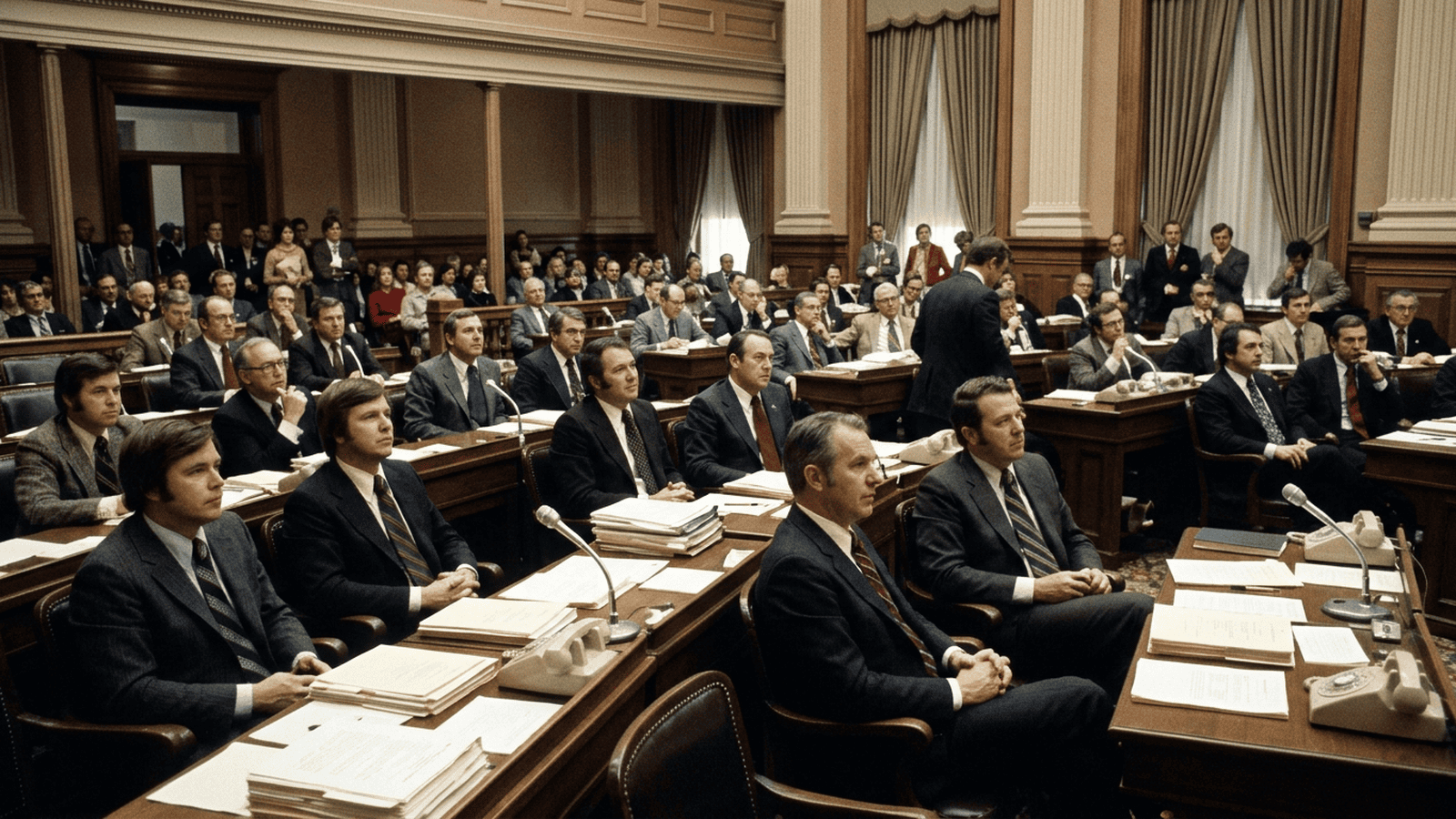
In 1974, Iowa Democrats won control of both legislative chambers while Republican Governor Robert D. Ray secured reelection, producing divided government. The result, part of a wider post-Watergate Democratic surge in the United States, shifted control of legislative leadership and agenda-setting without ending the need for bargaining.
TLDR: Iowa’s 1974 elections gave Democrats control of both chambers of the state legislature, even as Republican Governor Robert D. Ray won another term. The divided government shifted committee and agenda-setting power, requiring negotiation on budgets and public policy and reflecting the wider post-Watergate Democratic surge.
The 1974 midterm elections reshaped Iowa politics. Voters gave Democrats control of the state legislature, ending a long period of Republican dominance in the House and creating a divided government: Republican Governor Robert D. Ray remained in office while Democrats took charge of both legislative chambers. The result was part of a nationwide Democratic surge after the Watergate scandal, but it also reflected changing political concerns inside Iowa, from property taxes to public services and the future of rural communities. The outcome changed not only party labels but also which lawmakers could organize debate and move proposals through the chambers.
The national setting was unusually turbulent. President Richard Nixon had resigned in August, and voters went to the polls amid anger over Watergate, distrust of political leadership, and economic strain following inflation and the 1973 oil crisis. Democrats gained seats across the country. In Iowa, the shift translated into legislative power rather than a change in the governor’s office: Ray, a popular incumbent, won another term, while legislative races produced Democratic majorities in the House and Senate. The national backlash did not erase local judgments about candidates, and Ray’s victory underscored the distinction between state and federal political choices.
Republicans had held the Iowa House for years, and the change in control altered who set the chamber’s agenda. Democratic leaders gained the speakership, committee chairmanships, and the ability to decide which bills received hearings and floor votes. The Senate also came under Democratic control. Those organizational powers mattered: in a legislature where committees filter proposals and leadership schedules debate, a change in party balance can redirect policy even without a new governor. Committee scrutiny could reshape or delay a proposal before members considered it on the floor.
The election did not produce a single, uniform mandate. Iowa’s political landscape included urban voters, small towns, and farming communities with different priorities. Democrats could point to their new majorities, but they still had to negotiate with Ray, whose reelection showed that many voters supported his administration. The arrangement required bargaining between a Republican governor and Democratic legislative leaders on spending, taxes, education, and state services. Neither side could govern alone.
The transition also tested the practical mechanics of legislative leadership. New committee chairs had to assemble coalitions among members elected from varied districts, while Republicans adapted to minority status after years of directing the chamber. The change in power was not a constitutional overhaul or a sudden realignment of every Iowa voter. It was a parliamentary realignment: the parties’ positions inside the legislature changed, shifting control of procedure and negotiation as much as control of policy.
The Democratic majorities gave the party an opening to shape debates over the state budget and public programs, but the surviving Republican governorship kept those debates contested. Ray’s continued popularity showed the limits of treating the midterm as a simple referendum on national politics. Voters could reject the party associated with Watergate in legislative contests while retaining a governor they trusted. That split outcome made cooperation and compromise necessary in the statehouse.
The 1974 shift fits a broader pattern in which midterm elections can rearrange legislative power without replacing the executive. It also demonstrated how committee assignments, floor scheduling, and chamber leadership influence state policy. Democrats did not permanently secure control through one election; party balances changed again in later contests. Still, the takeover gave the party a consequential period to set legislative priorities and helped establish divided government as a defining feature of Iowa’s post-Watergate politics. The experience reinforced the value of legislative oversight and party accountability, as both sides had to defend their decisions before voters.

Dylan Brooks serves as the Senior Correspondent for Statehouses and Local Governance at Just Right News, where he brings a principled, constitutionalist lens to the often-overlooked machinery of state-level politics. As the lead voice behind the acclaimed feature series “Fifty Laboratories of Power,” Dylan has dedicated his career to the idea that the most impactful governance happens closest to home. His reporting consistently champions the Tenth Amendment, exploring how individual states can serve as testing grounds for innovative, conservative policy solutions that prioritize personal liberty and fiscal responsibility.
A native of Des Moines, Iowa, Dylan’s journalistic philosophy was forged in the heart of the American Midwest. Growing up in a community where local school board meetings and town halls were the bedrock of civic life, he developed a deep appreciation for the “retail politics” of the heartland. This upbringing instilled in him a fundamental belief that the American experiment is best preserved when power is decentralized. He carries the values of his Iowa roots into every assignment, maintaining a healthy skepticism of federal overreach and a steadfast commitment to the concerns of everyday citizens over the interests of the administrative state.
Now based in Madison, Wisconsin, Dylan operates from one of the nation’s most pivotal political battlegrounds. His location in a state capital known for its rigorous policy debates allows him to provide Just Right News readers with a front-row seat to the legislative process. From Madison, he tracks the ripple effects of statehouse decisions on local municipalities, ensuring that the connection between high-level policy and community impact is never lost. His work often highlights the success of conservative governors and legislatures in fostering economic growth, protecting parental rights, and securing the integrity of local institutions.
As an African American man in the conservative media landscape, Dylan offers a vital perspective on how limited government and free-market principles empower individuals and families. He frequently reports on how deregulation and school choice initiatives provide new avenues for success in underserved communities, challenging the monolithic narratives often presented by legacy media outlets. Dylan’s work is characterized by a commitment to the facts and a refusal to shy away from the complex realities of modern governance.
Throughout his tenure at Just Right News, Dylan has become a trusted authority for readers who value a rigorous, principled approach to the news. Whether he is dissecting a complex state budget or profiling a local grassroots movement, his goal remains the same: to provide the American public with the information they need to hold their local leaders accountable. By focusing on the “Fifty Laboratories of Power,” Dylan Brooks ensures that the vital work being done in statehouses across the country receives the national attention it deserves, always through a lens that respects the traditions and sovereignty of the American people.