

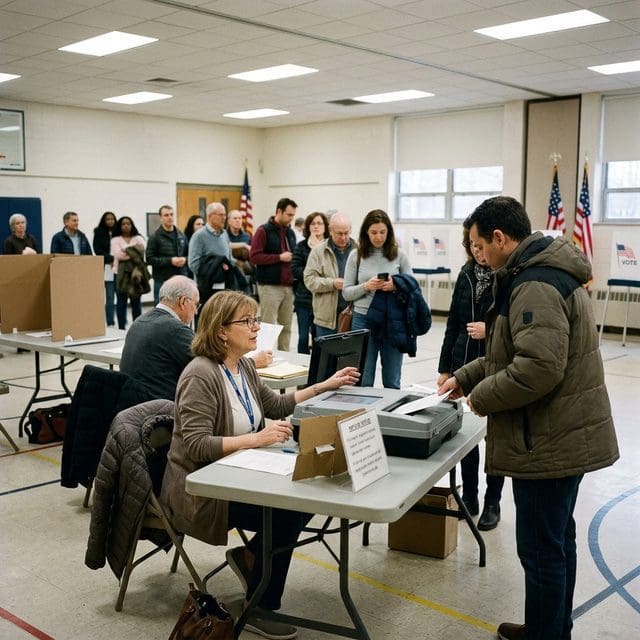
A reported ballot-scanner disruption in Westchester County put local election procedures under pressure, while available reporting leaves key details about its cause and scope unresolved.
A ballot-scanner glitch in Westchester County, New York, put local election operations under scrutiny Tuesday, offering a practical test of how county officials manage a problem where voters cast ballots and results are counted.
The United Press International headline reported that scanners at polling sites in the county experienced a glitch and that officials said ballots were safe. The material available for this report does not specify how many machines were affected, how long the disruption lasted, or what caused it. It also does not establish whether counting was delayed or whether the problem affected any contest.
Those limits matter. A malfunction at a polling place can prompt immediate concern, but a scanner problem alone does not show that ballots were lost, altered or excluded. Establishing what happened requires details about the equipment, the county’s backup procedures and the handling and counting of ballots. The source material does not provide that fuller account, so claims about the scale or consequences would be premature.
Westchester’s episode illustrates a defining feature of American election administration: much of the work is carried out by state and local authorities, not directed from Washington. States set election laws and oversee systems, while counties and other local jurisdictions handle essential operations such as staffing polling places and processing ballots. The division allows procedures to reflect local conditions, but it also means voters’ experience depends on whether local systems are prepared for equipment trouble and whether officials can explain their response.
The distinction is particularly relevant on a midterm election day. CBS News reported that all 435 seats in the U.S. House and 35 Senate seats were on the ballot, along with gubernatorial elections in 36 states. The scale of the contests puts local election administration in a larger political frame: county-level procedures support races for federal and state offices alike. A scanner problem does not by itself alter a statewide or congressional outcome, and the available reporting does not say that Westchester’s glitch changed one. But uncertainty about when ballots can be scanned or counted can attract attention beyond the polling site, especially when races are close.
The wider political stakes also sharpen scrutiny of election procedures. Donald Trump’s administration and state officials have been at odds over election-related matters, but the source material does not connect the Westchester malfunction to any federal directive, dispute or intervention. Nor does it describe a federal response. The immediate account is local: scanners glitched, and officials said ballots remained safe. There is no basis in the supplied reporting to characterize this as evidence of federal overreach or to attribute the equipment problem to a particular policy.
The practical questions for county and state officials remain straightforward: What backup process was used? Were voters able to continue casting ballots? How were ballots secured, and when would they be counted? Public answers would help distinguish an equipment interruption from a broader failure in election administration. The available material does not answer those questions, and the UPI headline alone cannot establish how the county’s safeguards worked in practice.
For states, election-day disruptions are a reminder that policy laboratories are not only places for lawmakers to try new rules. They are also systems tested under pressure, where planning, transparency and clear lines of responsibility matter. Local control brings responsibility close to voters, but it works best when local officials can demonstrate that contingencies are in place and explain them promptly. The available reporting on Westchester is too limited to judge its safeguards beyond the assurance that ballots were safe. It does show why confidence in elections depends on local competence—and on timely, verifiable explanations when the machinery of voting falters.

Dylan Brooks serves as the Senior Correspondent for Statehouses and Local Governance at Just Right News, where he brings a principled, constitutionalist lens to the often-overlooked machinery of state-level politics. As the lead voice behind the acclaimed feature series “Fifty Laboratories of Power,” Dylan has dedicated his career to the idea that the most impactful governance happens closest to home. His reporting consistently champions the Tenth Amendment, exploring how individual states can serve as testing grounds for innovative, conservative policy solutions that prioritize personal liberty and fiscal responsibility.
A native of Des Moines, Iowa, Dylan’s journalistic philosophy was forged in the heart of the American Midwest. Growing up in a community where local school board meetings and town halls were the bedrock of civic life, he developed a deep appreciation for the “retail politics” of the heartland. This upbringing instilled in him a fundamental belief that the American experiment is best preserved when power is decentralized. He carries the values of his Iowa roots into every assignment, maintaining a healthy skepticism of federal overreach and a steadfast commitment to the concerns of everyday citizens over the interests of the administrative state.
Now based in Madison, Wisconsin, Dylan operates from one of the nation’s most pivotal political battlegrounds. His location in a state capital known for its rigorous policy debates allows him to provide Just Right News readers with a front-row seat to the legislative process. From Madison, he tracks the ripple effects of statehouse decisions on local municipalities, ensuring that the connection between high-level policy and community impact is never lost. His work often highlights the success of conservative governors and legislatures in fostering economic growth, protecting parental rights, and securing the integrity of local institutions.
As an African American man in the conservative media landscape, Dylan offers a vital perspective on how limited government and free-market principles empower individuals and families. He frequently reports on how deregulation and school choice initiatives provide new avenues for success in underserved communities, challenging the monolithic narratives often presented by legacy media outlets. Dylan’s work is characterized by a commitment to the facts and a refusal to shy away from the complex realities of modern governance.
Throughout his tenure at Just Right News, Dylan has become a trusted authority for readers who value a rigorous, principled approach to the news. Whether he is dissecting a complex state budget or profiling a local grassroots movement, his goal remains the same: to provide the American public with the information they need to hold their local leaders accountable. By focusing on the “Fifty Laboratories of Power,” Dylan Brooks ensures that the vital work being done in statehouses across the country receives the national attention it deserves, always through a lens that respects the traditions and sovereignty of the American people.