

JinkoSolar reported 1.75 gigawatt-hours of third-quarter storage shipments and its first positive quarterly operating profit, while a UC Santa Barbara study finds August rainfall may help forecast low birthweight risk in West Africa.
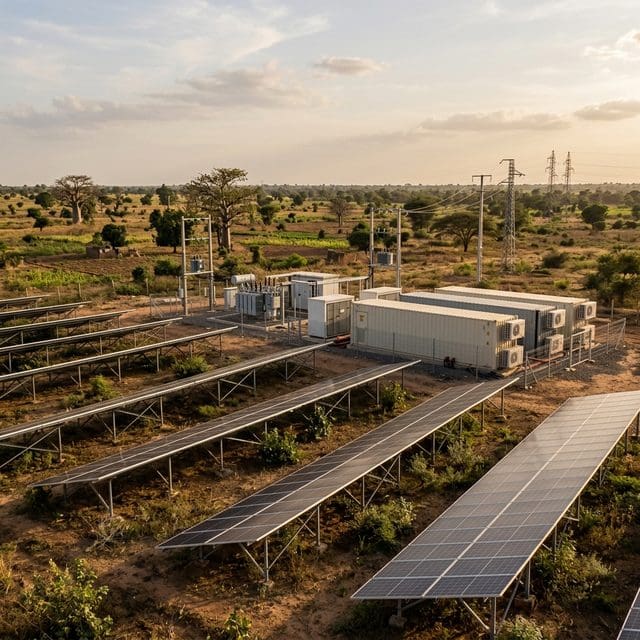
JinkoSolar’s energy-storage business recorded its first positive quarterly operating profit after shipments recognized as revenue reached approximately 1.75 gigawatt-hours in the third quarter, the company said. It maintained a full-year 2026 storage target of about 10 gigawatt-hours on a proof-of-delivery basis and forecast fourth-quarter solar-module shipments of 16 to 18 gigawatts.
The results mark a business milestone, but the available figures do not show whether the improvement is durable or how it compares with the costs and returns of the wider storage market. JinkoSolar did not provide a storage margin in the supplied information, nor details on what drove the profit. One positive quarter does not establish a longer-term trend.
Storage can complement solar generation by shifting electricity to times when output and demand do not coincide. Its value, however, depends on costs, operating conditions, charging opportunities and the price of electricity when discharged. The company’s shipment figures do not reveal how much equipment has been installed, what grid services it provides or how customers are using it. Shipments alone are not a measure of dependable power delivered to the grid.
The company’s guidance also covers two distinct product measures. The 10-gigawatt-hour annual storage target is based on proof of delivery; the 16-to-18-gigawatt fourth-quarter range concerns module shipments. Both are management targets, not guarantees of completed sales or installed capacity.
Other reported JinkoSolar revenue and earnings figures are inconsistent across outlets and could not be confirmed against a company filing. They are not a reliable basis for conclusions about the company’s overall financial performance or module economics.
Separately, UC Santa Barbara researchers examined how rainfall forecasting could inform public-health interventions in West Africa. Their method predicts the likelihood of low birthweights using climate and socioeconomic data. The study, published in the Proceedings of the National Academy of Sciences and co-authored by Shukla and Frank Davenport, found that rainfall during August alone produced forecast performance reasonably similar to using the full rainy season.
That result could give officials more lead time: subseasonal forecasts of August rainfall may help identify risks before the rainy season has run its course, the researchers said. But predictive performance is not proof that a forecast or a response to it will improve outcomes. The study does not establish which interventions would work, quantify their costs or measure the effects of acting on the model.
The two developments address different practical questions. For storage, the test is whether shipments translate into sustained returns and useful grid services at a cost customers can bear. For public-health forecasting, it is whether an earlier signal supports effective, affordable action. Each offers a reason to watch for follow-up evidence, not a settled case for broader investment.

Mark Davis serves as the Senior Correspondent for Energy, Climate, and Resource Economics at Just Right News. In an era where the conversation around the environment is often dominated by alarmism and top-down mandates, Mark provides a vital, market-oriented perspective on the complex forces shaping our world. As the lead voice behind the acclaimed feature series “Power and the Planet,” he explores the intersection of environmental policy, global energy markets, and the fundamental economic principles that sustain modern civilization.
Mark’s pragmatic approach to resource management was forged in the high desert of his hometown, Albuquerque, New Mexico. Growing up in a region defined by both its breathtaking natural beauty and its rugged, resource-dependent landscape, he developed an early appreciation for the delicate balance between conservation and utilization. New Mexico’s unique position as a hub for both traditional energy production and cutting-edge scientific research provided Mark with a front-row seat to the evolution of the American energy sector. This upbringing instilled in him a deep-seated belief that true environmental stewardship is inseparable from economic prosperity and technological innovation.
Now based in Boulder, Colorado, Mark operates from the heart of the nation’s climate research community. While Boulder is often seen as a bastion of environmental idealism, Mark utilizes his post to provide a necessary counterweight, grounded in the realities of resource economics. He understands that energy policy does not exist in a vacuum; it has tangible consequences for the American taxpayer, the stability of the national power grid, and the strength of the domestic manufacturing sector. By reporting from the front lines of the climate debate, he is able to challenge prevailing narratives with hard data and a commitment to the principles of the free market.
Throughout his tenure at Just Right News, Mark has distinguished himself by focusing on the “Resource Economics” aspect of his beat. He frequently highlights the hidden costs of rapid energy transitions and advocates for an “all-of-the-above” energy strategy that prioritizes American energy independence. His work often shines a light on the geopolitical implications of resource scarcity, arguing that a secure nation must first be an energy-secure nation. Whether he is analyzing the impact of federal land-use regulations or investigating the supply chains required for new technologies, Mark remains focused on how policy decisions affect the lives and livelihoods of everyday citizens.
In “Power and the Planet,” Mark continues to bridge the gap between complex scientific concepts and the economic realities facing the country. He rejects the false choice between a healthy environment and a thriving economy, instead seeking out solutions that leverage American ingenuity and private-sector competition. For Mark, reporting on the climate is not about following the latest trends, but about ensuring that the conversation remains tethered to the foundational values of liberty, property rights, and fiscal responsibility. His contributions ensure that Just Right News readers receive a comprehensive, clear-eyed view of the challenges and opportunities defining the future of our planet.