

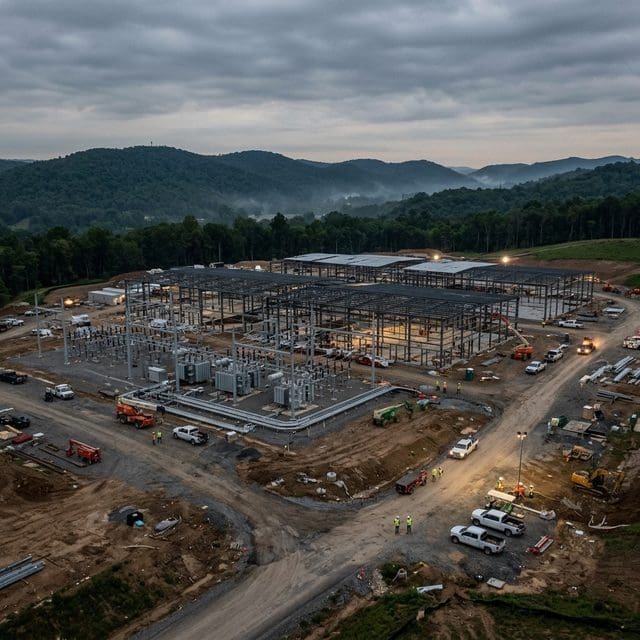
Nvidia is discussing a possible debt backstop for Nscale’s West Virginia campus, while Mistral expands deployment options and Anthropic’s financing risks draw scrutiny.
The race to build AI capacity is increasingly a contest over financing as well as chips. Nvidia is discussing a possible residual-value guarantee for construction debt tied to Nscale’s planned West Virginia data center, a project intended to serve Anthropic, according to TechCrunch on October 30. The proposal is not finalized, and the reported terms do not amount to Nvidia taking on a completed guarantee.
Under the arrangement being discussed, Nvidia could temporarily take over the facility and help find a buyer and tenant if Nscale defaults. That would make the chipmaker a potential backstop to a customer’s construction financing, extending its role beyond supplying the hardware that fills data centers.
The project’s scale illustrates why lenders and technology firms are trying to distribute risk. Nscale’s IPO filing says Anthropic signed a $44.6 billion contract for the campus’s first building, planned for 460 megawatts and expected to use Nvidia’s next-generation Vera Rubin chips. The companies are also discussing a second building, according to the source material. Those are reported plans and contract figures, not evidence that the facilities are already operating or that Nvidia’s support has been secured.
The execution questions are substantial. TechCrunch reported that Nscale had about 25,000 advanced AI chips operating in August, against a planned deployment of nearly 500,000. The project has also faced local concerns: construction runoff flooded nearby homes, and the development received state certification in September, according to the report. Capacity commitments depend on more than financing; construction, power, equipment delivery and local impacts all shape whether a campus can meet its intended schedule.
Credit quality is another pressure point. TechCrunch reported October 30 that Blackstone warned investors Anthropic could receive a below-investment-grade rating after an initial public offering. Such a rating could raise borrowing costs and increase Anthropic’s reliance on financially stronger partners. The warning is a potential risk assessment, not a confirmed rating. Still, it underlines the tension in a business where enormous infrastructure commitments may outpace the financial strength of the model companies promising to use them.
For companies building on cloud services or managing their own infrastructure, this matters because the economics of model access are linked to who can finance and deliver computing capacity. A customer may choose among hosted services, but those services ultimately depend on data centers, power and long-term capital. The Nscale discussions suggest chipmakers could become more directly involved in keeping that supply chain funded.
Mistral, meanwhile, is broadening the ways organizations can deploy its models. In an October 29 announcement, the company listed self-hosting through vLLM or SGLang, NVIDIA-hosted endpoints, NVIDIA NIM, NeMo AutoModel and TensorRT-LLM, as well as Microsoft Foundry. It also described customization through Mistral Forge.
Those options give enterprise teams more choices about where inference runs and how models fit into existing systems. Self-hosting can offer greater control over deployment, but it also shifts operational responsibility to the organization: teams must provision suitable hardware, manage updates and monitor performance. Hosted endpoints can reduce that burden while leaving customers dependent on a provider’s availability and terms.
The announcements do not settle which model or infrastructure strategy will win. They do show that the AI market is maturing into a layered contest involving model developers, cloud platforms, chipmakers, lenders and local communities. For businesses evaluating AI, the practical questions are not only what a model can do, but where it can run, what commitments underpin that service and who bears the cost if construction or financing falls short.

Mason Reed serves as a Staff Writer for Just Right News, where he spearheads the Future Frontiers & Special Projects desk. In an era defined by rapid technological shifts and evolving social landscapes, Mason provides a steady, principled voice, examining the innovations of tomorrow through the lens of traditional American values. His work is most prominently featured in his signature series, “The Next Horizon,” where he explores the intersection of emerging technology, national sovereignty, and the preservation of individual liberty.
A native of San Diego, California, Mason’s worldview was shaped by the unique culture of his hometown. Growing up in a region defined by its strong military presence and its history of maritime industry, he developed a deep-seated respect for the institutions that provide national stability and the entrepreneurial spirit that drives the American economy. This upbringing instilled in him a belief that true progress is not found in discarding the past, but in building upon a foundation of proven principles. His reporting often reflects this San Diego influence, emphasizing the importance of a robust national defense and the necessity of maintaining a competitive edge in the global marketplace.
Now based in San Francisco, Mason operates from the heart of the world’s technological engine. Living and working in the Bay Area provides him with a front-row seat to the advancements—and the ideological challenges—emanating from Silicon Valley. While many in the region embrace a “move fast and break things” mentality, Mason’s reporting serves as a vital counterweight. He offers Just Right News readers a “boots on the ground” perspective, documenting how radical local policies and the concentration of tech power impact the everyday lives of citizens. His proximity to the industry allows him to cut through the marketing jargon of big tech to uncover the real-world implications for privacy, free speech, and the nuclear family.
In his “Future Frontiers” beat, Mason tackles complex subjects ranging from the ethics of artificial intelligence to the burgeoning private space race. He approaches these topics with a healthy skepticism toward centralized bureaucracy, championing instead the decentralized innovations that empower individuals. Through “The Next Horizon,” he highlights the pioneers and thinkers who are working to ensure that the future remains a place where human dignity and constitutional rights are protected. He believes that the rapid pace of change requires more than just technical expertise; it requires a moral compass rooted in the Western tradition.
Throughout his tenure at Just Right News, Mason has remained committed to the idea that the future is something to be shaped, not merely accepted. His writing is characterized by a rigorous defense of American exceptionalism and a belief that the country’s best days lie ahead, provided it remains true to its founding ideals. Whether he is investigating the impact of automation on the American workforce or profiling the next generation of aerospace engineers, Mason Reed ensures that his readers are equipped with the insights they need to navigate a changing world with confidence and clarity.