

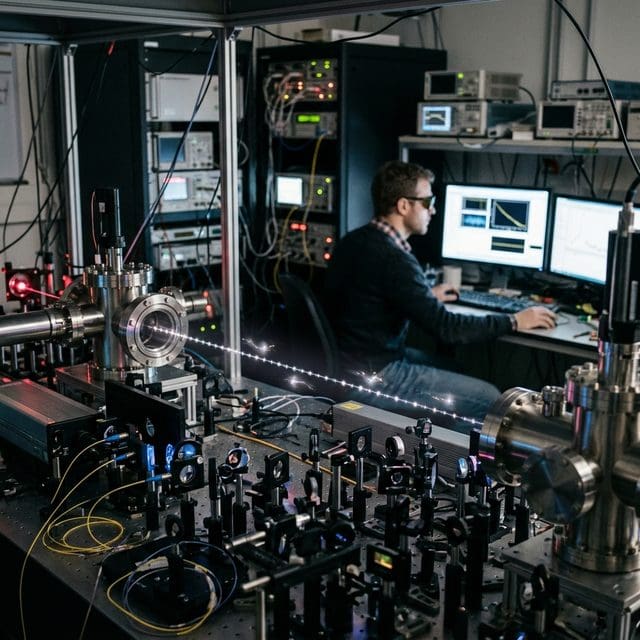
A Nature Physics experiment tracked bound quantum excitations moving and scattering in an ultracold-atom chain, giving researchers a controlled route into the unusual physics of fractons.
A quantum particle that cannot move freely sounds like a contradiction. But in some systems, motion is possible only in tightly choreographed combinations. A new experiment with ultracold atoms has brought that unusual physics into view, tracking bound excitations as they move and interact.
The peer-reviewed study, published October 30 in Nature Physics, was conducted by Sooshin Kim, Byungmin Kang, Markus Greiner and colleagues. The team arranged bosonic atoms in a one-dimensional optical lattice—a repeating pattern of light that acts like a row of microscopic traps—and used carefully controlled site-by-site potentials to create localized dipoles and antidipoles.
A dipole here is a bound arrangement of a hole, where an atom is missing, and a doublon, where a site holds an extra atom. Rather than watching only a large collection of atoms, the researchers deterministically generated these excitations and tracked their coherent dynamics at the level of individual bound states. They measured single-dipole quantum walks and the scattering of two dipoles.
That is the experiment’s central advance: creating specific excitations on demand and observing how they travel and collide, not merely noting that motion is restricted. Nature Physics described the result as “collective motion by tracking mobile bound states of fractons.” Fractons are excitations whose movement is constrained by the rules of their system; they cannot behave like ordinary particles that move independently in every direction.
The experiment offers a bottom-up way to investigate low-energy phases of fractonic matter. In a kinetically constrained system, motion may require coordinated changes that preserve quantities such as dipole moment. Those rules can produce behavior unlike that of familiar solids and fluids. A controllable test bed lets researchers compare theories of these dynamics with direct observations rather than relying only on bulk measurements.
The optical lattice is a laboratory, not a material ready for a device. Its value is control: researchers can prepare a chosen state, adjust conditions and observe individual atoms. That makes it possible to test how simple microscopic rules produce more complex collective states.
The study’s source data include atom- and dipole-number densities, polarizations, and probabilities of finding particles at neighboring sites. The complete raw fluorescence-image sets—several hundred gigabytes—are available from the corresponding author on reasonable request rather than being deposited publicly. That arrangement limits immediate access to the full imaging record for independent reanalysis.
Another Nature Physics result published October 30 examined UTe₂, an unconventional superconductor. Researchers reported an additional phase boundary, identified through an upward jump in sound velocity. They describe it as direct thermodynamic evidence that superconducting order is lost on cooling, and identify a tetracritical point involving ambient-pressure and pressure-induced order. Their phase diagram points to competition between two superconducting order parameters.
Quantum computing supplied a third development. An October 27 Nature Physics paper, “Order in a quantum chaotic sea,” reported an island of regular motion inside otherwise chaotic many-body dynamics on a superconducting processor. The researchers used feedback to steer the system toward that region. Like the atom experiment, it demonstrates how researchers can guide quantum systems into behavior that would be difficult to isolate through passive observation.
The ultracold-atom result does not establish a practical fracton technology. It provides something more basic: a controlled way to study the rules of an unfamiliar quantum world. Further experiments can use the platform to examine more complex arrangements and interactions, testing how constrained excitations combine into larger phases.

Mason Reed serves as a Staff Writer for Just Right News, where he spearheads the Future Frontiers & Special Projects desk. In an era defined by rapid technological shifts and evolving social landscapes, Mason provides a steady, principled voice, examining the innovations of tomorrow through the lens of traditional American values. His work is most prominently featured in his signature series, “The Next Horizon,” where he explores the intersection of emerging technology, national sovereignty, and the preservation of individual liberty.
A native of San Diego, California, Mason’s worldview was shaped by the unique culture of his hometown. Growing up in a region defined by its strong military presence and its history of maritime industry, he developed a deep-seated respect for the institutions that provide national stability and the entrepreneurial spirit that drives the American economy. This upbringing instilled in him a belief that true progress is not found in discarding the past, but in building upon a foundation of proven principles. His reporting often reflects this San Diego influence, emphasizing the importance of a robust national defense and the necessity of maintaining a competitive edge in the global marketplace.
Now based in San Francisco, Mason operates from the heart of the world’s technological engine. Living and working in the Bay Area provides him with a front-row seat to the advancements—and the ideological challenges—emanating from Silicon Valley. While many in the region embrace a “move fast and break things” mentality, Mason’s reporting serves as a vital counterweight. He offers Just Right News readers a “boots on the ground” perspective, documenting how radical local policies and the concentration of tech power impact the everyday lives of citizens. His proximity to the industry allows him to cut through the marketing jargon of big tech to uncover the real-world implications for privacy, free speech, and the nuclear family.
In his “Future Frontiers” beat, Mason tackles complex subjects ranging from the ethics of artificial intelligence to the burgeoning private space race. He approaches these topics with a healthy skepticism toward centralized bureaucracy, championing instead the decentralized innovations that empower individuals. Through “The Next Horizon,” he highlights the pioneers and thinkers who are working to ensure that the future remains a place where human dignity and constitutional rights are protected. He believes that the rapid pace of change requires more than just technical expertise; it requires a moral compass rooted in the Western tradition.
Throughout his tenure at Just Right News, Mason has remained committed to the idea that the future is something to be shaped, not merely accepted. His writing is characterized by a rigorous defense of American exceptionalism and a belief that the country’s best days lie ahead, provided it remains true to its founding ideals. Whether he is investigating the impact of automation on the American workforce or profiling the next generation of aerospace engineers, Mason Reed ensures that his readers are equipped with the insights they need to navigate a changing world with confidence and clarity.