

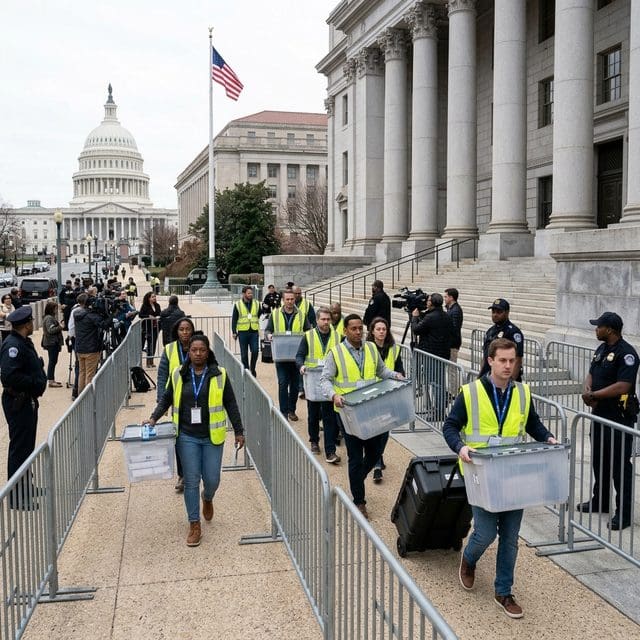
Federal judges constrained Trump administration efforts involving ballots and election officials as the Justice Department intensified an investigation into an alleged Alaska ballot scheme.
Federal courts on Thursday and Friday dealt setbacks to Trump administration efforts to intervene in election administration, while the Justice Department escalated a separate investigation into an alleged ballot scheme in Alaska. The developments put federal authority—and the distinction between allegations and established facts—at the center of the final days before the Nov. 3 election.
In a 2–1 decision Thursday, the Ninth U.S. Circuit Court of Appeals rejected the Justice Department’s emergency request to segregate ballots associated with about 20,000 people the administration alleged might be noncitizens. The court said the government had not shown that such extraordinary relief was clearly required by law, and warned of potentially “catastrophic effects” on the election system.
Separately, a federal judge barred the Justice Department from threatening or coercing California election officials over ballot processing, including through demands to segregate or withhold ballots the federal government deemed potentially ineligible. The rulings do not resolve every dispute over voter eligibility, but they limit the administration’s efforts to direct or pressure state officials.
The decisions turn on more than the administration’s stated goal of election integrity. Courts must assess whether the government has legal authority for its actions and whether a proposed remedy could disrupt the voting system. The Ninth Circuit emphasized the government’s burden to justify extraordinary relief and the potential consequences of trying to isolate individual ballots.
In Alaska, the Justice Department’s investigation took a more aggressive turn. U.S. Attorney Michael J. Heyman said the criminal inquiry had been underway for several months, but a New York Times report prompted a “significant surge” of law-enforcement resources in Alaska and elsewhere. The Associated Press reported that prosecutors issued dozens of grand-jury subpoenas and record-preservation demands this week.
The investigation concerns allegations that Mary Peltola’s Senate campaign recruited candidates to draw votes from Republican Sen. Dan Sullivan. Peltola’s campaign and national Democrats have denied the allegation. Alaska Gov. Mike Dunleavy ordered a state investigation and said the state’s election-certification process could be stopped or changed because of the inquiry. The House Oversight Committee has also opened an investigation.
The Justice Department asked a federal judge to preserve and segregate every ballot ranking Daniel J. Sullivan, whose name is at issue, and sought expedited discovery from Peltola’s campaign and the Democratic Senatorial Campaign Committee. The requested records include communications about efforts to recruit him. Prosecutors asked for a ruling by Monday, according to reporting on the filings. These requests are not findings that the campaign committed a crime.
At a Florida rally, President Donald Trump said Attorney General Todd Blanche would decide whether to prosecute. Trump also said Peltola “should be removed from the ballot and prosecuted,” and said Daniel J. Sullivan should be prosecuted. The comments do not determine the Justice Department’s decisions, which remain subject to the evidence and applicable law.
Trump’s campaign schedule also changed. After the Republican National Committee shifted planned Iowa and Kansas appearances to telephone events across 19 states, Trump’s in-person rallies in both states were reinstated for Sunday; the tele-rallies remained scheduled.
The developments raise distinct questions. In California, courts scrutinized federal efforts to direct or pressure state election officials. In Alaska, prosecutors are seeking evidence in a specific alleged scheme, alongside state and congressional inquiries. In both cases, election claims must be tested through lawful processes; allegations cannot substitute for proof.

Sophie Carter serves as a Staff Writer for Just Right News, where she anchors the outlet’s critical coverage of Elections, Influence, and Democracy Infrastructure. In an era where the mechanics of voting and the flow of political capital are under constant scrutiny, Sophie provides a steady, principled voice dedicated to the preservation of American institutional integrity and the rule of law.
Raised in Charlotte, North Carolina, Sophie’s perspective was forged in a community that balances rapid modern growth with a deep respect for tradition and civic duty. Growing up in the Queen City, she witnessed firsthand how a robust local culture depends on the trust between the citizen and the state. This upbringing instilled in her a foundational belief that the right to vote is a sacred trust—one that must be protected from both administrative overreach and the encroaching influence of special interest groups. Her reporting reflects these North Carolina roots, emphasizing the importance of community-led governance and the preservation of the individual’s voice in the face of nationalized political movements.
Now based in Atlanta, Georgia, Sophie operates from the heart of one of the nation’s most pivotal and contested political landscapes. Her location allows her to report from the front lines of the debate over election security, legislative reform, and the modernization of voting systems. For Sophie, the “infrastructure” of democracy is not merely a matter of machines and ballots; it is the collection of laws, people, and transparent processes required to maintain public confidence. Her work often highlights the necessity of clear, enforceable standards that ensure every legal vote is counted fairly and that the machinery of our republic remains accountable to the taxpayers who fund it.
Central to her work at Just Right News is her acclaimed feature series, “The Price of a Vote.” Through this ongoing project, Sophie explores the complex web of influence that shapes modern campaigns and policy decisions. She delves into how high-level lobbying, non-governmental organizations, and shifting bureaucratic regulations impact the weight of an individual citizen’s ballot. By examining the financial and structural pressures placed on the electoral process, she provides readers with a comprehensive look at the forces vying for control over the American political system.
Sophie’s approach to journalism is rooted in a commitment to the constitutional framework. She views her role as a watchdog for the voter, ensuring that the systems meant to serve the public remain transparent and free from corruption. Whether she is analyzing the implementation of new voting technologies or investigating the influence of outside money on state-level policy, her work is characterized by a rigorous adherence to facts and a refusal to succumb to the sensationalism that often plagues modern political reporting.
At Just Right News, Sophie Carter continues to be a vital resource for readers who value clarity, conviction, and a defense of traditional American values. Her deep ties to the Southeast and her specialized focus on the mechanics of our republic make her an essential voice in the ongoing conversation about the future of American self-governance. Through her reporting, she remains dedicated to the idea that a secure and honest electoral system is the bedrock of a free and prosperous society.