

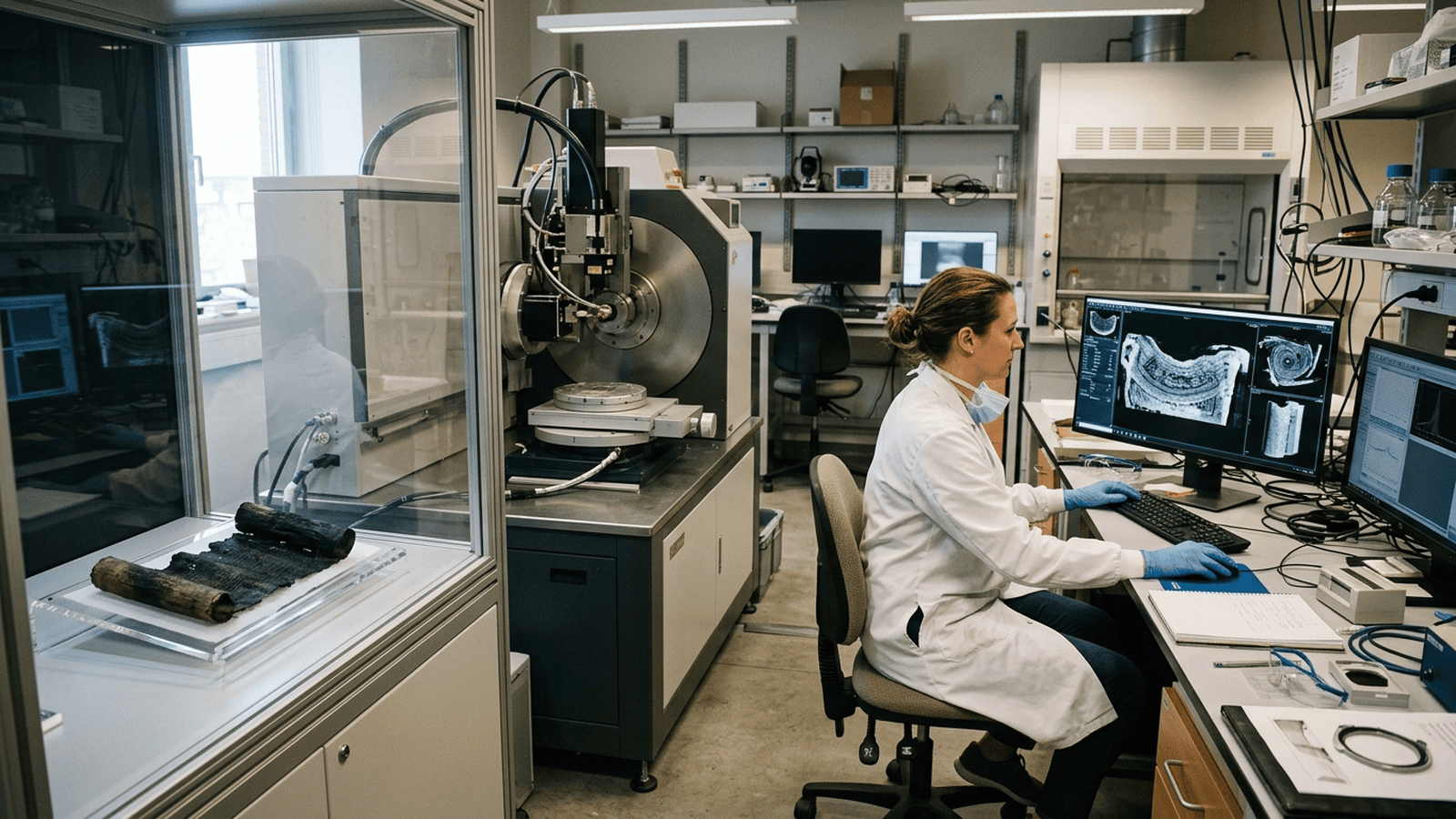
AI-assisted image analysis helped researchers recover more than 2,000 characters from a carbonized Herculaneum scroll without physically unrolling it. The text, attributed to the Greek philosopher Philodemus, offers a glimpse of ancient ideas and demonstrates how computational tools can help experts study fragile artifacts.
TLDR: Machine-learning tools helped researchers identify writing in X-ray scans of a fragile Roman scroll carbonized by Vesuvius. In 2024, a Vesuvius Challenge team won its grand prize after recovering more than 2,000 Greek characters attributed to philosopher Philodemus. The work could help reveal more texts without damaging them.
A computer vision technique has helped researchers read words from a Roman scroll that has remained sealed since the eruption of Mount Vesuvius in A.D. 79. The work does not involve physically unrolling the fragile object. Instead, researchers use X-ray scans and machine-learning tools to detect the faint traces of ink within its tightly folded layers.
The scroll is one of hundreds found in the Villa of the Papyri at Herculaneum, a town buried by volcanic material near Pompeii. The eruption carbonized the papyrus, leaving it brittle and blackened. Earlier attempts to open similar scrolls damaged or destroyed them, so conservators have kept many intact rather than risk unrolling them. The collection is unusually important because it preserves a library of ancient works that would otherwise be known only through later quotations or copies.
The Vesuvius Challenge, an international research competition, has brought together computer scientists, papyrologists and imaging specialists to find another way. Researchers at the University of Kentucky, including computer scientist Brent Seales, have worked for years on methods to scan and virtually unwrap the scrolls. The competition provides high-resolution scans and rewards teams that develop tools to identify the scroll’s layers and recover its writing.
The process begins with X-ray computed tomography, which creates a three-dimensional picture of the scroll’s interior. The scans can reveal the structure of the papyrus, but the ink is difficult to distinguish: ancient ink made with carbon does not show up clearly against carbonized papyrus. Researchers therefore need software to identify subtle differences in texture and surface shape that may mark the location of ink. Repeated scans from different angles help reconstruct those layers.
Machine-learning models help locate those traces. A model can be trained on sections where the papyrus surface is visible, then used to identify similar patterns in the scan. The resulting images can be digitally flattened into readable surfaces. Human specialists still need to interpret the marks, distinguish letters from damage and determine how the text fits together.
In February 2024, the Vesuvius Challenge announced that three researchers had won its grand prize for recovering more than 2,000 characters from a scroll. The team identified at least four passages, each containing more than 140 legible characters. The text was attributed to the ancient Greek philosopher Philodemus and discusses topics including pleasure and the senses. The prize was awarded for meeting the contest’s criteria for a substantial, verified reading—not for translating the entire scroll.
That distinction matters. The recovered text represents a small portion of a much larger work, and reading it remains a painstaking task. Some letters are incomplete or uncertain, while the scroll’s distorted layers complicate the digital reconstruction. Specialists compare proposed readings with Greek vocabulary, grammar and other surviving writings to check whether the interpretation is plausible.
The achievement demonstrates how computational tools can make previously inaccessible cultural material available for study. It also illustrates a broader role for AI in research: software can detect patterns across large or complex datasets, while experts provide context and assess what those patterns mean. The approach may eventually be applied to other Herculaneum scrolls, many of which have not been opened.
Researchers are continuing to refine the scanning, segmentation and ink-detection methods. Better models and more precise scans could allow teams to recover larger stretches of text and make the process faster. Each newly read passage may add evidence about ancient philosophy, literature and daily life, while the physical scroll remains protected. The next challenge is to turn scattered lines into a reliable, continuous account without mistaking damaged papyrus for writing.

Lisa Grant serves as a Staff Writer for Just Right News, where she spearheads the publication’s coverage of Technology, Data Capitalism, and Surveillance. With a focus on the encroaching influence of Big Tech on the American way of life, Grant brings a critical, liberty-minded perspective to the most complex digital issues of the modern era. Her reporting is defined by a deep-seated skepticism of centralized power and a commitment to protecting the privacy and autonomy of the individual against the rising tide of what she calls the “Algorithmic State.”
Grant’s unique insight into the tech industry is rooted in her upbringing in Palo Alto, California. Growing up in the epicenter of Silicon Valley, she witnessed firsthand the transformation of the technology sector from a hub of scrappy, freedom-loving innovators into a landscape dominated by monolithic corporations. This proximity to the birth of the digital revolution provided her with an insider’s understanding of the culture and motivations driving the industry. For Grant, the shift toward data capitalism—where personal information is harvested as a primary commodity—is not just a market evolution, but a fundamental challenge to traditional American values of property rights and personal privacy. She saw the “garage startup” ethos replaced by a culture of data-mining and social engineering, a transition that informs her vigilant reporting today.
Now based in Seattle, Washington, Grant operates from another of the nation’s primary technological frontiers. Her location in the Pacific Northwest allows her to observe the real-world consequences of the tech industry’s expansion, from the implementation of invasive surveillance technologies in urban centers to the growing partnership between corporate entities and municipal governance. By reporting from the ground in Seattle, she bridges the gap between the abstract world of coding and the tangible impact it has on citizens’ daily lives, often highlighting how local policies serve as a testing ground for broader national surveillance initiatives.
At the heart of her work for Just Right News is her acclaimed feature series, “The Algorithmic State.” Through this series, Grant explores the ways in which automated systems and artificial intelligence are increasingly used to bypass traditional legislative processes and social norms. She argues that the reliance on opaque algorithms to manage society threatens to erode the transparency and accountability essential to a free republic. Her work meticulously documents how data-driven governance can lead to a “soft” surveillance state that penalizes traditional viewpoints and rewards digital conformity.
Grant’s reporting is a vital resource for readers who are wary of the “nanny state” and the unchecked power of digital gatekeepers. She views the defense of the digital frontier as the next great battle for constitutional conservatives. By exposing the mechanisms of data capitalism and the quiet expansion of surveillance networks, she empowers her audience to reclaim their digital sovereignty. In an era where information is often weaponized by those in power, Lisa Grant remains a steadfast advocate for the truth, ensuring that the principles of liberty and individual agency are not lost in the transition to an increasingly digital world.