

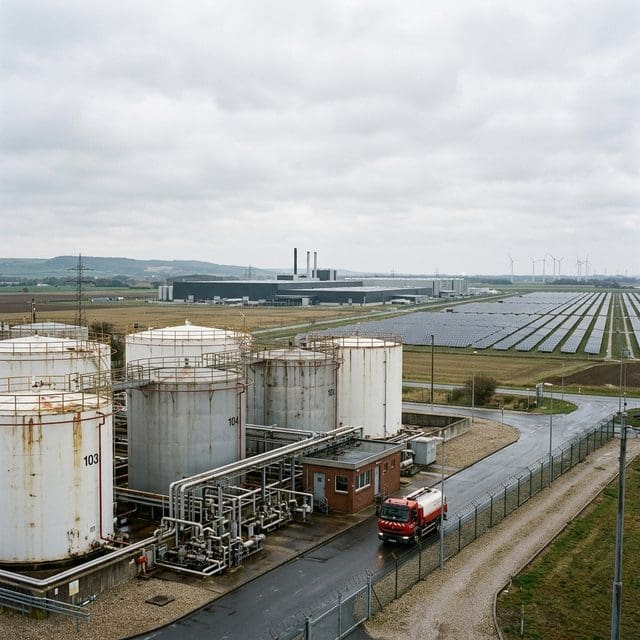
The IEA’s latest emergency-stock release aims to ease fuel pressure, while China’s proposed solar-technology controls highlight Europe’s exposure to concentrated supply chains.
The International Energy Agency is preparing another release of emergency oil stocks, including more than 20 million barrels of diesel, as governments try to cushion fuel markets while confronting a separate vulnerability in the clean-energy supply chain: China’s control over key solar manufacturing know-how.
IEA members agreed on October 15 to accelerate the release of roughly 100 million barrels of remaining emergency stocks. The diesel is to be released “as soon as possible,” according to the agency’s announcement, carried by Global News. About 330 million barrels had already been released under the response, and total volumes are now expected to exceed the original commitment of more than 400 million barrels.
The reserve action offers a short-term supply bridge, not a durable substitute for production, refining capacity or functioning transport routes. Drawing down stocks can put additional barrels into the market when buyers are scrambling for supply, but it also leaves less inventory available for a later disruption. The diesel component is especially direct: it targets a fuel used across freight, agriculture and industry, rather than relying on lower crude prices alone to ease pressure at the pump or for businesses.
The scale of releases matters, but so does what happens after them. Emergency stocks are finite, and their effectiveness depends on timing, the locations of the inventories and the ability to move the fuel to where it is needed. The IEA announcement does not, by itself, establish how much prices will fall or how quickly the released diesel will reach consumers. It does show governments leaning on public reserves to manage immediate risk while longer-term supply conditions remain uncertain.
At the same time, China has proposed restrictions on 12 photovoltaic technologies, spanning production processes for polysilicon, wafers, crystalline-silicon cells and perovskite-silicon tandem cells. The proposal targets manufacturing know-how, equipment, licensing, installation and technical support. It is not a blanket ban on exports of finished solar cells or modules.
The distinction is significant for Europe and other importers. Access to panels can expand solar capacity in the near term, but access to the expertise and equipment needed to manufacture them is a different question. If controls are adopted, they could make it harder for companies outside China to develop or scale domestic production, even if finished products remain available for purchase. That could prolong reliance on imported hardware and technical capabilities precisely as governments seek more secure energy systems.
The measures had not taken effect as of October 16. Temporary pre-export registration began that day, while public consultation is scheduled to run through November 15. The proposal therefore signals a possible change in policy, not a completed restriction. Its eventual reach will depend on the final rules and how they are enforced.
The two developments expose different sides of energy security. Oil reserves can help soften a near-term shock, but they cannot permanently replace supply. Solar equipment can add generation without fuel purchases, but concentrated manufacturing and technology expertise create their own strategic risks. For policymakers, resilience means weighing the cost of maintaining spare capacity and domestic production against the expense of relying on imports—and recognizing that no single technology or stockpile eliminates exposure to global markets.
For Europe, the practical test is whether emergency fuel measures buy time and whether proposed trade controls change the economics of building a more diverse solar industry. For energy consumers, the outcomes will be measured in dependable supply and costs, not in the language of either fossil-fuel security or clean-energy ambition alone.

Mark Davis serves as the Senior Correspondent for Energy, Climate, and Resource Economics at Just Right News. In an era where the conversation around the environment is often dominated by alarmism and top-down mandates, Mark provides a vital, market-oriented perspective on the complex forces shaping our world. As the lead voice behind the acclaimed feature series “Power and the Planet,” he explores the intersection of environmental policy, global energy markets, and the fundamental economic principles that sustain modern civilization.
Mark’s pragmatic approach to resource management was forged in the high desert of his hometown, Albuquerque, New Mexico. Growing up in a region defined by both its breathtaking natural beauty and its rugged, resource-dependent landscape, he developed an early appreciation for the delicate balance between conservation and utilization. New Mexico’s unique position as a hub for both traditional energy production and cutting-edge scientific research provided Mark with a front-row seat to the evolution of the American energy sector. This upbringing instilled in him a deep-seated belief that true environmental stewardship is inseparable from economic prosperity and technological innovation.
Now based in Boulder, Colorado, Mark operates from the heart of the nation’s climate research community. While Boulder is often seen as a bastion of environmental idealism, Mark utilizes his post to provide a necessary counterweight, grounded in the realities of resource economics. He understands that energy policy does not exist in a vacuum; it has tangible consequences for the American taxpayer, the stability of the national power grid, and the strength of the domestic manufacturing sector. By reporting from the front lines of the climate debate, he is able to challenge prevailing narratives with hard data and a commitment to the principles of the free market.
Throughout his tenure at Just Right News, Mark has distinguished himself by focusing on the “Resource Economics” aspect of his beat. He frequently highlights the hidden costs of rapid energy transitions and advocates for an “all-of-the-above” energy strategy that prioritizes American energy independence. His work often shines a light on the geopolitical implications of resource scarcity, arguing that a secure nation must first be an energy-secure nation. Whether he is analyzing the impact of federal land-use regulations or investigating the supply chains required for new technologies, Mark remains focused on how policy decisions affect the lives and livelihoods of everyday citizens.
In “Power and the Planet,” Mark continues to bridge the gap between complex scientific concepts and the economic realities facing the country. He rejects the false choice between a healthy environment and a thriving economy, instead seeking out solutions that leverage American ingenuity and private-sector competition. For Mark, reporting on the climate is not about following the latest trends, but about ensuring that the conversation remains tethered to the foundational values of liberty, property rights, and fiscal responsibility. His contributions ensure that Just Right News readers receive a comprehensive, clear-eyed view of the challenges and opportunities defining the future of our planet.