

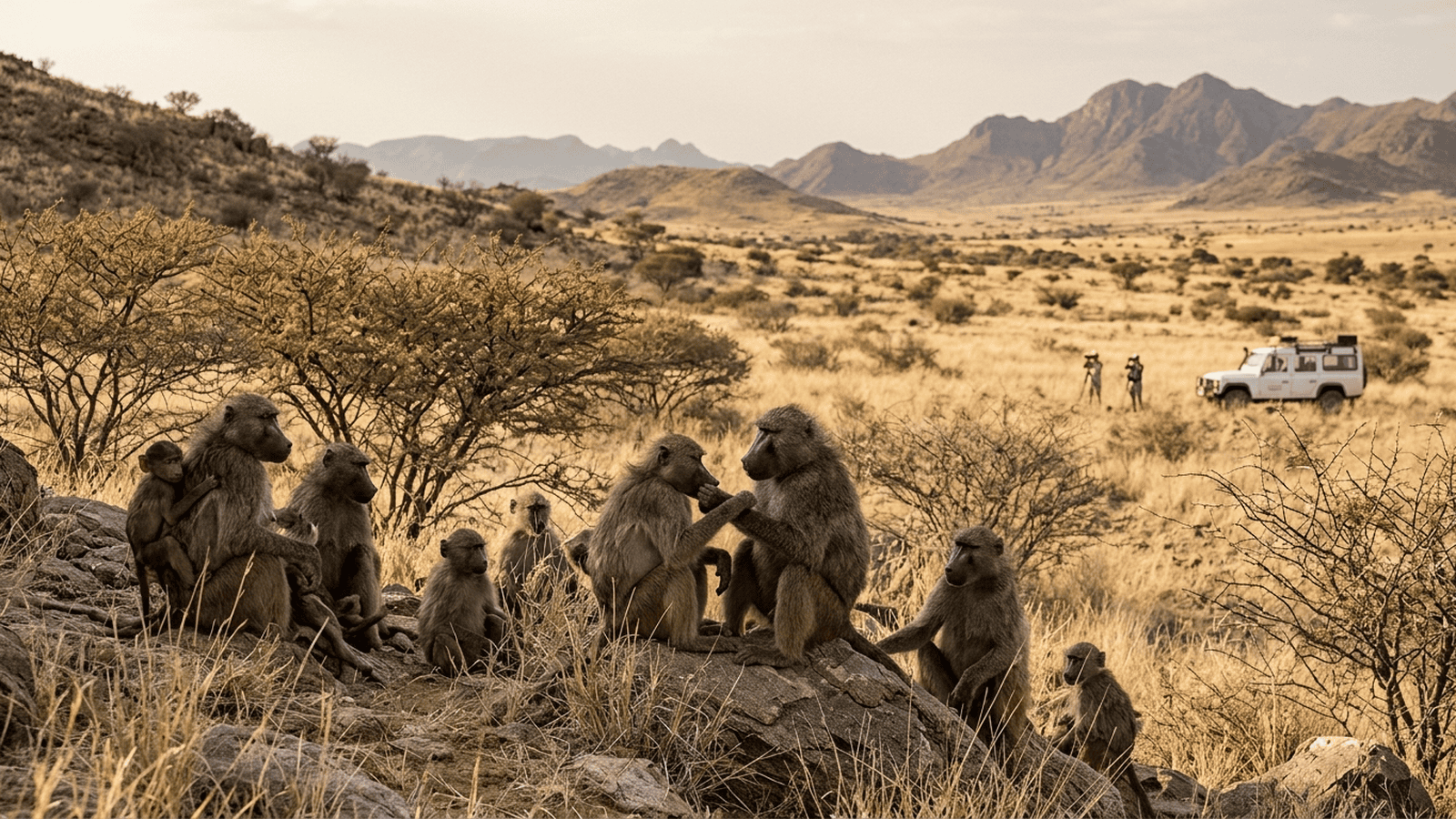
A 2012 study of wild female chacma baboons in Namibia found an association between grooming-network size and the structure of brain regions involved in social behavior. Because the research was observational, it cannot show whether social experience changes the brain or brain differences help animals form relationships.
TLDR: Researchers studying wild female chacma baboons in Namibia compared observations of grooming relationships with MRI scans. Females with more grooming partners tended to have greater gray-matter volume in some regions linked to social behavior. The observational findings reveal an association, not whether social experience changes the brain or brain structure shapes relationships.
A field study of wild baboons has found that the size of a female’s social network is associated with the structure of several brain regions. The research offers a rare look at how social relationships and the brain correspond in animals living outside a laboratory, where bonds form amid the daily demands of finding food, avoiding danger and raising young.
The work, published in 2012 in the Proceedings of the National Academy of Sciences, examined adult female chacma baboons in Namibia. Researchers observed the animals’ social relationships in the wild and used magnetic resonance imaging to measure brain structures. They then compared those measurements with how many regular grooming partners each female had.
Grooming is an important part of baboon social life. It helps animals maintain relationships, and females often form durable bonds with a small number of partners. The researchers found that females with more grooming partners tended to have greater gray-matter volume in parts of the brain involved in social behavior and processing information about other individuals. The result pointed to a relationship between social network size and brain anatomy, rather than a simple measure of overall intelligence.
The team focused on brain areas with roles in managing social information, including regions involved in recognizing individuals and regulating behavior. The comparisons suggested that the brains of animals with larger networks may differ in ways that help them handle more social connections. However, the study was observational: it could not establish whether brain structure helped a baboon build a larger network, whether social experience shaped the brain, or whether both were influenced by other factors.
That uncertainty is central to interpreting the findings. A brain scan records anatomy at one point in time, while social relationships change as animals age, move through rank structures and experience shifts in group membership. The association does not show that grooming itself enlarges a brain region, or that every baboon with a larger network has the same neural profile. It does suggest that real-world social demands are worth studying alongside the brain’s physical organization.
Research on human social networks has also linked the number and complexity of relationships to brain regions involved in social cognition. The baboon study provides a useful comparison because the animals live in stable groups and their interactions can be observed directly over time. But similarities across species should be treated carefully: human relationships involve language, institutions and cultural practices that are not captured by measures of grooming partners.
The field setting was essential to the question. In a controlled laboratory, researchers can measure behavior under standardized conditions, but those conditions cannot reproduce the full social lives of free-ranging animals. Long-term observation allowed the team to identify regular partners rather than relying on a brief encounter. Combining that record with imaging offered a way to connect naturally occurring relationships to individual differences in brain anatomy.
The study also illustrates the practical and ethical challenges of neuroscience research with wild animals. Imaging requires temporarily capturing and safely handling animals, and such work depends on careful veterinary oversight and established field protocols. The resulting scans provide information that cannot be collected simply by watching behavior, while the observations give meaning to measurements that might otherwise be difficult to interpret.
The findings do not settle how social experience and brain structure influence one another. They do, however, support further research that tracks the same animals over longer periods, pairing repeated observations of relationships with measures of brain development and change. Such work could clarify whether social networks shape neural organization, whether neural differences help animals maintain relationships, or how both processes unfold together in the wild.

Ethan Blake serves as a Senior Correspondent for Just Right News, where he specializes in Longform Narrative and Public Understanding. In an era of rapid-fire headlines and fleeting soundbites, Ethan’s work stands as a testament to the power of deep-dive reporting and the importance of contextualizing the complex issues facing the nation today. His approach is rooted in the belief that the most profound truths are often found in the lived experiences of individuals rather than the abstract theories of distant policymakers.
Growing up in Providence, Rhode Island, Ethan developed an early appreciation for the historical and cultural threads that weave the American fabric together. Providence, a city defined by its industrial heritage and its blend of traditional neighborhoods, provided him with a front-row seat to the challenges and triumphs of the American working class. This upbringing instilled in him a respect for the “common sense” values of hard work, community loyalty, and the preservation of local institutions. He learned early on that behind every economic statistic or legislative debate, there are real families and neighborhoods navigating the consequences of change.
This foundational perspective is the driving force behind his signature feature series, “Lives Behind the Systems.” Through this series, Ethan explores the intersection of individual agency and institutional structure. Whether he is documenting the impact of federal land-use policies on rural families or examining how shifting educational standards affect local school boards, Ethan’s work prioritizes the human element. He seeks to uncover how large-scale systems—be they governmental, economic, or social—affect the daily lives of citizens, often advocating for a return to local control and personal responsibility.
Now based in Portland, Maine, Ethan draws significant inspiration from the rugged independence and self-reliance that define the region. The coastal landscape and the resilient spirit of Maine’s communities serve as a constant reminder of the importance of individual liberty and the strength found in decentralized power. Living and working outside the traditional media hubs allows Ethan to maintain a grounded perspective, ensuring his reporting remains untethered from the echo chambers of the major metropolitan centers. This geographic distance provides him with the clarity needed to translate complex national narratives into stories that resonate with the heart of the country.
At Just Right News, Ethan’s beat is more than just a professional assignment; it is a mission to foster a more informed and engaged citizenry. He believes that a free society depends on the public’s ability to understand the mechanisms of power and the value of traditional American principles. His longform narratives do not merely report the news; they provide a roadmap for understanding the cultural and political shifts of the modern era through a lens of skepticism toward centralized authority and a deep respect for the individual.
Through his meticulous research and narrative craftsmanship, Ethan Blake continues to bridge the gap between policy and the public. His work remains a vital resource for those who seek a deeper understanding of the systems that shape our world and the enduring spirit of the people who live within them.