

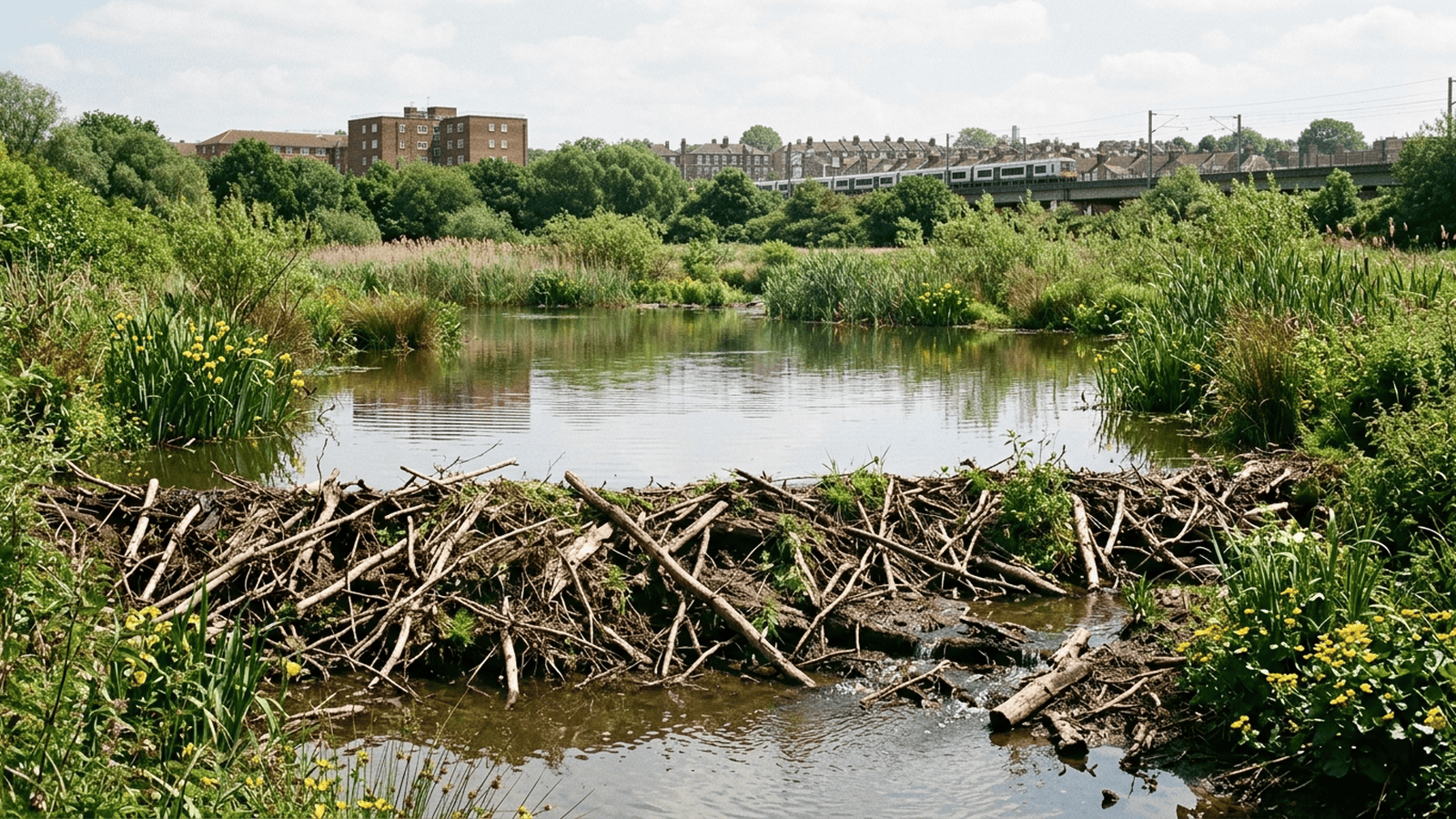
Five Eurasian beavers released in Greenford in October 2023 have reshaped a wetland and helped protect nearby streets, homes and Greenford Station from flooding, according to the Ealing Beaver Project. By July, they had built seven dams and created three ponds that hold rainwater and release it more slowly downstream. Project veterinarian Sean McCormack said the area had no flooding by the beavers’ second winter, while the project reports benefits around the station and homes. The beavers were proposed as a lower-cost alternative to planned engineering works, although the account gives no exact costs or formal review schedule. Their return has also supported other wildlife and produced two kits in 2026.
TLDR: Beavers in Greenford have built seven dams and three ponds that slow rainwater, with the project reporting reduced flooding around Greenford Station and nearby homes. The account describes a potential lower-cost alternative to planned engineering but gives no exact budget, formal monitoring schedule or next deadline.
A family of beavers is helping hold back floodwater in Greenford, a West London town where heavy rain had repeatedly caused problems near Greenford Station. Since five Eurasian beavers arrived in October 2023, they have reshaped a wetland close to busy streets and the city’s transport network. The project reports that their dams have helped protect the station lobby and nearby homes from flooding.
The practical rationale is clear: slow water before it reaches the urban area downstream. Local authorities had been considering costly engineering works to create reservoirs, while veterinarian and conservationist Sean McCormack and other members of the Ealing Beaver Project proposed using the beavers to help manage the water. McCormack said the approach could cost a fraction as much and might work more effectively. That is a straightforward case for putting a local landscape to work before committing to expensive construction.
The animals have done the building themselves. By July, they had constructed seven dams and created three ponds that retain water. Rainfall that might otherwise rush downstream is held in ponds, spread across the wetland and released more slowly. The result is a natural system built from felled trees and gathered branches, rather than the planned reservoir works.
The project’s account of the results is notable. McCormack said there was no flooding in the downstream area the project was meant to help by the beavers’ second winter. The project also reports that the dams helped prevent flooding in the station lobby and surrounding residential area. The account does not provide measurements of water levels or a cost comparison, so the scale of the benefit cannot be independently quantified from the information available here.
The beavers were not brought to Greenford solely as flood managers. Their return also restores a species that had been hunted to extinction in the area centuries ago. The five animals were the first to return to West London in about 400 years, and they now live in a fenced site that remains accessible to the public. Their work has changed the wetland in ways that extend beyond holding water.
One beaver lodge stands roughly six feet high, with an underwater entrance leading to the lagoon. A fallen tree, chewed through on one side and brought down into the water, is expected to provide habitat for beetles, woodpeckers, bats and other wildlife. These changes are part of the same practical process: the animals alter the land to meet their needs, and the altered habitat creates opportunities for other species.
The beavers have also bred successfully. Willow and Woody welcomed two kits in 2026, their third consecutive year of breeding, according to the project. McCormack has called that continued success “nature’s report card.” Visitors can join guided evening beaver safaris, and McCormack estimated a 90% chance of spotting a beaver during a recent visit. The public access and guided visits make the site both a conservation project and a local attraction.
The practical impact described so far is specific but limited. The beavers’ dams and ponds hold water, the project reports fewer flooding problems downstream and around Greenford Station, and the approach was proposed as a lower-cost alternative to expensive engineering works. The source provides no exact project budget, household charge, application form, compliance rule, enforcement process or deadline. It also does not describe a formal monitoring schedule or a government policy requirement. Those details are not part of the account, rather than details that can be assumed.
There is a tradeoff in the method: the beavers fell trees and redirect water, changing a landscape that would otherwise be managed through planned engineering works. That means accepting a less human-directed form of flood management in this wetland. The project presents that change as useful because water is slowed and retained, while the resulting habitat supports wildlife. The reported benefits make the case for considering this approach in other communities, though McCormack’s comments about wider use are a possibility, not a confirmed plan.
For now, the next steps and oversight arrangements are not specified in the account. What is documented is a working wetland, seven dams, three ponds and reported flood protection after the beavers’ arrival. Any future expansion would need its own clear plans and evidence; no such deadline or formal review is described here. In Greenford, the project’s reported results show that the beavers have already made a practical contribution, and further claims should rest on continued observation rather than assurances that the source does not provide.

Chloe Foster serves as a Staff Writer for Just Right News, where she spearheads the outlet’s coverage of Media, Culture, and Information Integrity. In an era defined by rapid-fire digital communication and shifting societal norms, Chloe has distinguished herself as a vital voice for readers seeking clarity amidst the noise. Her signature feature series, “The Story Wars,” has become a cornerstone of the publication, offering a deep dive into the ideological battles currently shaping American life and the ways in which mainstream narratives are constructed, disseminated, and often manipulated.
Chloe’s unique perspective is informed by a life lived in two of the nation’s most influential cultural hubs. Raised in Los Angeles, California, she grew up in the shadow of the world’s most powerful media and entertainment apparatus. This upbringing provided her with a front-row seat to the “dream factory,” allowing her to observe firsthand how cultural exports are crafted and how they often diverge from the lived experiences of everyday Americans. Her time in Los Angeles instilled in her a healthy skepticism of manufactured consensus and a passion for uncovering the truths that lie beneath polished public relations campaigns.
Today, Chloe operates from Brooklyn, New York, a vantage point that places her at the epicenter of the modern media landscape. Living and working in a deep-blue urban environment as a conservative journalist has sharpened her reporting, requiring a rigorous commitment to intellectual honesty and a steadfast defense of traditional values. Her base in Brooklyn allows her to engage directly with the institutions and influencers who drive the national conversation, providing Just Right News readers with an “on-the-ground” look at the cultural shifts originating in the Northeast.
As a Hispanic woman, Chloe brings a nuanced understanding of community and heritage to her beat. She frequently explores how media portrayals of the Latino community often overlook the deep-seated faith, entrepreneurial spirit, and family-centric values that define it. Her work challenges the monolithic labels often applied by mainstream outlets, instead highlighting the diversity of thought and the conservative principles that resonate within her community.
In her role at Just Right News, Chloe views “Information Integrity” not merely as a buzzword, but as a mission. She believes that a healthy republic requires a media landscape where facts are prioritized over agendas and where the public is empowered to think for themselves. Through “The Story Wars,” she deconstructs the framing of major news events, exposing bias and providing the context necessary for readers to understand the broader cultural implications of the day’s headlines.
Chloe Foster’s reporting is more than just a collection of articles; it is a sustained effort to reclaim the narrative for those who feel sidelined by the prevailing media establishment. By bridging the gap between her West Coast roots and her East Coast base, she continues to provide essential commentary on the forces that define our shared American culture.