

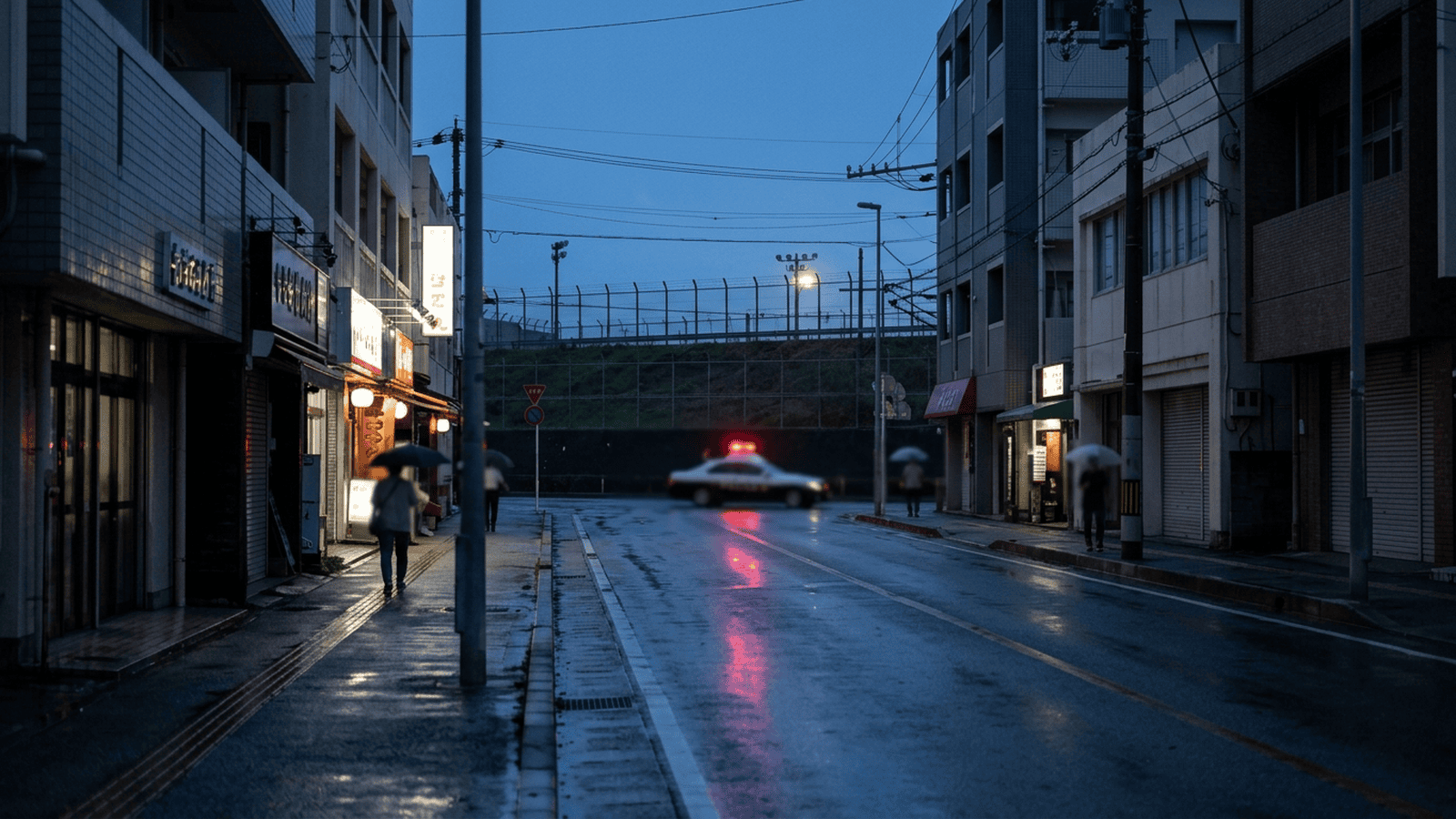
Okinawa police arrested U.S. Marine Lance Cpl. Devin Jacob Ballard on suspicion of murdering Anna Yagi and stealing her belongings; he denies the allegations. Japanese prosecutors began reviewing the case Monday and are expected to decide in coming weeks whether to file formal charges. The case highlights the 1960 Status of Forces Agreement, including limits on Japanese jurisdiction and custody in some cases involving U.S. personnel. Okinawa hosts most U.S. troops in Japan and 70% of the country’s American military facilities, while residents debate the bases’ burdens and strategic value. No policy change has been announced, and the legal case remains unresolved.
TLDR: Japanese prosecutors are reviewing a Marine’s case after an Okinawa police arrest, with a decision on possible formal charges expected in coming weeks. The proceedings unfold under a long-standing U.S.-Japan agreement that shapes jurisdiction and custody, while the allegations remain denied and unproven.
Okinawa prefectural police have arrested Lance Cpl. Devin Jacob Ballard, a 20-year-old U.S. Marine stationed at Futenma Air Station, on suspicion of murdering Anna Yagi, 39, and stealing her wallet and backpack. Police allege the offenses took place at a hotel in Naha early Saturday. Ballard has denied the allegations, according to Japanese media. The case remains under review, and prosecutors have not yet announced whether they will file formal charges.
The broader rationale for the U.S. military presence, as described in the account, is strategic security. Japan relies on U.S. military strength as a deterrent and emphasizes the importance of American forces being trained and ready around the clock. The United States also views Okinawa as a strategic foothold for operations in the region, including monitoring China, the Taiwan Strait and the Korean peninsula.
The reported sequence of events began with security camera footage showing a man entering the hotel with Yagi and later leaving alone. A patrolling officer later saw Ballard walking in an entertainment district in Okinawa City, about 15 miles northeast of Naha. Kyodo News reported that the officer recognized similarities between Ballard’s shaved head and tattoos and the man shown in the footage. Police arrested him that day.
The arrest is taking place within a legal arrangement shaped by the Japan Status of Forces Agreement, signed in 1960. The agreement sets out the legal status of U.S. military personnel based in Japan. One contested issue is Japan’s lack of primary jurisdiction over crimes committed by U.S. personnel while on duty. The Japan Federation of Bar Associations says that, for off-duty crimes, a person who remains on a base is not transferred to Japanese custody until indictment.
In this case, the report says a Japanese police officer questioned and detained Ballard while he was walking on a public street. Japanese prosecutors began examining the case on Monday and are expected to decide in coming weeks whether to bring formal charges. If convicted, Ballard could face life in prison or the death penalty. Those outcomes remain conditional; the allegations have not been established in court.
The legal framework has drawn criticism beyond this case. Japanese authorities face limits when seeking to investigate alleged environmental pollution inside U.S. bases or regulate low-altitude flights by U.S. aircraft. The arrangement also affects the ordinary expectations of local control and equal application of domestic law. Those limits are part of the established agreement, while the current case proceeds through Japanese police and prosecutors.
Okinawa’s concerns reflect the scale and history of the military presence. The island was under U.S. occupation from World War II until 1972. It now hosts 70% of America’s military facilities in Japan and most of the roughly 50,000 U.S. troops based in the country, despite making up only 0.6% of Japan’s land area. Japan regained sovereignty under the 1952 San Francisco Peace Treaty, while Okinawa remained under U.S. control until its return to Japan in 1972.
The presence has also brought continuing local costs and disputes. Prefectural police recorded 101 U.S. military-related criminal cases last year, up from about 40 in 2020. The account also cites noise, helicopter crashes and earlier crimes, including the 1995 gang rape of a 12-year-old Okinawan girl by three U.S. soldiers. Some residents oppose the bases, while others point to their strategic value and their contribution of about 5% of the region’s annual income.
The immediate practical impact is procedural, not a new rule or announced policy change. Japanese police have made an arrest, prosecutors are reviewing evidence, and a decision on formal charges is expected in coming weeks. The source provides no new fees, forms, compliance deadlines or enforcement changes. The case also places established limits on Japanese jurisdiction and custody in view, underscoring the trade-off between local authority and the bilateral military arrangement.
The next necessary steps are the prosecutors’ review and a decision on charges, followed by any court process if charges are filed. The case’s outcome remains unknown, and the allegations remain contested. Those steps will determine how the matter proceeds under Japanese law and the existing U.S.-Japan framework; no further official assurance or oversight plan is reported.

Sean Bradley serves as the Senior Correspondent for Trade, Supply Chains, and Global Labor at Just Right News, where he brings a principled, clear-eyed perspective to the complex systems that power the modern world. With a focus on the economic forces that impact the American household, Bradley has distinguished himself as a leading voice in explaining how global shifts in manufacturing and logistics translate to the kitchen table.
Growing up in Long Beach, California, Bradley’s interest in the movement of goods was forged against the backdrop of one of the nation’s most vital maritime gateways. Raised in a community where the towering cranes of the port were a constant fixture on the horizon, he developed an early appreciation for the blue-collar industries that form the backbone of the American economy. This upbringing instilled in him a profound respect for the dockworkers, truckers, and laborers who keep the country moving, a sentiment that remains a cornerstone of his reporting today. For Bradley, trade is not merely a series of abstract figures on a spreadsheet; it is a human endeavor that sustains families and defines the strength of a nation.
Now based in Seattle, Washington, Bradley occupies a strategic vantage point in another of the country’s most significant trade hubs. His location allows him to witness firsthand the intersection of traditional industry and the evolving technological landscape of global logistics. From the Pacific Northwest, he monitors the flow of goods across the ocean, providing Just Right News readers with timely insights into how international tensions, regulatory hurdles, and labor disputes affect the availability and cost of essential goods.
His signature feature series, “The Journey of Things,” has become a staple for readers seeking to understand the intricate path products take from raw materials to the retail shelf. Through this series, Bradley pulls back the curtain on the global marketplace, often highlighting the risks of over-reliance on foreign adversaries and the importance of domestic manufacturing resilience. His reporting consistently emphasizes the conservative values of national sovereignty, free-market competition, and the protection of the American worker from unfair global practices.
As a journalist of Irish heritage, Bradley maintains a deep-seated respect for the dignity of the individual worker and the importance of community stability. He approaches his beat with a commitment to transparency, often questioning the status quo of globalist policies that prioritize corporate efficiency over local prosperity. Whether he is reporting from a warehouse floor or analyzing a new international trade agreement, his goal remains the same: to provide the American public with the truth about where their products come from and what it costs to get them there.
Throughout his tenure at Just Right News, Bradley has remained a steadfast advocate for economic common sense. His work serves as a vital resource for those who believe that a strong nation is built on secure borders, robust trade, and a respected workforce. By combining his local roots in Long Beach with his professional experience in Seattle, Bradley continues to offer a unique and necessary perspective on the forces that shape the American way of life.