

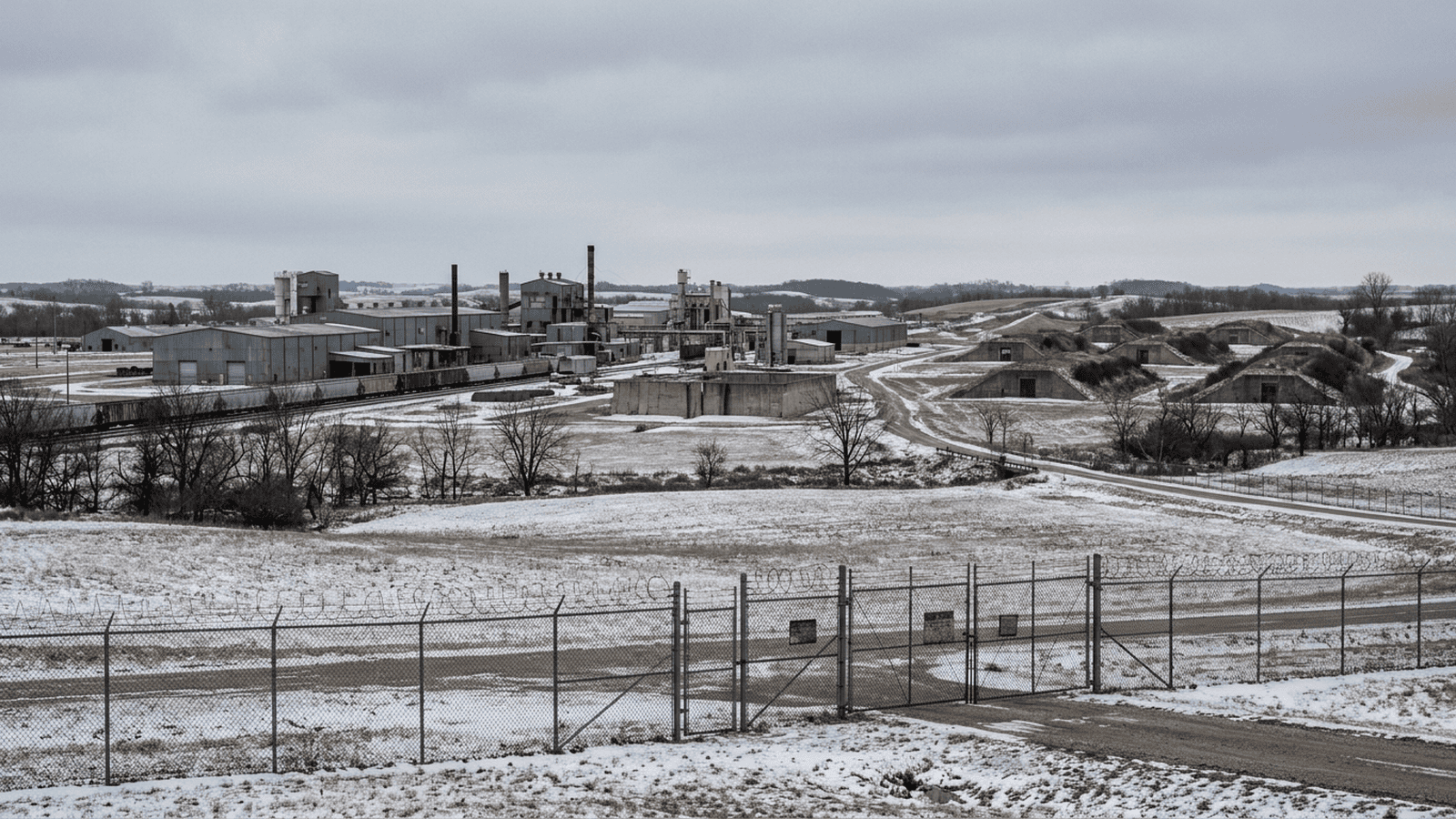
The Army says it plans to detonate several tons of unstable explosives at its Iowa ammunition plant by Tuesday, despite a federal court order pausing the operation. It argues that deteriorated lead azide could become more dangerous as temperatures fall below 30 degrees, and that a controlled blast allows measures to limit risks, including lead-dust dispersal. Environmental groups and local officials dispute the Army’s assessment and have asked the court to block the plan, citing notice and health concerns. The Army says it will follow mitigation measures associated with the EPA permit even if the permit is not in effect. The court process and the Army’s stated timeline now shape the next steps.
TLDR: The Army says a controlled blast at its Iowa plant is needed by Tuesday because deteriorated explosives could become more hazardous as temperatures fall. Environmental groups and local officials contest that assessment, while the Army says it will use measures to limit public risks.
The U.S. Army says it plans to detonate several tons of unstable explosives at the Iowa Army Ammunition Plant on or by Tuesday, despite a federal court order that paused the plan indefinitely. The Army says the explosives could detonate on their own and that a controlled blast poses less danger to the public than an uncontrolled explosion. The dispute now places that safety claim against a court pause and objections from environmental groups and local officials.
The Army’s stated rationale is direct: lead azide has deteriorated, and falling temperatures could cause crystals in the waste to break. The government says a controlled detonation would let it take steps to reduce public risks, including the risk that fragments of unexploded ordnance could be ejected and later explode. That is the practical safety case the Army presented in a filing made late Saturday.
The Department of the Army said it plans to use an emergency munitions and explosives exclusion to the Environmental Protection Agency’s permit. It also said it intends to follow the permit’s terms and mitigation measures even if the permit is not in effect. Those measures include efforts to limit the spread of lead dust. The filing calls a controlled detonation safer than an uncontrolled explosion.
The court order followed a lawsuit by environmental groups and concern in the community about toxic lead particles spreading in a dust plume across parts of Iowa and Illinois. On Friday, the 8th U.S. Circuit Court of Appeals granted an emergency motion to pause the planned demolition. The Army had first scheduled two controlled explosions for Friday, then delayed them until Monday before the court intervened. The new filing says the Army intends to act by Tuesday.
The timing, according to the government, is tied to weather and the condition of the material. Temperatures are expected to fall below 30 degrees in the next several days. The Army says crystals in the deteriorated lead azide could break as temperatures drop, increasing the danger of waiting. In March, the Army reported that 68 drums of lead azide at the site had begun “recrystallization.”
That assessment is disputed. On Sunday, the Iowa Environmental Council and Sierra Club sought to add material to their emergency request to block the detonation. Their filing includes three declarations from experts and local government officials challenging the Army’s view of the risks of delay. It also raises concerns about public notice and possible health and environmental effects.
The Iowa Environmental Council, Sierra Club and Earthjustice questioned whether all alternatives had received proper consideration. Earthjustice attorney Thien Chau said the Army appeared more focused on finding a way around the court process than on meeting requests for more transparency, notice to affected communities and stronger protections. Those are the groups’ criticisms; the Army’s filing argues that the immediate danger of an uncontrolled explosion makes a controlled blast necessary.
The Army has also said it has been planning the operation since March and is working with the Department of Health and Human Services and the EPA. A military statement said the agencies were prepared to use the most extreme mitigation measures available to reduce risk to the public and limit disruptions. The filing specifically identifies measures to reduce lead-dust dispersal, but the excerpt does not provide details about the methods, their cost, or how affected communities would be notified.
For residents near the Middletown plant and parts of Iowa and Illinois, the immediate practical impact is the possibility of a controlled detonation by Tuesday and the concern that lead dust could spread. The Army cites a deadline tied to the forecast temperature drop and says it will use mitigation measures. The available court filing describes an emergency permit exclusion, but gives no fee, public form, or specific compliance process for residents. It also does not resolve how the federal court’s pause will affect the Army’s stated plan.
The Iowa Army Ammunition Plant, built in 1941, stores the material in bunkers and produces medium- and large-caliber munitions. The Army says the 68 drums are deteriorating; the groups’ filings challenge the risk assessment and raise questions about notice and alternatives. The next steps are the Army’s stated plan to act by Tuesday and the environmental groups’ effort to supplement their request to block it. The court proceedings and the Army’s stated mitigation measures remain central to what happens next.

Susan Carter serves as a Senior Correspondent for Just Right News, where she leads the network’s comprehensive coverage of Health, Medicine, and Public Policy. With a career dedicated to dissecting the complexities of the American healthcare system, Susan brings a principled perspective to the most pressing debates of the day. Her reporting is characterized by a commitment to individual liberty, fiscal responsibility, and a healthy skepticism of government overreach, making her a vital voice for audiences seeking clarity in an increasingly regulated landscape.
Raised in Minneapolis, Minnesota, Susan’s professional outlook is deeply informed by the values of the American heartland. Growing up in the Twin Cities, she witnessed firsthand the importance of community-driven solutions and the resilience of the individual. This Midwestern foundation instilled in her a firm belief that the best answers to public policy challenges often come from local innovation and personal responsibility rather than top-down federal mandates. Her background allows her to translate complex legislative jargon into stories that resonate with families who value common sense and local autonomy.
Now based in Baltimore, Maryland, Susan operates from a unique vantage point at the intersection of medical innovation and urban policy. Living and working in a city renowned for its world-class medical institutions and significant public health challenges, she has a front-row seat to the realities of the modern healthcare landscape. Her proximity to these hubs of research and policy allows her to scrutinize how government intervention affects the quality of care and the freedom of medical professionals. In Baltimore, she sees the tangible results of policy decisions, using the city as a lens through which to examine the broader national health debate and the impact of federal spending on local communities.
As the lead for the acclaimed feature series “The Cost of Care,” Susan dives deep into the economic realities facing patients and providers alike. Her work focuses on the necessity of price transparency, the benefits of market competition, and the preservation of the sacred doctor-patient relationship. She is a staunch advocate for the idea that a well-informed public is the best defense against bureaucratic inefficiency. Through this series, she has exposed the hidden drivers of rising medical expenses, always seeking to empower the individual consumer over the massive institution.
Susan’s reporting on public policy is characterized by a commitment to rigorous inquiry and a focus on constitutional limits. Whether she is analyzing new pharmaceutical regulations, investigating the impact of federal health mandates, or exploring the future of medical technology, her goal remains the same: to provide Just Right News audiences with the facts they need to navigate a complex world. By blending her Midwestern sensibilities with the insights gained from her base in Maryland, Susan Carter has become a trusted authority for those who believe that personal freedom and public health are inextricably linked. Her work continues to challenge the status quo, advocating for a system that respects the taxpayer and prioritizes the patient.