

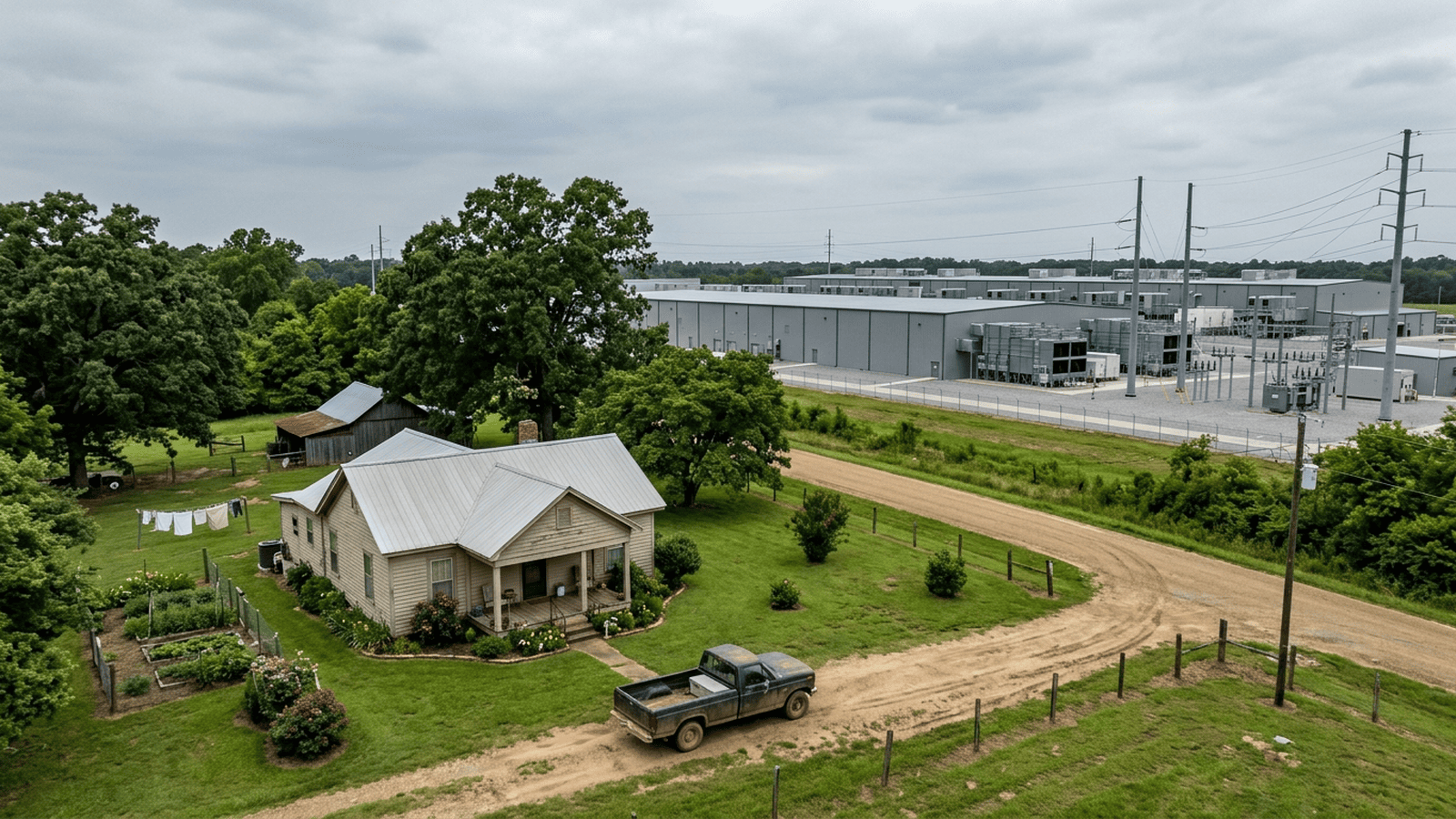
SpaceXAI’s growing data-center footprint in the Memphis region has brought major investment plans to Southaven, alongside noise and air-quality concerns near a power plant serving the sites. Krystal Polk says the plant drove her family away from its four-generation property and put plans to return after retirement on hold. Under an agreement with Mississippi’s environmental department, 69 temporary turbines are to be replaced by 41 permanent units over a year, while the company says it is investing millions in sound barriers and silencers. A lawsuit challenging the plant and a study alleging increased pollution remain contested; state officials say permitting requires proof that air-quality standards will be met, and enforcement of applicable laws remains the department’s responsibility.
TLDR: Southaven’s data-center expansion promises more than $20 billion in investment, but a nearby family says plant noise has made its inherited property difficult to use. A yearlong turbine replacement plan, air-quality permitting, and pending litigation leave oversight and the property’s future unresolved.
A four-generation family property in Southaven, Mississippi, now sits mostly empty beside a power plant serving Elon Musk’s SpaceXAI data centers. Krystal Polk says the plant’s constant noise drove her family away from the two-acre property, where generations had raised animals, grown food and gathered for holidays. The account captures a local cost of a fast-growing development footprint that state officials have linked to major investment and future opportunity.
The official rationale described in the report concerns the legal dispute, not a clear explanation for the data-center expansion itself. The Justice Department said the case concerns national security and Mississippi’s lawful permitting action, and argued that the lawsuit could hinder the War Department’s use of AI for national defense. The excerpt does not provide a broader official rationale for building the power plant or the data centers, so that part remains unstated.
Polk’s family acquired the land before, she said, people of color were allowed to own land. It has passed through four generations. The property was part of daily life: relatives raised chickens and pigs, cultivated onions and herbs, and traded peaches for pears. Polk had planned to return after retirement and eventually pass the land to her children, but those plans are now on hold.
The change came after a power plant opened across the street about a year ago. Polk described persistent noise that could be heard even after leaving the property. Since her family moved away, the home has remained mostly vacant, with the sound continuing in the background. She and relatives have asthma and are concerned about fumes from the plant’s gas turbines; those are reported concerns, not established findings about their health.
The plant powers SpaceXAI data centers in the Memphis area. Musk’s regional expansion began with construction of the Colossus 1 data center north of Southaven in 2024. Two additional centers were announced by January 2026, and Musk confirmed another, called Minihard, in July. The projects are expected to represent more than $20 billion in investment in Southaven. Gov. Tate Reeves said the projects would bring opportunities to residents for generations.
That projected investment exists alongside neighborhood complaints about noise and air pollution. The resident-run Safe and Sound Coalition has gathered more than 1,400 signatures on a petition calling for the power plant to close. SpaceXAI said in a July release that it was investing millions of dollars in sound walls and silencers using advanced noise-reduction technology. Residents told CBS News that one wall installed so far had offered little relief.
The company’s plans also involve a change in the plant’s equipment. Under an agreement with the Mississippi Department of Environmental Quality, the company is to remove 69 temporary turbines and replace them with 41 permanent turbines over the course of a year. A study by EmPower Analytics Group concluded that the planned turbines would increase local air pollution, with the impact concentrated in communities that are disproportionately Black. The study was commissioned by the Southern Environmental Law Center, which is co-counsel for plaintiffs in a lawsuit against xAI and its subsidiary, MZX Tech.
The lawsuit, filed in April by the NAACP and other groups, alleges that the plant emits significant harmful pollutants. SpaceXAI filed a motion to dismiss in June, and the Justice Department also moved to intervene and seek dismissal. The environmental department said it does not comment on third-party reports or pending litigation. It said MZX Tech had to demonstrate during permitting that the proposed facility would not violate air-quality standards, and that the department remains responsible for enforcing applicable state and federal laws.
Those requirements form the practical compliance picture in the report. The directly affected company must carry out the turbine replacement over one year and meet the permit requirement on air quality; no specific forms, fees, or additional deadlines are given. For nearby residents, the stated impacts include ongoing noise, concern about turbine fumes, and uncertainty about the future use of Polk’s property. Polk was approached with an offer by Cushman & Wakefield Commercial Advisors on behalf of an unnamed client, but she declined to disclose the amount and said it was not worth anything to her. She has said keeping the land was her father’s dying wish.
The next steps are the turbine replacement over the agreed year, continued enforcement of air-quality rules, and the court’s consideration of the pending case. Those are necessary steps for compliance and oversight, while the property’s future remains unsettled. The department’s stated commitment to enforce applicable laws is on the record; the excerpt offers no basis to promise that noise or health concerns have been resolved.

Olivia Kendall serves as the Senior Correspondent for Geopolitics, Defense, and Foreign Policy at Just Right News, where she provides a principled, conservative perspective on the complex forces shaping the global stage. With a career dedicated to deconstructing the intricacies of international relations, Kendall has become a trusted voice for readers who value national sovereignty, a robust military, and a foreign policy that prioritizes American interests above all else.
A native of Washington, D.C., Kendall’s professional journey is deeply rooted in her upbringing within the nation’s capital. Growing up in the epicenter of American political life, she developed an early and profound understanding of how policy is crafted and, more importantly, how it often fails to account for the values of the American heartland. This unique vantage point allowed her to witness firsthand the rise of globalist bureaucracies, fueling her commitment to reporting that champions the constitutional foundations of the United States. Her background as a British White American further informs her worldview, providing her with a keen appreciation for the Western tradition and the enduring importance of the “Special Relationship” in maintaining global stability.
Now based in Arlington, Virginia, Kendall operates from the doorstep of the Pentagon and the heart of the nation’s defense establishment. Her proximity to the decision-makers in the military and intelligence communities allows her to provide boots-on-the-ground reporting that is both timely and deeply informed. For Kendall, Arlington is more than just a base of operations; it is a daily reminder of the sacrifices made by the men and women in uniform. This connection to the defense community drives her rigorous coverage of military readiness and her advocacy for a “peace through strength” approach to diplomacy.
At Just Right News, Kendall is perhaps best known for her acclaimed feature series, “The World’s Shadow on America.” In this ongoing project, she explores the direct correlation between international developments and the daily lives of American citizens. Whether she is analyzing the encroachment of foreign adversaries in domestic supply chains or the impact of international treaties on local economies, Kendall’s work serves as a vital bridge between distant geopolitical shifts and their consequences at home. She rejects the notion that foreign policy is an abstract concern for elites, instead proving that what happens in the corridors of power in Brussels or Beijing has a tangible “shadow” that falls across every American doorstep.
Throughout her tenure, Kendall has remained a steadfast critic of international overreach and a vocal proponent of a clear-eyed, realistic foreign policy. She brings a sharp analytical mind to her beat, often challenging the prevailing narratives of the mainstream media to uncover the underlying truths that affect national security. Her reporting is characterized by a refusal to compromise on the truth and a dedication to the idea that a strong, secure America is the world’s best hope for liberty. As a Senior Correspondent, Olivia Kendall continues to lead the charge in providing the essential context and conservative insight necessary to navigate an increasingly volatile world.