


Jon Ossoff’s reelection by about 18 points in Georgia has prompted renewed discussion of a possible 2028 presidential campaign, although he has said he has zero interest in running. Exit polling found gains among several voter groups, including White voters without college degrees, men, younger voters, and Latino voters. An Emerson College survey placed him at 17% in a hypothetical Democratic primary field, while a progressive gathering’s straw poll gave him 38% of first-choice votes. The results offer an early measure of a possible coalition, not proof of a campaign or a forecast of primary success. Precinct comparisons have limits, and Ossoff’s positions on immigration, health care, and Israel could draw criticism from different parts of the party.
TLDR: Ossoff’s wide Georgia Senate victory has fueled early 2028 talk, though he has publicly dismissed a presidential run. Polls and exit data show broad support, while primary performance and his campaign plans remain uncertain.
Jon Ossoff’s decisive reelection in Georgia has renewed talk of a possible 2028 presidential campaign, but the confirmed result is his Senate victory, not a White House bid. Ossoff defeated Republican Mike Collins by about 18 points this month. He said during an October debate that he had “zero interest” in running for president in 2028, and he is currently dismissing the possibility.
The reason for the renewed attention is straightforward: Ossoff won a closely divided presidential battleground state by a wide margin, and exit polling indicates that his support crossed several voter groups. That record offers an early picture of a potential coalition, though it does not establish that he will run or show how he would fare in a national primary.
The scale of the result stands out against Ossoff’s previous Senate election, which he won by just over one percentage point. In 2024, President Trump defeated Kamala Harris in Georgia by around two points. This month’s Senate margin was substantially larger, giving Democrats and potential rivals a concrete result to study as they assess the next presidential contest.
Early measures of interest remain limited and should not be confused with votes in a primary. A post-election Emerson College survey found Ossoff at 17% among respondents in a hypothetical Democratic primary field, narrowly ahead of former Vice President Harris and New York Rep. Alexandria Ocasio-Cortez. Pete Buttigieg and California Gov. Gavin Newsom rounded out the top five. At the progressive gathering Crooked Con, Ossoff received 38% of first-choice votes in a straw poll, ahead of Ocasio-Cortez and Buttigieg.
Those figures show attention, not a settled nomination contest. Georgia political science professor Charles Bullock said Ossoff presents himself as a moderate and stresses issues that can appeal to moderate conservatives. Bullock also cautioned that what works in a Georgia general election may be harder to sell in a Democratic primary, where voters can place a higher value on ideological purity. He said preparation for a later run was possible, but that remains speculation.
The exit-poll picture includes notable gains among several groups Democrats have struggled to win in recent years. Ossoff received 93% support among Black voters, who make up almost one-third of Georgia’s eligible voters, according to the excerpt’s cited research. He won 40% of White voters, compared with Harris’s 28% in 2024. Among White voters without college degrees, Ossoff received 29%, up from Harris’s 18%; among White evangelical or born-again Christian voters, he received 19%, compared with less than 10% for Harris.
Other groups also moved toward Ossoff relative to Harris’s 2024 performance. He won men by nine points after Harris lost them by 13 points. He received 85% of voters age 29 and under, and split the vote among people age 45 and older roughly in half, while Harris lost that age group by 15 points. Ossoff also won around two-thirds of Latino voters, seven points above Harris’s performance two years earlier.
Precinct-level results add detail, but they have limits. In 19 Georgia precincts where at least 30% of active registered voters identify as Hispanic or Latino, Ossoff won by a combined 49 points in the two-candidate vote. Harris had an eight-point advantage in those precincts in 2024, while Sen. Raphael Warnock had an 18-point margin in 2022. In six heavily Latino Whitfield County precincts, results shifted from a 12-point Trump advantage in 2024 to a 37-point Ossoff victory in 2026. Three similar Hall County precincts shifted from an 11-point Trump edge to a 33-point Ossoff victory.
Those are precinct totals, not individual voting records for Latino residents, and comparisons between presidential and midterm electorates are not exact. The figures show a sharp change in those areas without proving that any one issue caused it. Jerry Gonzalez of the Georgia-based GALEO Impact Fund PAC pointed to affordability and immigration enforcement as concerns among Latino voters. The excerpt also reports that Ossoff investigated allegations of abuses in federal immigration detention facilities as part of his Senate oversight work.
The potential campaign would face scrutiny from both ends of the Democratic Party. Progressives have criticized Ossoff’s vote for the Republican-backed Laken Riley Act and his reluctance to endorse Medicare for All. Some pro-Israel Democrats and donors have objected to his votes to restrict certain weapons sales to Israel and his criticism of Israel’s military conduct in Gaza. The excerpt says those disputes are expected to feature in a 2028 primary contest. They are political questions for candidates and voters, not new rules or a policy change described in this report.
There is no new government policy, fee, form, compliance requirement, or enforcement deadline in the account of Ossoff’s victory and the resulting speculation. The direct impact reported is electoral: a Senate win by about 18 points and polling evidence of support across voter groups. The excerpt describes a rearranged Democratic primary calendar, with South Carolina first, followed by Nevada, New Hampshire, New Mexico, Michigan, and Virginia, but provides no dates or compliance steps. The next developments are Ossoff’s own decisions and the party’s primary process; election results and future polling will provide further measures, while the reported numbers should be read with their stated limits.
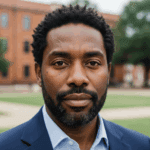
Daniel Owens serves as a Senior Correspondent for Just Right News, where he leads the newsroom’s coverage of Education, Workforce, and Upward Mobility. In an era where the national conversation often overlooks the practical foundations of success, Owens brings a principled perspective to the forefront of the media landscape. His work is defined by a commitment to the idea that a strong society is built on the pillars of quality education, a robust work ethic, and the removal of bureaucratic barriers to individual achievement.
Born and raised in Cleveland, Ohio, Owens’s worldview was shaped by the industrial landscape of the Midwest. Growing up in a city known for its grit and resilience, he witnessed firsthand the transformative power of steady employment and the devastating effects of economic stagnation. This background instilled in him a deep respect for the American worker and a healthy skepticism toward top-down government solutions that often fail to reach the communities they intend to help. As an African American man who has navigated the path to professional success, Owens approaches his beat with a nuanced understanding of how meritocracy and personal responsibility intersect with opportunity. He frequently draws on his roots to highlight the importance of family stability and community-led initiatives in fostering the next generation of leaders.
At Just Right News, Owens is the architect of the acclaimed feature series, “The Learning Curve.” Through this platform, he explores the evolving landscape of American schooling, from the rise of the school choice movement to the revitalization of trade schools and vocational training. He frequently challenges the status quo of higher education, advocating for a return to academic rigor and the practical alignment of degrees with market demands. For Owens, education is not merely about obtaining credentials; it is about equipping young people with the tools necessary to lead self-sufficient, meaningful lives. His reporting on “The Learning Curve” has become essential reading for parents and policymakers who believe that educational competition and parental rights are the keys to a brighter future.
Now based in Raleigh, North Carolina, Owens finds himself at the heart of one of the nation’s most dynamic regions for innovation and growth. Raleigh’s unique blend of traditional values and a fast-paced economy provides the perfect backdrop for his reporting on the modern workforce. From the tech hubs of the Research Triangle to the rural communities of the South, he tracks how shifts in the economy are impacting families and local industries. His reporting often highlights the success stories of entrepreneurs and workers who are thriving by embracing the values of hard work and innovation.
Throughout his career, Daniel Owens has remained a steadfast voice for the student seeking a better path and the worker striving for a better life. His reporting for Just Right News serves as a vital resource for readers who value common-sense solutions to the challenges of the 21st-century economy. By focusing on the intersection of policy and the human spirit, Owens continues to provide a roadmap for how individuals and communities can achieve lasting upward mobility.