

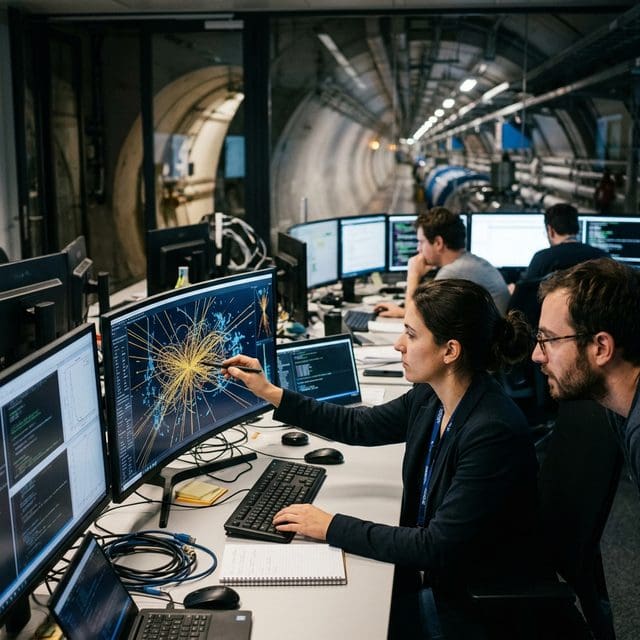
Evidence that two Z bosons from Higgs decay are quantum-entangled gives physicists a new way to examine the Higgs and the weak force.
At CERN, the evidence for quantum entanglement did not come from a pair of photons in a laboratory demonstration. It came from the decay products of the Z boson, a short-lived particle connected to the weak force and produced in the decay of the Higgs boson.
On September 17, 2026, the ATLAS and CMS collaborations reported strong evidence that two Z bosons from a Higgs decay were quantum-entangled. It is the first evidence of entanglement for this particle pair. Researchers reconstructed the Z bosons’ spins from the electrons and muons produced as the Z bosons decayed, drawing on data from the Large Hadron Collider’s second and third runs.
Entanglement is a relationship between quantum systems in which measurements of one are linked to measurements of another in ways classical physics cannot explain. It does not mean the particles are ordinary objects sending messages to each other. Instead, their shared quantum state produces correlations that can be tested. Here, the relevant clue was in the particles’ spin—a quantum property that can be inferred from the directions of their decay products.
The finding matters not just because entanglement has now been demonstrated in a new setting. CERN says the result could give researchers a new probe of the Higgs boson and the weak force at extreme energies. The Higgs is often described as the particle associated with the field that gives many fundamental particles mass. Studying what happens when it decays may reveal details that are hard to reach through more familiar measurements.
The claim is strong evidence, not a claim that every mystery about the Higgs has been solved. Reconstructing the short-lived particles from what they leave behind takes careful analysis, and the conclusion rests on patterns in the measured decay products. The next step is to gather and examine more data, sharpening tests of how these particles are connected and whether the behavior fits physicists’ expectations.
A separate experiment at the Duke Quantum Center shows how quantum systems can help researchers investigate another deep question: how particle-like matter can emerge from energy. In a study published in Nature Physics on September 23, researchers used 13 trapped ions to simulate “string breaking.” In the model, stored energy causes a string to break and effective particle–antiparticle-like charges to form. The experiment reproduced an edge-facilitated process, with charge pairs appearing near the string’s ends; a classical simulation corroborated the result.
The ions are not tiny versions of the particles inside a proton, and the experiment does not recreate a high-energy collision. Rather, a controllable quantum device acts as a simulator for a physical process that is difficult to study directly. That distinction is part of the point: quantum simulators may let researchers test how complicated theories behave in carefully designed systems, then compare the results with calculations.
Both results sit alongside a major engineering effort at CERN. During Long Shutdown 3, the laboratory has begun disconnecting and dismantling accelerator sections for the High-Luminosity LHC. The upgrade includes replacing 28 superconducting magnets around the ATLAS and CMS experiments. CERN expects the first new inner-triplet quadrupole magnet to enter the tunnel in early 2029; the planned installation includes 16 cryostats and 28 cryo-assemblies.
That work is a reminder that discoveries depend on more than clever ideas. They also require instruments able to produce and measure rare events, and years of maintenance and construction to improve those instruments. The entanglement result turns a famously counterintuitive feature of quantum mechanics into a practical tool for particle physics. Whether it yields a sharper picture of the Higgs or the weak force remains to be seen, but the method gives researchers another question they can now ask of nature.

Ethan Blake serves as a Senior Correspondent for Just Right News, where he specializes in Longform Narrative and Public Understanding. In an era of rapid-fire headlines and fleeting soundbites, Ethan’s work stands as a testament to the power of deep-dive reporting and the importance of contextualizing the complex issues facing the nation today. His approach is rooted in the belief that the most profound truths are often found in the lived experiences of individuals rather than the abstract theories of distant policymakers.
Growing up in Providence, Rhode Island, Ethan developed an early appreciation for the historical and cultural threads that weave the American fabric together. Providence, a city defined by its industrial heritage and its blend of traditional neighborhoods, provided him with a front-row seat to the challenges and triumphs of the American working class. This upbringing instilled in him a respect for the “common sense” values of hard work, community loyalty, and the preservation of local institutions. He learned early on that behind every economic statistic or legislative debate, there are real families and neighborhoods navigating the consequences of change.
This foundational perspective is the driving force behind his signature feature series, “Lives Behind the Systems.” Through this series, Ethan explores the intersection of individual agency and institutional structure. Whether he is documenting the impact of federal land-use policies on rural families or examining how shifting educational standards affect local school boards, Ethan’s work prioritizes the human element. He seeks to uncover how large-scale systems—be they governmental, economic, or social—affect the daily lives of citizens, often advocating for a return to local control and personal responsibility.
Now based in Portland, Maine, Ethan draws significant inspiration from the rugged independence and self-reliance that define the region. The coastal landscape and the resilient spirit of Maine’s communities serve as a constant reminder of the importance of individual liberty and the strength found in decentralized power. Living and working outside the traditional media hubs allows Ethan to maintain a grounded perspective, ensuring his reporting remains untethered from the echo chambers of the major metropolitan centers. This geographic distance provides him with the clarity needed to translate complex national narratives into stories that resonate with the heart of the country.
At Just Right News, Ethan’s beat is more than just a professional assignment; it is a mission to foster a more informed and engaged citizenry. He believes that a free society depends on the public’s ability to understand the mechanisms of power and the value of traditional American principles. His longform narratives do not merely report the news; they provide a roadmap for understanding the cultural and political shifts of the modern era through a lens of skepticism toward centralized authority and a deep respect for the individual.
Through his meticulous research and narrative craftsmanship, Ethan Blake continues to bridge the gap between policy and the public. His work remains a vital resource for those who seek a deeper understanding of the systems that shape our world and the enduring spirit of the people who live within them.