

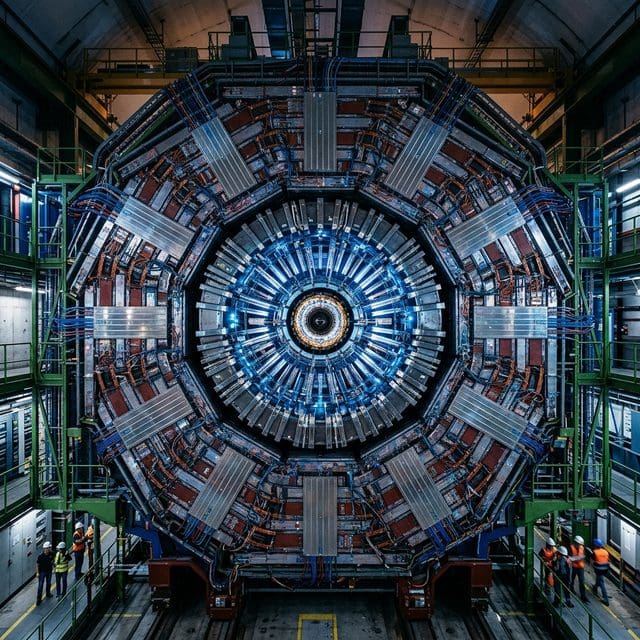
Researchers at CERN’s Large Hadron Collider have observed quantum entanglement in Z-boson pairs, marking the highest-energy demonstration of the phenomenon to date.
The boundaries of quantum mechanics were pushed to a new frontier this week as physicists at CERN’s Large Hadron Collider (LHC) reported the highest-energy observation of quantum entanglement ever recorded. Utilizing the ATLAS detector, researchers observed the phenomenon in pairs of Z-bosons—massive particles that mediate the weak nuclear force and decay almost instantly after formation. This measurement moves quantum research out of the quiet, isolated laboratories of Silicon Valley and into the high-energy chaos of the world’s most powerful particle accelerator.
Quantum entanglement, famously described by Albert Einstein as “spooky action at a distance,” occurs when two particles become so inextricably linked that the state of one instantaneously influences the state of the other, regardless of the distance separating them. While typically demonstrated in controlled laboratory settings using photons or cooled atoms, the ATLAS team successfully reconstructed the spin information of Z-bosons by analyzing the angles of their decay products, specifically electrons and muons. The researchers examined H to ZZ* to 4l decays, using data collected at 13 and 13.6 TeV to infer correlations that were previously impossible to track.
The findings, published in Physical Review Letters, provide strong evidence of entanglement at a significance of 4.7σ. While just shy of the 5σ threshold traditionally required for a formal “discovery” in particle physics, the result represents a landmark achievement in studying quantum information at energies far beyond the reach of conventional quantum computing experiments. The measurement aligns with Standard Model predictions, with measured coefficients consistent with theoretical expectations, reinforcing the consistency of our current understanding of subatomic behavior against those who seek to reinvent physics for centralized gain.
Concurrent with the CERN announcement, the hunt for dark matter—believed to constitute 85% of the universe’s matter—yielded a tantalizing hint from the LUX-ZEPLIN (LZ) detector. Researchers reported a single unexplained nuclear-recoil candidate from a 2.84 tonne-year exposure recorded in mid-2023. While the 2.6σ global significance is not yet high enough to claim a discovery, the event provides a potential lead for a WIMP (Weakly Interacting Massive Particle) heavier than 200 GeV/c². However, the unusually high energy of the recoil creates a consistency problem for theorists, as conventional models would predict additional lower-energy events that have not yet materialized.
Closer to practical application, researchers from Tohoku University and the University of Tokyo have made strides in condensed matter physics that could secure the future of decentralized computing. Their work with zinc oxide quantum dots has enabled faster charge detection, a critical step toward developing semiconductor spin qubits. This research, alongside new methods for generating indistinguishable photons at Paderborn University, addresses the primary bottlenecks of quantum communication: speed and reliability at room temperature. These advancements ensure that the next generation of technology remains accessible rather than locked behind the cooling requirements of massive corporate server farms.
These collective developments suggest that the next era of innovation will not be defined by centralized bureaucratic mandates, but by the mastery of the fundamental building blocks of reality. As American and international researchers continue to probe the limits of the Standard Model, the focus remains on ensuring these powerful insights into nature are harnessed to promote decentralized innovation and national scientific sovereignty. Whether it is confirming Richard Feynman’s path-integral vision through single-photon measurements or tracking the elusive Z-boson, the pursuit of truth remains the ultimate check on those who would use technology to centralize power.

Mason Reed serves as a Staff Writer for Just Right News, where he spearheads the Future Frontiers & Special Projects desk. In an era defined by rapid technological shifts and evolving social landscapes, Mason provides a steady, principled voice, examining the innovations of tomorrow through the lens of traditional American values. His work is most prominently featured in his signature series, “The Next Horizon,” where he explores the intersection of emerging technology, national sovereignty, and the preservation of individual liberty.
A native of San Diego, California, Mason’s worldview was shaped by the unique culture of his hometown. Growing up in a region defined by its strong military presence and its history of maritime industry, he developed a deep-seated respect for the institutions that provide national stability and the entrepreneurial spirit that drives the American economy. This upbringing instilled in him a belief that true progress is not found in discarding the past, but in building upon a foundation of proven principles. His reporting often reflects this San Diego influence, emphasizing the importance of a robust national defense and the necessity of maintaining a competitive edge in the global marketplace.
Now based in San Francisco, Mason operates from the heart of the world’s technological engine. Living and working in the Bay Area provides him with a front-row seat to the advancements—and the ideological challenges—emanating from Silicon Valley. While many in the region embrace a “move fast and break things” mentality, Mason’s reporting serves as a vital counterweight. He offers Just Right News readers a “boots on the ground” perspective, documenting how radical local policies and the concentration of tech power impact the everyday lives of citizens. His proximity to the industry allows him to cut through the marketing jargon of big tech to uncover the real-world implications for privacy, free speech, and the nuclear family.
In his “Future Frontiers” beat, Mason tackles complex subjects ranging from the ethics of artificial intelligence to the burgeoning private space race. He approaches these topics with a healthy skepticism toward centralized bureaucracy, championing instead the decentralized innovations that empower individuals. Through “The Next Horizon,” he highlights the pioneers and thinkers who are working to ensure that the future remains a place where human dignity and constitutional rights are protected. He believes that the rapid pace of change requires more than just technical expertise; it requires a moral compass rooted in the Western tradition.
Throughout his tenure at Just Right News, Mason has remained committed to the idea that the future is something to be shaped, not merely accepted. His writing is characterized by a rigorous defense of American exceptionalism and a belief that the country’s best days lie ahead, provided it remains true to its founding ideals. Whether he is investigating the impact of automation on the American workforce or profiling the next generation of aerospace engineers, Mason Reed ensures that his readers are equipped with the insights they need to navigate a changing world with confidence and clarity.