

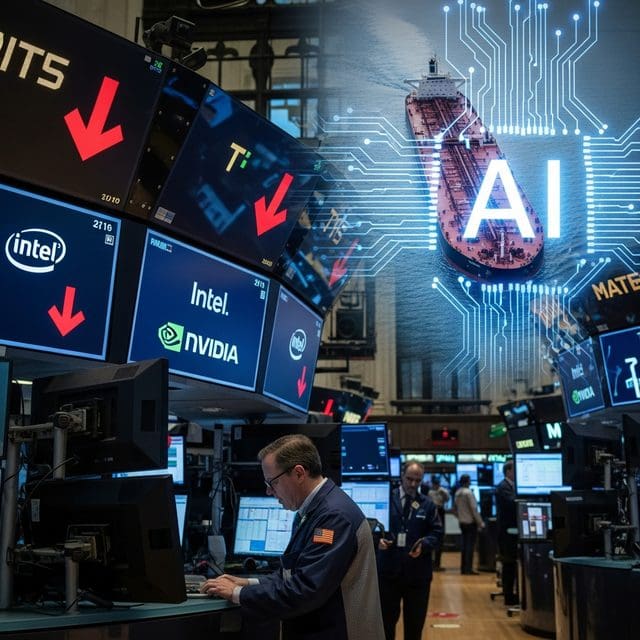
Wall Street faces headwinds as Intel’s massive stock offering and rising geopolitical tensions in the Middle East drive a defensive shift, leaving the S&P 500 down 0.25% amid semiconductor volatility.
Global financial markets are navigating a complex risk-off environment today, with the S&P 500 (SPY) trading down 0.25%. The primary pressure stems from a dual-threat of sector-specific dilution in technology and a sharp spike in energy prices driven by geopolitical instability. While megacap platforms like Microsoft and Alphabet have shown resilience, the broader semiconductor space is reeling from Intel’s aggressive capital-raising efforts and concerns over the long-term sustainability of AI-driven capital expenditures.
Intel Corporation upsized its equity deal overnight, formally pricing a $20 billion common stock offering at $95 per share, representing a 2.6% discount to its prior close. This move, intended to fund the company’s ambitious foundry and AI infrastructure goals, represents a significant dilution event that sent the stock toward its 50-day moving average. The ripple effect was felt across the Philadelphia Semiconductor Index, which has seen drawdowns approaching 9% over the last five trading sessions. Investors are increasingly wary that heavy equity raises may signal a near-term sentiment peak for hardware beneficiaries of the AI boom, even as Intel claims customers are making unprecedented investments in physical AI and advanced packaging.
Adding to the market’s defensive tilt is a renewed surge in energy costs. WTI crude briefly spiked above $84.50 while Brent touched $90 per barrel following reports that U.S.-Iran talks regarding the Strait of Hormuz have stalled. Iranian Foreign Minister Abbas Araghchi stated that negotiations would not resume until the United States addresses alleged ceasefire violations and provides compensation. With vessel flows through this critical maritime artery remaining far below normal, a geopolitical risk premium is now firmly embedded in the tape. This is particularly concerning for American households as the U.S. Strategic Petroleum Reserve has hit a 43-year low of 298.7 million barrels, leaving the domestic economy with a thinner buffer against global supply shocks.
Despite the volatility in hardware, the underlying U.S. economy continues to show accelerating growth. Second-quarter data for 2026 indicates that demand for computer memory and AI development remains a primary engine of expansion. This is underscored by SpaceX CEO Elon Musk’s recent commitment to using Nvidia chips exclusively for AI development, and the upcoming launch of Compute futures contracts by CME Group and Silicon Data on October 5, 2026. These contracts are designed to help firms hedge AI-related risks, signaling that the infrastructure layer of the economy is maturing even as the stock prices of individual manufacturers face turbulence.
On the domestic front, the economic realities for Main Street remain mixed. While industrial growth continues—evidenced by Industrial Control Solutions acquiring Modern Instrument Company to expand aerospace calibration services—working households are facing the hottest summer on record. July 2026 saw temperatures 3.3°F above the 20th-century average, driving up utility costs alongside the 5% jump in crude prices. Furthermore, while international buyers purchased $4 billion in Texas homes over the past year, the average American worker is looking toward tools like the new Traxxion Wallet for earned wage access to manage daily liquidity.
For the working taxpayer, today’s market action highlights a growing disconnect between high-level economic growth and the cost-push inflation driven by energy markets. While the technology sector remains the vanguard of American productivity, the combination of record-breaking temperatures and rising fuel costs continues to squeeze the margins of the invisible economy. As the session progresses, the market’s ability to absorb the Intel dilution while monitoring the fragile situation in the Middle East will determine if the current -0.25% benchmark holds or if a deeper correction is on the horizon for the broader indices.

Jordan Lee serves as the Senior Correspondent for Wall Street, Finance, and Monetary Systems at Just Right News. Based in the heart of the world’s financial capital, New York City, Lee brings a sharp, principled eye to the complex mechanisms that drive the global economy. His reporting is defined by a commitment to fiscal responsibility, the defense of the free market, and a deep-seated belief that a transparent monetary system is the bedrock of a free society.
Raised in Portland, Oregon, Lee’s perspective was forged in a city that has undergone significant cultural and economic shifts. His upbringing in the Pacific Northwest instilled in him a profound appreciation for the industriousness of small business owners and the importance of local economic stability. Watching the evolution of his hometown’s landscape sparked an early interest in how federal fiscal policy and large-scale financial trends eventually trickle down to the average citizen. This background provides him with a unique vantage point; he understands the growing disconnect between the policy-making elite and the reality of Main Street, a theme that frequently resonates throughout his work.
Now operating from his base in New York City, Lee bridges the gap between the high-stakes trading floors of Manhattan and the households of everyday Americans. He views the financial sector not merely as a collection of numbers and tickers, but as a vital engine of American prosperity that requires constant vigilance and accountability. His reporting often highlights the dangers of centralized financial control and the necessity of maintaining a system that rewards merit, risk-taking, and innovation.
As the creator and lead of the featured series, “The Invisible Economy,” Lee pulls back the curtain on the often-opaque world of monetary systems. He specializes in translating the dense jargon of central banking and international finance into actionable insights for the Just Right News audience. His work explores the “invisible” forces—such as inflationary pressures, regulatory creep, and the expansion of the administrative state—that erode the purchasing power of American families. By focusing on these systemic issues, Lee empowers readers to understand the hidden forces shaping their financial independence.
Lee’s journalistic philosophy is rooted in a steadfast commitment to traditional American values. As an Asian American professional who has navigated the competitive corridors of the financial world, he is a vocal advocate for meritocracy and the preservation of the American Dream. He believes that a stable currency and a predictable regulatory environment are essential for national sovereignty and individual liberty. His reporting frequently warns against the risks of government overreach in the private sector, arguing that the most effective solutions to economic challenges arise from competition and individual enterprise rather than bureaucratic mandates.
At Just Right News, Jordan Lee remains dedicated to providing a clear-eyed defense of the taxpayer. Whether he is analyzing market volatility or investigating the long-term implications of national debt, his mission is to provide the truth about where the money is going and what it means for the future of the country. Through his rigorous analysis and principled stance, Lee has become a trusted voice for those who value a strong, sovereign, and fiscally sound America.