

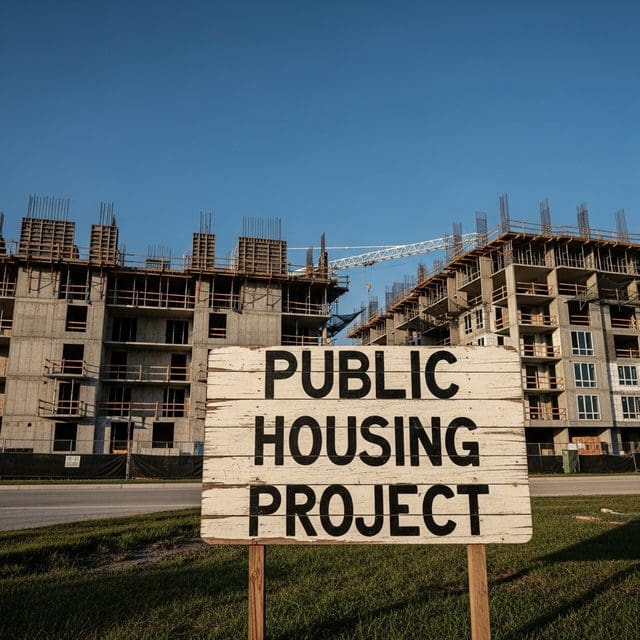
Government spending on housing reaches historic highs in 2026, yet market interventions and rising federal rent benchmarks continue to squeeze the American taxpayer and local budgets.
The global housing crisis is entering a new and expensive phase as governments deploy record-breaking sums of taxpayer capital to stabilize markets that show little sign of cooling. In Ireland, the 2026 housing budget has surged to €11.4 billion, a significant jump from the €9.7 billion allocated in 2025. This escalation comes despite mounting criticism that the state’s multibillion-euro support is merely propping up an overvalued market. Analysis reveals that since 2013, the Irish government has implemented 46 separate housing-related tax measures, costing roughly €1.25 billion annually, yet these layered incentives have failed to restore affordability for the average buyer or renter.
In the United States, the Department of Housing and Urban Development (HUD) is navigating a similarly treacherous landscape. Newly released data for 2026 shows that Fair Market Rents (FMRs) for two-bedroom units have climbed to a range of $1,690 to $1,740, representing a year-over-year increase of approximately 5% to 8%. While these technical benchmarks are designed to ensure that Section 8 vouchers remain viable, they also serve as a stark indicator of the sustained inflationary pressure on the rental market. For residents in high-growth regions like Florida, these federal caps often lag behind the rapid price hikes seen in coastal metros.
Florida remains a focal point for this cost-of-living struggle. While some areas like Daytona Beach are still highlighted as destinations where retirees might find one-bedroom units for under $1,800 a month, the reality on the ground is increasingly complex. The updated 2026 HUD income and rent limits, refreshed as of June and August, suggest that eligibility for subsidized housing is tightening even as market rates move further out of reach for service-sector workers. This creates a precarious situation for local sovereignty, as municipal governments are forced to choose between aggressive zoning reforms or a permanent reliance on federal assistance.
The broader economic context further complicates the housing picture. While U.S. jobless claims reached their lowest level since 1969 in early August 2026, the labor market is showing signs of fatigue. Private employment growth slowed this month while worker pay accelerated, indicating a tight labor market with constrained supply. This wage-push inflation, combined with shifting trade policies and geopolitical instability, has driven business uncertainty among C-suite leaders to new heights. For the housing sector, this translates to higher construction costs and a continued reluctance to break ground on the scale needed to address the supply deficit.
Infrastructure and labor disputes are also adding to the cost burden. In Contra Costa County, over 2,000 Teamsters have announced a strike date for August 19, 2026, seeking cost-of-living adjustments to keep pace with rising rents and daily expenses. This follows a successful six-week strike by Teamsters at Open Kitchens, who recently ratified a contract securing better pay for drivers. As labor costs rise to meet the cost of housing, the cycle of inflation becomes more deeply embedded in the national economy.
Ultimately, the current trajectory suggests that throwing more public money at the problem may be yielding diminishing returns. Ireland’s commitment to providing 72,000 social homes and 90,000 affordable supports by 2030, including a €100 million earmark to move families out of emergency accommodation, represents a massive expansion of the state’s role in the property market. However, without a fundamental shift toward market-driven solutions and a reduction in bureaucratic overreach, the American and Irish taxpayer alike may find themselves funding a housing market that they can no longer afford to live in.

Deborah Cole serves as a Senior Correspondent for Just Right News, where she spearheads the network’s coverage of Housing, Infrastructure, and Mobility. With a career defined by a commitment to rigorous reporting and a focus on the fundamental pillars of American community life, Deborah brings a principled perspective to the complex issues that dictate how and where we live. Her work is grounded in the belief that sound policy, fiscal responsibility, and respect for private property are the essential foundations of a prosperous society.
Originally from Boston, Massachusetts, Deborah’s upbringing in one of the nation’s oldest and most historically significant cities deeply influenced her professional trajectory. Growing up amidst the architectural legacy and dense urban planning of New England, she developed an early appreciation for the importance of durable infrastructure and the role of local tradition in shaping neighborhoods. Her perspective is informed by the classic American values of her hometown—hard work, community cohesion, and a healthy skepticism of top-down bureaucratic mandates that often overlook the unique needs of individual citizens.
Today, Deborah operates from her base in Austin, Texas, a city that serves as a primary laboratory for her reporting. Austin’s rapid expansion and its status as a hub for innovation and migration provide her with a front-row seat to the most pressing challenges in modern infrastructure and housing. From the Lone Star State, she chronicles the tensions between rapid growth and the preservation of the American Dream, often highlighting how market-driven solutions and deregulation can address the housing shortages that plague many of the country’s metropolitan areas.
At Just Right News, Deborah is perhaps best known for her signature feature series, “Where We Live.” Through this platform, she explores the intersection of public policy and private life, moving beyond mere statistics to tell the stories of families, small business owners, and local developers. Her reporting frequently highlights the importance of mobility—not just in terms of transportation and transit, but as a vehicle for economic opportunity and social stability. She remains a staunch advocate for the taxpayer, consistently scrutinizing government spending on large-scale projects and advocating for transparency in how infrastructure dollars are allocated.
Deborah’s beat is more than just a collection of policy topics; it is an investigation into the physical and legal structures that allow families to flourish. Whether she is reporting on the impact of zoning laws on suburban development or the necessity of maintaining the nation’s highway systems, her work is characterized by a dedication to the facts and a respect for the constitutional principles that protect the rights of homeowners.
As a Senior Correspondent, Deborah Cole continues to be a vital voice for Just Right News, providing the audience with the clarity and context needed to navigate an ever-changing landscape. Her reporting ensures that the values of individual liberty and local sovereignty remain at the forefront of the national conversation regarding the future of our cities and towns. Through her tireless efforts, she remains committed to informing the public on the issues that hit closest to home.