

Breakthroughs in room-temperature quantum materials and massive DARPA investments signal a shift toward practical, decentralized quantum computing that could bypass traditional cooling requirements.
The quest for quantum supremacy has long been tethered to the deep freeze. For decades, the promise of near-instantaneous computation has required temperatures colder than deep space, necessitating massive cooling infrastructures that keep the technology locked behind the gates of big tech and government labs. However, recent developments in condensed matter physics and strategic federal investments suggest a future where quantum power is both portable and practical, potentially moving away from the centralized bureaucracy of massive data centers.
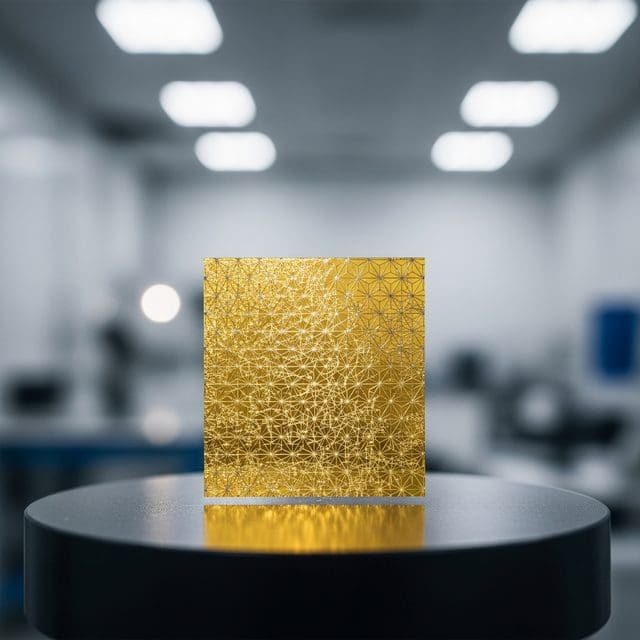
Researchers recently unveiled a significant breakthrough involving a microscopic gold crystal that could bring quantum technology out of the deep freeze. According to reports published in Nature, this “metacrystal”—constructed from a gold film carved with microscopic structures—can sort and transport quantum states of light at room temperature. By acting as a filter that directs quantum light along separate paths while preserving information integrity, this discovery challenges the assumption that quantum effects must be heat-sensitive. For the American innovator, this points toward a future where quantum devices are not just the domain of centralized server farms, but could eventually reside in local hardware that respects individual privacy.
While academic labs push the boundaries of materials science, the federal government is placing significant bets on commercialization timelines. The Defense Advanced Research Projects Agency (DARPA) recently awarded a $125 million contract to the startup PsiQuantum under the Quantum Benchmarking Initiative. This program is specifically designed to determine whether an industrially useful quantum computer can be achieved by the year 2033. This award, following a $31.8 million agreement from September 2025, represents the company’s largest U.S. government award to date. It is a concrete signal that the United States is prioritizing technological sovereignty in a field that will define the next century of national security.
However, the path to this frontier faces corporate hurdles. Microsoft’s heavily publicized Majorana-based approach to quantum computing has faced renewed scrutiny. Despite public claims of a breakthrough, reports from Reuters indicate that the scientific community is raising fresh questions. Specifically, a critique in Nature suggests that Microsoft has not yet published its discovery of the Majorana particle in a peer-reviewed journal, despite making public announcements. This lack of transparency highlights the tension between corporate marketing and the rigorous, verifiable science required to build a truly stable and trustworthy quantum system. In an era where centralized entities often prioritize narrative over data, the demand for peer-reviewed evidence serves as a necessary check on corporate ambition.
Complementing these hardware advances are new discoveries in thermal management. Scientists at UCLA recently demonstrated the ability to guide heat with the same precision as light at room temperature. This development in thermal transport is critical for the next generation of semiconductors and quantum chips. By controlling how heat moves through a device, engineers can prevent the degradation of delicate quantum states, further paving the way for high-performance computing that does not require a liquid nitrogen hookup. Additionally, researchers have found that even natural sunlight can create quantum entanglement, a phenomenon once thought to require expensive, laboratory-grade lasers.
These advancements represent a pivotal moment for individual liberty in the digital age. If quantum computing remains a centralized utility, it risks becoming another tool for bureaucratic overreach. But if breakthroughs in room-temperature materials continue, we may see a future of decentralized quantum power—one that empowers the individual, secures the national interest, and upholds the principles of open, verifiable innovation. As the 2033 benchmark approaches, the focus must remain on ensuring these technologies serve the citizen, not just the state.

Mason Reed serves as a Staff Writer for Just Right News, where he spearheads the Future Frontiers & Special Projects desk. In an era defined by rapid technological shifts and evolving social landscapes, Mason provides a steady, principled voice, examining the innovations of tomorrow through the lens of traditional American values. His work is most prominently featured in his signature series, “The Next Horizon,” where he explores the intersection of emerging technology, national sovereignty, and the preservation of individual liberty.
A native of San Diego, California, Mason’s worldview was shaped by the unique culture of his hometown. Growing up in a region defined by its strong military presence and its history of maritime industry, he developed a deep-seated respect for the institutions that provide national stability and the entrepreneurial spirit that drives the American economy. This upbringing instilled in him a belief that true progress is not found in discarding the past, but in building upon a foundation of proven principles. His reporting often reflects this San Diego influence, emphasizing the importance of a robust national defense and the necessity of maintaining a competitive edge in the global marketplace.
Now based in San Francisco, Mason operates from the heart of the world’s technological engine. Living and working in the Bay Area provides him with a front-row seat to the advancements—and the ideological challenges—emanating from Silicon Valley. While many in the region embrace a “move fast and break things” mentality, Mason’s reporting serves as a vital counterweight. He offers Just Right News readers a “boots on the ground” perspective, documenting how radical local policies and the concentration of tech power impact the everyday lives of citizens. His proximity to the industry allows him to cut through the marketing jargon of big tech to uncover the real-world implications for privacy, free speech, and the nuclear family.
In his “Future Frontiers” beat, Mason tackles complex subjects ranging from the ethics of artificial intelligence to the burgeoning private space race. He approaches these topics with a healthy skepticism toward centralized bureaucracy, championing instead the decentralized innovations that empower individuals. Through “The Next Horizon,” he highlights the pioneers and thinkers who are working to ensure that the future remains a place where human dignity and constitutional rights are protected. He believes that the rapid pace of change requires more than just technical expertise; it requires a moral compass rooted in the Western tradition.
Throughout his tenure at Just Right News, Mason has remained committed to the idea that the future is something to be shaped, not merely accepted. His writing is characterized by a rigorous defense of American exceptionalism and a belief that the country’s best days lie ahead, provided it remains true to its founding ideals. Whether he is investigating the impact of automation on the American workforce or profiling the next generation of aerospace engineers, Mason Reed ensures that his readers are equipped with the insights they need to navigate a changing world with confidence and clarity.