

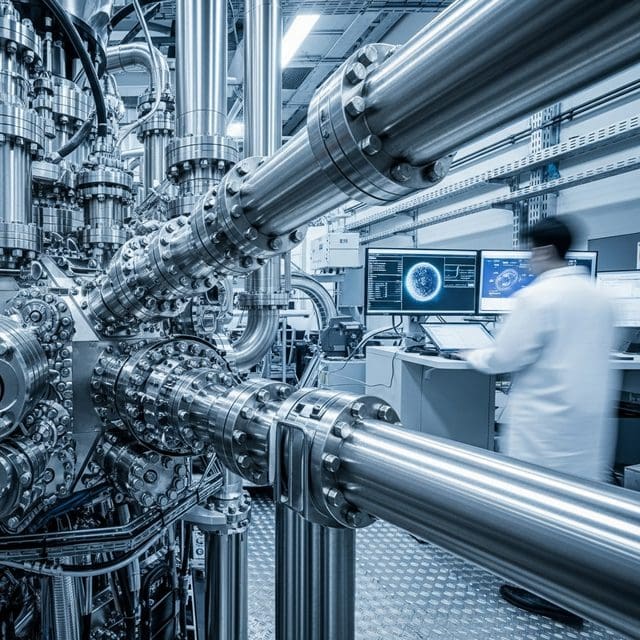
Chinese physicists have confirmed the existence of the glueball, a new form of matter composed entirely of force-carrying particles, validating a core prediction of the Standard Model.
A half-century of theoretical speculation reached a definitive conclusion this week as researchers in Beijing announced the confirmed discovery of the ‘glueball’—a long-sought form of matter composed entirely of gluons. The announcement, made on August 6, 2026, by the Institute of High Energy Physics (IHEP) under the Chinese Academy of Sciences, marks a pivotal moment for the Standard Model of particle physics. While traditional matter is built from quarks held together by gluons, the glueball is unique because it contains no quarks at all. It is a particle made of the very force that binds others together.
The discovery centers on a particle designated as X(2370), first detected by the team in 2011. After fifteen years of rigorous experimental research at the Beijing Electron Positron Collider, the team utilized the Beijing Spectrometer III (BESIII) to identify multiple new decay modes. Crucially, they determined its ‘flavor-singlet’ property, which serves as the decisive signature required to distinguish a glueball from ordinary quark-based particles. This finding provides the clearest experimental result in the global search for glueballs over nearly five decades. By proving that gluons can bind with one another, the IHEP team has verified a fundamental prediction of how the strong force behaves, providing a new benchmark for nuclear physics and future lattice QCD calculations.
While Chinese researchers solidified the foundations of particle theory, American innovation focused on the practical application of quantum mechanics to ensure technological sovereignty. On August 5, 2026, Palo Alto-based D-Wave Quantum Inc. announced a significant hardware breakthrough in quantum error correction. Published in Nature, the research demonstrates a fast, high-fidelity two-qubit entangling gate. The system achieved approximately 99.9% fidelity for two-qubit operations with gate times of about 500 nanoseconds, incorporating native hardware-level error detection that could revolutionize the path to fault-tolerant computing.
Dr. Alan Baratz, CEO of D-Wave, emphasized that the greatest remaining challenge in gate-model quantum computing is building systems that can correct errors efficiently as they scale. Their simulations indicate this new architecture could reduce the logical error rate by a factor of 10 for each increment in error correction. This is a vital development for the American tech sector, as D-Wave targets a 100-logical-qubit system capable of performing over one million operations by 2032. Such a system would represent a massive leap over current capabilities, moving quantum computing from the laboratory into the realm of production-grade operations.
These dual advancements—one in the fundamental understanding of matter and the other in the mastery of quantum information—underscore a period of rapid acceleration in the physical sciences. At Rice University, researchers also contributed to this momentum by developing a precise temperature tuning method for trapped-ion quantum simulators to match real-world conditions. Furthermore, new 3D imaging of molecular orbitals has enabled femtosecond video capture of electron wavefunctions, allowing scientists to witness the subatomic world with unprecedented clarity.
As laboratories move from theoretical proofs to tangible hardware, the implications for national interest in high-tech manufacturing and computational security become increasingly clear. The confirmation of the glueball reminds the scientific community that the laws of nature still hold secrets, even as engineers race to harness those laws for the next generation of industry. Whether it is the binding of gluons or the entanglement of qubits, the frontier of physics is being settled by those who can turn abstract theory into verifiable, physical reality.

Mason Reed serves as a Staff Writer for Just Right News, where he spearheads the Future Frontiers & Special Projects desk. In an era defined by rapid technological shifts and evolving social landscapes, Mason provides a steady, principled voice, examining the innovations of tomorrow through the lens of traditional American values. His work is most prominently featured in his signature series, “The Next Horizon,” where he explores the intersection of emerging technology, national sovereignty, and the preservation of individual liberty.
A native of San Diego, California, Mason’s worldview was shaped by the unique culture of his hometown. Growing up in a region defined by its strong military presence and its history of maritime industry, he developed a deep-seated respect for the institutions that provide national stability and the entrepreneurial spirit that drives the American economy. This upbringing instilled in him a belief that true progress is not found in discarding the past, but in building upon a foundation of proven principles. His reporting often reflects this San Diego influence, emphasizing the importance of a robust national defense and the necessity of maintaining a competitive edge in the global marketplace.
Now based in San Francisco, Mason operates from the heart of the world’s technological engine. Living and working in the Bay Area provides him with a front-row seat to the advancements—and the ideological challenges—emanating from Silicon Valley. While many in the region embrace a “move fast and break things” mentality, Mason’s reporting serves as a vital counterweight. He offers Just Right News readers a “boots on the ground” perspective, documenting how radical local policies and the concentration of tech power impact the everyday lives of citizens. His proximity to the industry allows him to cut through the marketing jargon of big tech to uncover the real-world implications for privacy, free speech, and the nuclear family.
In his “Future Frontiers” beat, Mason tackles complex subjects ranging from the ethics of artificial intelligence to the burgeoning private space race. He approaches these topics with a healthy skepticism toward centralized bureaucracy, championing instead the decentralized innovations that empower individuals. Through “The Next Horizon,” he highlights the pioneers and thinkers who are working to ensure that the future remains a place where human dignity and constitutional rights are protected. He believes that the rapid pace of change requires more than just technical expertise; it requires a moral compass rooted in the Western tradition.
Throughout his tenure at Just Right News, Mason has remained committed to the idea that the future is something to be shaped, not merely accepted. His writing is characterized by a rigorous defense of American exceptionalism and a belief that the country’s best days lie ahead, provided it remains true to its founding ideals. Whether he is investigating the impact of automation on the American workforce or profiling the next generation of aerospace engineers, Mason Reed ensures that his readers are equipped with the insights they need to navigate a changing world with confidence and clarity.